by Jobuza Team | Oct 5, 2026 | BLOG, Latest Jobs
Government Jobs for Candidates With Computer Programming Skills
If you have a strong command of computer programming and coding, several government-sector careers can offer good opportunities. Candidates with skills in languages such as Python, Java, C++, JavaScript and SQL can explore technical positions across government departments, public-sector organisations and research institutions.
Top Government Jobs for Programmers
-
Scientist/Technical Officer: Organisations such as ISRO, DRDO, CSIR and other research bodies recruit candidates for software development, computing and technical roles.
-
NIC Scientist/Technical Assistant: The National Informatics Centre offers opportunities in software development, database management, networking and e-governance.
-
Government Software Developer: Various ministries and government agencies hire IT professionals to develop and maintain digital platforms and applications.
-
Programmer/IT Officer: Public-sector banks, government departments and other institutions recruit professionals for programming, cybersecurity and IT infrastructure.
-
Data Analyst/Computer Scientist: Candidates with programming, data science and analytical skills can pursue roles involving large datasets, artificial intelligence and computational research.
-
Defence-sector IT jobs: Organisations such as DRDO and defence-related establishments offer technical careers involving software, embedded systems, cybersecurity and advanced computing.
Skills That Can Help
Apart from a relevant degree such as BTech/BE in Computer Science, IT or Electronics, candidates can strengthen their prospects by developing skills in:
-
Python, Java, C/C++ and JavaScript
-
Data structures and algorithms
-
Database management and SQL
-
Artificial intelligence and machine learning
-
Cybersecurity
-
Cloud computing
-
Web and application development
by Jobuza Team | Oct 5, 2026 | BLOG, Latest Jobs
The CSIR–National Chemical Laboratory (CSIR-NCL), Pune has invited online applications for 24 Multi-Tasking Staff (MTS) posts. The recruitment is being conducted under Advertisement No. NCL/01-2026/MTS. Eligible candidates can submit their applications through the official recruitment portal.
CSIR NCL MTS Recruitment 2026: Key Details
-
Organisation: CSIR–National Chemical Laboratory, Pune
-
Post: Multi-Tasking Staff (MTS)
-
Total vacancies: 24
-
Advertisement No.: NCL/01-2026/MTS
-
Application mode: Online
-
Application start date: October 5, 2026, at 10 AM
-
Last date: November 4, 2026, at 5 PM
-
Educational qualification: Class 10/Matriculation or equivalent
-
Upper age limit: 25 years as on November 4, 2026
-
Selection: Competitive written examination
How to Apply for CSIR NCL MTS Recruitment 2026
Candidates interested in the recruitment can apply online by following these steps:
-
Visit the official CSIR-NCL recruitment portal:
-
Look for Advertisement No. NCL/01-2026/MTS.
-
Register using a valid email ID and create your login credentials.
-
Fill in the application form with your personal, educational and other required details.
-
Upload the documents and photograph/signature as specified in the notification.
-
Pay the applicable application fee, if required.
-
Review all details carefully before submitting the form.
-
Submit the application and download/save a copy for future reference.
CSIR-NCL has specifically stated that applications must be submitted online only and that candidates should not send a hard copy of the application.
Eligibility
Applicants should have passed Class 10/SSC/Matriculation or an equivalent examination from a recognised board, subject to the other conditions prescribed in the recruitment notification. The upper age limit is 25 years as on November 4, 2026, with relaxation applicable to eligible categories according to government rules.
Salary
The MTS position is classified as a Group C post and falls under Pay Level 1, with a pay scale of ₹18,000–₹56,900. The reported total monthly emoluments are approximately ₹40,000, subject to applicable allowances and conditions.
by Jobuza Team | Oct 5, 2026 | BLOG, Latest Jobs
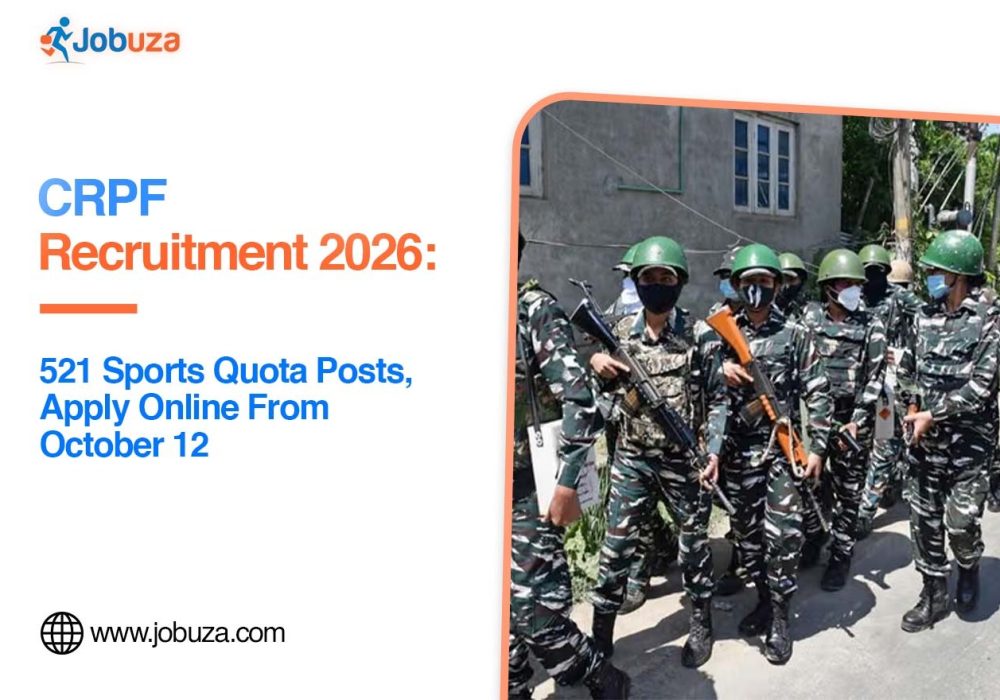
The Central Reserve Police Force (CRPF) has announced recruitment for 521 posts under the Sports Quota 2026. Eligible male and female sportspersons can apply online for the posts of Head Constable (General Duty) and Constable (General Duty). The online application process will begin on October 12, 2026, and the last date to submit applications is November 11, 2026.
CRPF Sports Quota Recruitment 2026: Vacancy Details
The 521 vacancies are divided into two posts:
The Head Constable post carries Pay Matrix Level 4 (₹25,500–₹81,100), while the Constable post is under Pay Matrix Level 3 (₹21,700–₹69,100)
Who Can Apply?
Candidates should generally be 18 to 23 years old as on August 1, 2026, subject to applicable age relaxations. For educational qualification, candidates applying for Head Constable (GD) should have passed Class 12, while Constable (GD) applicants should have passed Class 10 from a recognised board.
Applicants must also meet the prescribed sports achievement criteria. The relevant sporting achievements are required to fall within the specified period of September 30, 2024, to September 30, 2026.
CRPF Recruitment 2026: Important Dates
| Event |
Date |
| Application starts |
October 12, 2026 |
| Last date to apply |
November 11, 2026 |
| Application correction window |
November 12–14, 2026 |
How to Apply for CRPF Sports Quota Recruitment 2026
Candidates can apply online by following these steps:
- Visit the official CRPF recruitment portal.
-
Select the CRPF Sports Quota Recruitment 2026
application link.
-
Complete the registration process using the required details.
- Fill in the online application form carefully.
-
Upload the required educational, identity and sports-related documents.
- Pay the applicable application fee, if required.
- Submit the application form.
-
Download and save the confirmation page or application form for future reference.
The official CRPF website also provides recruitment-related notifications and information.
Selection Process
The recruitment process includes identity and document verification, Physical Standard Test (PST), Sports Trial and medical examination. There is no conventional written examination for this Sports Quota recruitment. The Sports Trial is qualifying in nature, while the merit list is based on marks awarded for eligible sports achievements
by Jobuza Team | Oct 5, 2026 | BLOG, Latest Jobs
The GSSSB Staff Nurse Recruitment 2026 notification has been released for candidates looking for a government nursing job in Gujarat. The Gujarat Subordinate Service Selection Board (GSSSB) has announced 131 Staff Nurse, Class-3 vacancies under the Health and Family Welfare Department, Office of the Director, Employees’ State Insurance Scheme.
The recruitment is being conducted through Advertisement No. 458/2026-27. Eligible candidates can apply online through the OJAS Gujarat portal. The application process started on September 28, 2026, and the last date to submit the application is October 12, 2026, up to 11:59 PM. Candidates should check the eligibility conditions and notification carefully before applying.
GSSSB Staff Nurse Recruitment 2026: Highlights
| Particulars |
Details |
| Organization |
Gujarat Subordinate Service Selection Board (GSSSB) |
| Department |
Health and Family Welfare Department |
| Post |
Staff Nurse, Class-3 |
| Advertisement No. |
458/2026-27 |
| Total Vacancies |
131 |
| Application Mode |
Online |
| Application Start Date |
September 28, 2026 |
| Last Date to Apply |
October 12, 2026 |
| Fee Payment Last Date |
October 15, 2026 |
| Age Limit |
18 to 35 years |
| Selection Process |
Competitive Examination |
| Job Location |
Gujarat |
| Official Website |
GSSSB |
The recruitment is for Staff Nurse posts under the Employees’ State Insurance Scheme. Applications are being accepted online through the OJAS portal, and candidates need to complete One Time Registration before applying.
GSSSB Staff Nurse Vacancy 2026
GSSSB has announced 131 Staff Nurse vacancies. The category-wise distribution is given below:
| Category |
Total Vacancies |
Women Reserved |
| Unreserved |
46 |
15 |
| EWS |
13 |
4 |
| SEBC |
45 |
14 |
| SC |
16 |
5 |
| ST |
11 |
3 |
| Total |
131 |
41 |
The notification includes reservation provisions as applicable under Gujarat government rules. Candidates should check the official advertisement for the detailed reservation conditions and category requirements.
GSSSB Staff Nurse Eligibility Criteria 2026
Candidates should make sure they meet the required educational and other conditions before filling out the application form.
Educational Qualification
Applicants should have either a B.Sc. Nursing degree from a recognised university or institution, or a Diploma in General Nursing and Midwifery (GNM) from an institution recognised by the Gujarat Nursing Council or Indian Nursing Council.
Candidates are also required to have basic knowledge of computer applications and adequate knowledge of Gujarati or Hindi, or both. The required nursing registration conditions mentioned in the recruitment notification must also be fulfilled.
Age Limit
The prescribed age limit for the GSSSB Staff Nurse post is 18 to 35 years. The relevant eligibility conditions, including age and category-related requirements, are considered according to the dates and rules mentioned in the recruitment notification. Relaxation applies to eligible categories as per government rules.
GSSSB Staff Nurse Salary 2026
Selected candidates will initially receive a fixed monthly remuneration of ₹40,800. After the initial fixed-pay period, the post carries Level-5 pay of ₹29,200 to ₹92,300, subject to the applicable service conditions. Candidates should refer to the official notification for the complete salary and appointment terms.
GSSSB Staff Nurse Application Fee 2026
The application fee varies according to the candidate’s category.
| Category |
Application Fee |
| Unreserved |
₹500 |
| Women of all categories |
₹400 |
| SEBC |
₹400 |
| SC |
₹400 |
| ST |
₹400 |
| EWS |
₹400 |
| Divyang/PwD |
₹400 |
| Ex-Servicemen |
₹400 |
Candidates should complete the fee payment within the prescribed deadline. The reported last date for fee payment is October 15, 2026.
GSSSB Staff Nurse Selection Process 2026
The selection for the Staff Nurse post will be based on a competitive written examination, followed by the required recruitment formalities such as document verification.
The written examination is based on nursing-related subjects and the Gujarati language. Candidates should prepare according to the syllabus and examination scheme given in the official notification.
GSSSB Staff Nurse Exam Pattern 2026
The reported examination structure includes two papers:
| Paper |
Subject |
Marks |
| Paper I |
Nursing Subject |
100 |
| Paper II |
Gujarati Language |
100 |
| Total |
— |
200 |
The nursing paper covers core areas of nursing, while the second paper focuses on Gujarati language. Candidates should check the official notification for the detailed syllabus, marking scheme, duration, and negative-marking provisions before beginning their preparation.
Important Dates for GSSSB Staff Nurse Recruitment 2026
| Event |
Date |
| Notification Release |
September 28, 2026 |
| Online Application Starts |
September 28, 2026 |
| Last Date to Apply |
October 12, 2026 |
| Last Date for Fee Payment |
October 15, 2026 |
| Written Examination |
To be announced |
The examination date has not yet been announced. Candidates should regularly check the GSSSB website for updates regarding the admit card and examination schedule.
How to Apply for GSSSB Staff Nurse Recruitment 2026
Eligible candidates can apply online through the OJAS Gujarat portal. The basic application process is as follows:
- Visit the official OJAS Gujarat portal.
- Complete One Time Registration (OTR) if you have not registered earlier.
- Select Online Application and choose GSSSB.
- Find Advertisement No. 458/2026-27 – Staff Nurse, Class-3.
- Read the recruitment details carefully.
- Log in using your registration details and date of birth.
- Enter your personal and educational information.
- Upload the required photograph and signature.
- Review the application form carefully.
- Pay the applicable examination fee.
- Confirm and submit the application.
- Save the application number and confirmation details for future use.
Candidates should check every detail before confirming the application because changes may not be possible after final confirmation.
Documents Required
Candidates should keep the required documents ready before starting the online application. These may include:
- Recent passport-size photograph
- Signature
- B.Sc. Nursing or GNM certificate
- Nursing registration documents
- Educational certificates
- Category certificate, where applicable
- EWS certificate, where applicable
- Valid identity proof
- Other documents specified in the notification
Candidates should upload documents in the format and size prescribed by OJAS.
Bottom Line
The GSSSB Staff Nurse Recruitment 2026 is an opportunity for eligible nursing candidates to apply for 131 Class-3 Staff Nurse posts under the Gujarat Health and Family Welfare Department. Applications are being accepted online through OJAS, and candidates must complete the process by October 12, 2026.
Before submitting the form, candidates should carefully check their qualifications, age, nursing registration, category documents, and other requirements. It is also important to keep checking the official GSSSB and OJAS portals for the examination date, admit card, and further recruitment updates.
by Jobuza Team | Oct 5, 2026 | BLOG, Latest Jobs
If you are looking for a government teaching job in Chhattisgarh, the CG Vyapam Lecturer Recruitment 2026 could be an important opportunity. The recruitment drive has been announced for 854 Lecturer posts under the E and T cadres.
The vacancies are available for subjects including Hindi, English, Sanskrit, Physics, Political Science, History, Geography, and Economics. The online application process started on September 29, 2026, and candidates can apply until October 26, 2026, up to 5 PM.
Before filling out the form, candidates should go through the qualifications, age limit, vacancy details, and other requirements carefully.
CG Vyapam Lecturer Recruitment 2026: Highlights
| Detail |
Information |
| Organization |
Chhattisgarh School Education Department |
| Exam Authority |
CG Vyapam/CGSSB |
| Post |
Lecturer |
| Total Vacancies |
854 |
| E Cadre |
424 |
| T Cadre |
430 |
| Job Location |
Chhattisgarh |
| Application Mode |
Online |
| Application Starts |
September 29, 2026 |
| Last Date |
October 26, 2026, up to 5 PM |
| Exam Date |
November 29, 2026 |
| Pay Level |
Level 9 |
| Official Website |
CGSSB/CG Vyapam |
Candidates should check the official notification for any changes in dates or recruitment conditions.
CG Vyapam Lecturer Vacancy 2026
A total of 854 Lecturer vacancies have been announced. The posts are divided between the E and T cadres.
| Subject |
E Cadre |
T Cadre |
Total |
| Hindi |
60 |
60 |
120 |
| English |
60 |
60 |
120 |
| Sanskrit |
60 |
60 |
120 |
| Physics |
44 |
50 |
94 |
| Political Science |
50 |
50 |
100 |
| History |
50 |
50 |
100 |
| Geography |
50 |
50 |
100 |
| Economics |
50 |
50 |
100 |
| Total |
424 |
430 |
854 |
Important Dates
Candidates should keep these dates handy so they do not miss the application deadline.
| Event |
Date |
| Notification Released |
September 29, 2026 |
| Application Starts |
September 29, 2026 |
| Last Date to Apply |
October 26, 2026 |
| Application Correction |
October 27 to 29, 2026 |
| Admit Card |
November 23, 2026* |
| Written Exam |
November 29, 2026* |
*Candidates should check the official website for the latest schedule.
Eligibility Criteria
Educational Qualification
Candidates applying for Lecturer posts need to meet the educational requirements prescribed for their selected subject. Generally, candidates need a relevant postgraduate degree along with a B.Ed. qualification. The postgraduate subject should match the subject for which the candidate is applying. Since requirements can differ depending on the subject, it is important to read the official notification before submitting the form.
Age Limit
Candidates must be at least 21 years old. The upper age limit and applicable relaxations are provided in the recruitment notification. Candidates belonging to eligible reserved categories can receive age relaxation according to the applicable Chhattisgarh government rules.
Salary
The Lecturer posts come under Pay Matrix Level 9. The actual salary received by a selected candidate will depend on the applicable government pay rules and allowances.
Selection Process
The recruitment process includes a written examination followed by the required verification stages.
Candidates should be prepared for:
- Written Examination
- Document Verification
- Medical Examination
The exact requirements should be checked in the official recruitment notification.
CG Vyapam Lecturer Exam 2026
The written examination is scheduled for November 29, 2026. Candidates who submit their applications successfully should download their admit cards when they are released. The admit card will contain important information such as the examination centre, reporting time, and instructions. It is a good idea to check the official website regularly rather than waiting for updates from unofficial sources.
How to Apply for CG Vyapam Lecturer Recruitment 2026
Applying online is straightforward. Candidates can follow these steps:
- Visit the official CGSSB website.
- Go to the online application section.
- Find the Lecturer Recruitment 2026 link.
- Complete the registration process.
- Enter your personal and educational details.
- Select the appropriate subject and cadre.
- Upload the required photograph and documents.
- Pay the application fee, if applicable.
- Check the information entered in the form.
- Submit the application before the deadline.
- Download and save the final application form.
Candidates should avoid waiting until the last day because website traffic can sometimes cause problems during the final hours.
Documents Required
Keep the following documents ready before starting the application:
- Recent passport-size photograph
- Signature
- Postgraduate degree and marksheet
- B.Ed. certificate and marksheet
- Class 10 certificate
- Valid identity proof
- Category certificate, if applicable
- Chhattisgarh domicile/residence certificate, where required
- Other documents mentioned in the notification
Make sure your name, date of birth, and educational details match your original documents.
Important Things to Remember
- Check the qualification for your chosen subject.
- Make sure you meet the age requirement.
- Submit the application before October 26, 2026.
- Check all details before final submission.
- Keep a copy of the application form.
- Download the admit card once it becomes available.
- Follow the official website for any changes in the examination schedule.
Bottom Line
The CG Vyapam Lecturer Recruitment 2026 has opened applications for 854 Lecturer posts in Chhattisgarh. Candidates who meet the required educational and other eligibility conditions can apply online until October 26, 2026. With the written examination scheduled for November 29, 2026, applicants should complete their forms on time and start preparing according to the requirements of their selected subject.
by Jobuza Team | Oct 1, 2026 | BLOG, Defence Jobs, Latest Jobs
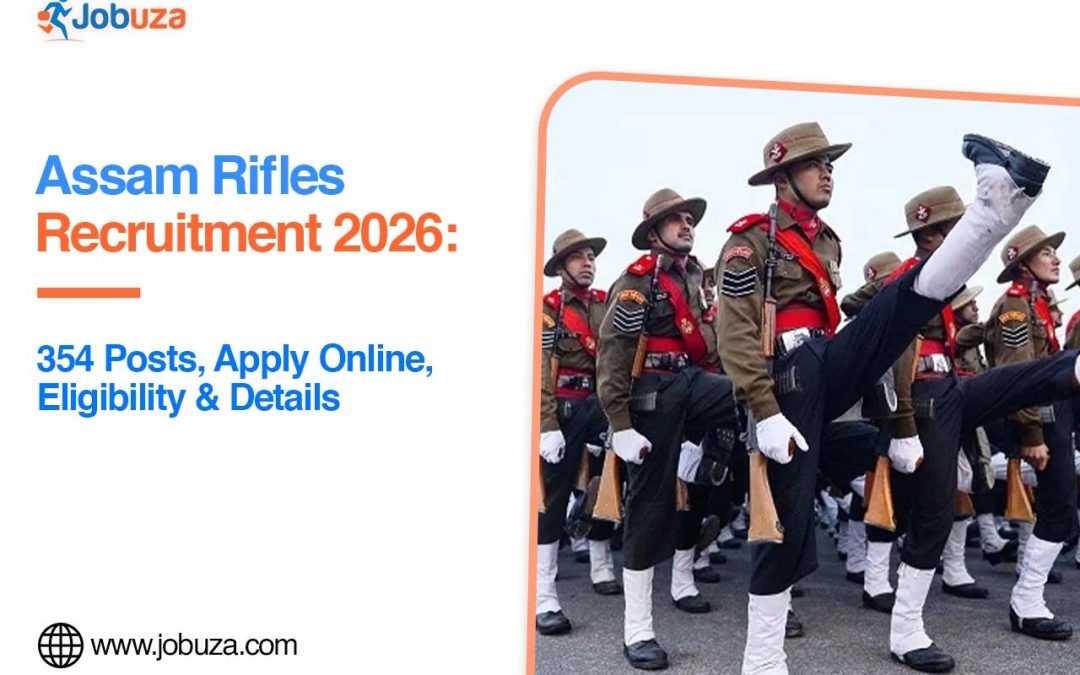
The Assam Rifles has released the Assam Rifles Recruitment 2026 notification for 354 Group C Technical and Tradesman posts. The recruitment includes different technical, tradesman, and other specialist positions such as Warrant Officer, Havildar, and Rifleman.
The online application process has already started on September 28, 2026, and eligible candidates can submit their applications until October 28, 2026, up to 11:59 PM. The recruitment rally is tentatively scheduled to begin from November 23, 2026 onwards. Candidates should check the post-wise qualifications, age limit, physical requirements, and other conditions before filling out the application form.
Assam Rifles Recruitment 2026 Highlights
| Detail |
Information |
| Organization |
Assam Rifles |
| Recruitment |
Technical and Tradesman Recruitment Rally 2026 |
| Total Vacancies |
354 |
| Post Type |
Group C Technical and Tradesman |
| Application Mode |
Online |
| Application Starts |
September 28, 2026 |
| Last Date to Apply |
October 28, 2026 |
| Last Time |
11:59 PM |
| Recruitment Rally |
November 23, 2026 onwards (Tentative) |
| Job Location |
All India |
| Official Website |
Assam Rifles |
The recruitment is being conducted by the Directorate General Assam Rifles, Shillong. The vacancies are spread across several technical and tradesman categories.
Assam Rifles Vacancy 2026
A total of 354 vacancies have been announced under the Technical and Tradesman Recruitment Rally 2026. The posts cover different trades, including technical, medical, and tradesman positions. The recruitment includes posts such as Warrant Officer, Havildar, and Rifleman.
| Post Category |
Total Vacancies |
| Group C Technical & Tradesman Posts |
354 |
| Total |
354 |
The detailed vacancy distribution is post- and trade-specific, so candidates should check the official notification before applying for a particular position.
Important Dates
| Event |
Date |
| Notification |
August 27, 2026 |
| Online Application Starts |
September 28, 2026 |
| Last Date to Apply |
October 28, 2026 |
| Last Time |
11:59 PM |
| Recruitment Rally |
November 23, 2026 onwards* |
*The recruitment rally date is tentative and may be updated by Assam Rifles.
Assam Rifles Recruitment 2026 Eligibility
The eligibility requirements are different for different posts. Candidates should therefore read the post-wise requirements carefully instead of assuming that one qualification applies to all 354 vacancies.
Depending on the post, qualifications can include Class 10, ITI, diploma, or other technical/educational qualifications. The exact qualification must match the trade for which the candidate is applying.
Age Limit
The age requirement is also post-wise. The recruitment notification specifies the applicable age criteria with reference to July 1, 2026. Candidates should check the official notification for the exact age limit and relaxation applicable to their category and selected post.
Application Fee
Candidates from the General, OBC, and EWS categories are required to pay an application fee of ₹100. SC, ST and Ex-Servicemen candidates are exempted from the fee, as reported for the recruitment. Candidates should check the official notification and application portal for the accepted payment methods before submitting the form.
Assam Rifles Recruitment 2026 Selection Process
The selection process includes multiple stages because the recruitment covers technical and tradesman positions.
The selection process generally includes:
- Physical Standard Test (PST)
- Physical Efficiency Test (PET)
- Document Verification
- Computer-Based Test
- Trade/Skill Test
- Detailed Medical Examination
- Review Medical Examination, where applicable
The exact requirements can vary according to the post and trade. Candidates should carefully read the notification for the applicable selection stages.
How to Apply for Assam Rifles Recruitment 2026
Candidates can complete the application process online by following these steps:
- Visit the official Assam Rifles website.
- Open the recruitment section.
- Find the Technical and Tradesman Recruitment Rally 2026 notification.
- Read the eligibility requirements for your preferred post.
- Open the online application link.
- Complete the registration using your valid mobile number and email ID.
- Fill in your personal and educational details.
- Upload the required documents, photograph, and signature.
- Pay the application fee, if applicable.
- Check the complete form carefully.
- Submit the application before the deadline.
- Download and save the confirmation page for future reference.
The application deadline is October 28, 2026, up to 11:59 PM.
Documents Required
Candidates should keep the required documents ready before starting the application. These may include:
- Recent passport-size photograph
- Signature
- Class 10 certificate
- Educational qualification certificates
- ITI or diploma certificate, where applicable
- Domicile or Permanent Residence Certificate
- Category certificate, if applicable
- Valid identity proof
- Other documents mentioned in the notification
Candidates should make sure that the information entered in the application matches their original documents.
Important Instructions for Candidates
- Read the post-wise eligibility criteria before applying.
- Apply before October 28, 2026.
- Check the physical standards required for your post.
- Upload clear and valid documents.
- Enter your details exactly as mentioned in your certificates.
- Keep a copy of the submitted application form.
- Check the official website regularly for rally and admit-card updates.
- Do not depend on unofficial websites for changes to the recruitment schedule.
Official Website
Candidates should use the official Assam Rifles website for the recruitment notification, application process, and further updates.
Bottom Line
The Assam Rifles Recruitment 2026 has opened applications for 354 Group C Technical and Tradesman posts. The application window is open from September 28 to October 28, 2026, while the recruitment rally is tentatively scheduled to begin on November 23, 2026.
Since eligibility varies from one trade to another, candidates should check the post-wise qualifications, age requirements, physical standards, and selection process before submitting the application.