by Jobuza Team | Jul 23, 2025 | BLOG, Trending News
How to File Your ITR Without Form 16 for AY 2024–25
Filing your Income Tax Return (ITR) without Form 16 might seem challenging—especially for salaried individuals—but it is entirely doable with the right documents. For the Assessment Year (AY) 2024–25, i.e. Financial Year (FY) 2023–24, the deadline to file your ITR without penalty is 31st July 2025. Even if you haven’t received Form 16 from your employer, you can still file your return accurately using alternative sources.
What Is Form 16 and Why You Might Not Have It
Form 16 is a certificate issued by your employer. It contains details of your salary and the Tax Deducted at Source (TDS) during the financial year. You may not have Form 16 if:
-
Your employer didn’t issue it on time
-
You’ve changed jobs and didn’t collect it from your previous company
-
The company has shut down
If that’s the case, don’t worry—you can still file your return based on your salary slips, bank statements, and Form 26AS.
Step 1: Gather Salary and TDS Details from Alternative Sources
Start by collecting your monthly salary slips to calculate your total annual salary. Include:
Next, check your bank account statements for monthly salary credits. This helps verify the income you’ve received.
Then, log in to the Income Tax e-filing portal and download your Form 26AS or Annual Information Statement (AIS). These documents show all TDS entries made against your PAN by employers and other institutions like banks.
Step 2: Compute Total Income and Claim Deductions
Now, compute your gross income. Include:
After calculating gross income, apply eligible deductions under various sections such as:
-
Section 80C – LIC, PPF, ELSS, EPF, etc.
-
Section 80D – Medical insurance premiums
-
Section 24(b) – Home loan interest
Keep supporting documents and receipts ready in case the Income Tax Department asks for them later.
Step 3: Choose the Correct ITR Form
Most salaried individuals can file using ITR-1 (Sahaj). However, if you have:
…you’ll need to choose ITR-2 or ITR-3, depending on your income sources.
You can then either manually fill the form on the e-filing portal or pre-fill data using the AIS and TIS (Taxpayer Information Summary).
Step 4: File and E-Verify Your ITR
Once you’ve entered all the details and verified your tax payable or refund, submit your ITR online. But remember—your job isn’t done yet. You must e-verify your return within 30 days to complete the process. You can e-verify using:
If you don’t verify, your ITR will be considered invalid.
Final Thoughts: Filing Without Form 16 Is Absolutely Possible
Form 16 makes the process easier, but it’s not essential. As long as you have access to salary slips, bank records, and Form 26AS/AIS, you can file your ITR accurately. Just ensure that all entries are cross-verified, and keep documentation handy. Filing on time without Form 16 is completely legal—and well within your reach.
by Jobuza Team | Jul 22, 2025 | BLOG, Trending News
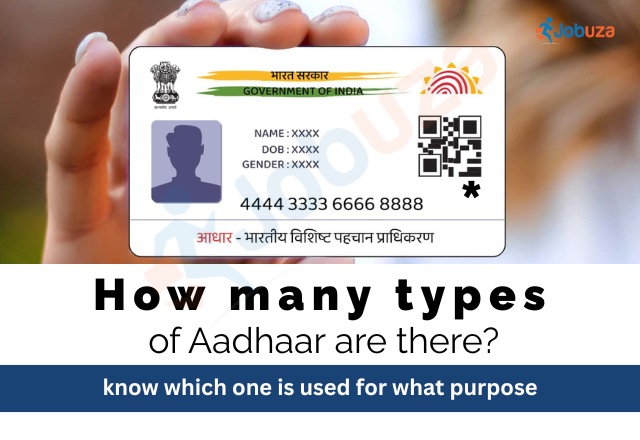
Types of Aadhaar Card: Which One Do You Need and What Is It Used For?
In India today, whether you’re booking a train ticket, catching a flight, or applying for any government or private service, one thing is almost always required—your Aadhaar card. It serves as a strong proof of identity and is used across countless sectors. But did you know that Aadhaar is available in four different formats?
The Unique Identification Authority of India (UIDAI) offers Aadhaar in multiple formats to suit different needs and preferences. All these formats are legally valid and accepted as proof of identity across India. Let’s understand the four types of Aadhaar cards and their specific uses.
1. Aadhaar Letter
The Aadhaar Letter is the traditional version of the Aadhaar card. It’s a paper-based, laminated letter that comes with a printed QR code, issue date, and printed date.
If your Aadhaar letter is lost or damaged, you can reprint it by visiting the UIDAI website and placing an online request.
2. Aadhaar PVC Card
The Aadhaar PVC Card is a compact, durable, and more secure version of the Aadhaar card. It’s similar to a debit or credit card and is printed on plastic (PVC).
You can apply for it online using your Aadhaar number, Virtual ID, or Enrolment ID.
3. mAadhaar (Mobile Aadhaar)
mAadhaar is the digital version of Aadhaar that lives in your smartphone. It’s an official mobile application developed by UIDAI.
You can download the app from the Play Store or App Store and log in using your registered mobile number.
4. eAadhaar (Electronic Aadhaar)
eAadhaar is a digitally signed, password-protected electronic version of the Aadhaar card.
-
Download from: UIDAI official website
-
Cost: Free
-
Key Features:
-
Can be downloaded instantly after enrolment or update
-
Digitally signed and accepted everywhere
-
Includes QR code and complete Aadhaar details
-
Best For: Instant download, official online submissions, and backups
You can access it using your Aadhaar number and OTP received on your registered mobile number.
Which Aadhaar Format Should You Choose?
All four Aadhaar formats—Aadhaar Letter, PVC Card, mAadhaar, and eAadhaar—are equally valid and serve different preferences:
| Format |
Ideal For |
| Aadhaar Letter |
Traditional use, general ID proof |
| PVC Card |
Wallet-sized, travel-friendly option |
| mAadhaar |
Digital-first users, mobile access |
| eAadhaar |
Instant download, online submissions |
No matter which format you use, your Aadhaar number remains the same, and it can be used for all legal and official purposes.
by Jobuza Team | Jul 21, 2025 | BLOG, Trending News
ITR Refund Delayed in 2025? These 8 Common Mistakes Could Be the Reason
If you’re still waiting for your Income Tax refund for the financial year 2024–25, you’re not alone. While many taxpayers have already received their refunds, others are experiencing unexpected delays. The Income Tax Department processes verified returns quickly, but certain common mistakes can cause your refund to get stuck.
Here are the top reasons why your ITR refund might be delayed in 2025:
1. Incorrect Deduction Claims
Claiming deductions under sections like 80C, HRA, or medical insurance without valid proof can lead to trouble. If the Income Tax Department finds your claims suspicious or unsupported, they may hold back your refund and send a notice asking for clarification or documents.
2. Mismatch in AIS (Annual Information Statement)
AIS includes details of your income such as savings interest, dividends, and other financial transactions. If the data in your ITR doesn’t match with the AIS, even by a small margin, the system may flag it for review. This mismatch can result in refund delays until the discrepancy is resolved.
3. TDS Credit Not Matching with Form 26AS
Form 26AS and AIS reflect the TDS deducted by employers, banks, or clients. If the deducted tax shown in your form does not match what you’ve reported, the refund will not be released. This is common among freelancers and contractual workers whose clients fail to report TDS on time.
4. Bank Account Not Verified
Your refund is directly transferred to your registered bank account. If your account is not e-verified, linked correctly, or KYC-compliant, the refund will fail. Always ensure that your bank details are updated and verified on the Income Tax portal.
5. Delay in Refund Processing
Even after successful filing and verification, refund processing can take a few weeks. The status may show as “under processing” for up to 30 to 45 days. This is considered normal and usually doesn’t require any action from your side.
6. Refund Generated but Not Credited
In some cases, the Income Tax Department issues the refund, but the money doesn’t reflect in your account. This can happen if your bank account has become inactive, the IFSC code has changed, or your KYC is incomplete. You may need to submit a refund reissue request through the income tax portal.
7. ITR Selected for Scrutiny or Assessment
If your ITR has been flagged for further review or scrutiny, the refund will be kept on hold until the verification process is complete. This process can take longer depending on the nature of the assessment and the response time from the taxpayer.
8. Past Tax Dues Adjusted Against Refund
If you have any outstanding tax liabilities from previous years, the department has the authority to adjust the amount from your current refund. You will usually receive an email or SMS notification explaining the deduction.
Final Words
A delayed ITR refund can be frustrating, but in most cases, it’s due to correctable issues. Always double-check your ITR before submission, match your income details with AIS and Form 26AS, and ensure your bank account is fully verified. If everything is in order and your refund is still pending, it’s worth waiting at least 30–45 days before raising a grievance or reissue request.
by Jobuza Team | Jul 16, 2025 | BLOG, Trending News
Windows and Microsoft Office Users Alerted by Indian Government Over Serious Security Risk
The Indian government has issued a high-level security warning for users of Windows and Microsoft Office. The alert was released in July 2025 by CERT-In (Indian Computer Emergency Response Team), and it affects millions of people who use Microsoft software on personal computers or in businesses.
Why This Alert Matters
CERT-In has found multiple security flaws in Microsoft products. These issues could allow hackers to:
-
Break into your computer
-
Steal private or sensitive data
-
Run harmful software without your permission
-
Bypass your security settings
-
Crash your system or make it unusable
-
Trick users with fake messages or websites
These problems are dangerous and can affect anyone using Microsoft software—whether at home or at work.
Who Is at Risk?
The security warning covers a wide range of Microsoft tools, including:
-
Windows (all major versions)
-
Microsoft Office (Word, Excel, PowerPoint, Outlook, etc.)
-
Microsoft Edge browser
-
Microsoft Dynamics
-
SQL Server
-
Azure (Microsoft’s cloud platform)
-
Developer tools
-
System Center
-
Older products under Extended Security Updates (ESU)
-
Microsoft Apps
So, if you’re using a Windows PC, Office apps, or any Microsoft enterprise software, you could be affected.
What Should You Do?
Microsoft has already released updates and patches to fix these issues. To stay safe, you should:
-
Go to your PC settings and check for updates
-
Turn on automatic updates if it’s not already enabled
-
Restart your system after the updates are installed
Microsoft says the chance of these flaws being actively used by hackers is currently low, but it’s still important to update your system right away.
Final Tip
This is a serious security warning that affects millions of users. If you use any Microsoft product—especially Windows or Office—update your system now to protect your personal data and avoid potential threats.
by Jobuza Team | Jul 14, 2025 | BLOG, Trending News
UPI Rules Changing from August 1: New Transaction Limits, Autopay Timings & Account Link Rules Explained
UPI Rules Changing: If you use apps like Google Pay, PhonePe, Paytm, or BHIM, there’s an important update you need to know.
Starting August 1, 2025, the rules around UPI (Unified Payments Interface) will change. These updates are being introduced to improve your safety, reduce fraud, and make digital payments more efficient.
Here’s a simple breakdown of everything that’s changing.
1. New Transaction Limits Based on Use
Until now, most UPI payments had a single daily limit. But from August 1, the limit will depend on the type of transaction.
Here’s how the new limits look:
-
Merchant Payments (shopping, services, bills):
₹1 lakh per day (₹5 lakh for hospitals or education)
-
UPI Credit Line (new feature):
₹1 lakh per transaction (based on your bank’s credit offer)
-
Money Transfers to Friends or Family (P2P):
₹1 lakh per day (no change)
Why this matters:
This makes UPI safer by allowing higher limits only for trusted services like healthcare or education, and avoids misuse in other categories.
2. Limit on UPI IDs Per Account
Starting August, you can have only 4 UPI IDs per bank account across all apps.
If you’ve created multiple IDs on different apps (like PhonePe, Paytm, etc.), old or unused ones might get deactivated automatically.
Why this matters:
This helps reduce confusion and prevent fraud through unused UPI IDs.
3. UPI Autopay Timing Will Be Restricted
If you use UPI for subscriptions, OTT apps, EMIs, or SIPs, there’s a new rule:
No automatic payment will go through at night or midnight anymore.
Why this matters:
It gives you better control and reduces the risk of missing or suspicious transactions happening late at night.
4. UPI Credit Line Will Be Available
Banks will soon allow you to use a pre-approved credit line through UPI.
This means you can borrow money like a short-term loan directly in your UPI app. You’ll see this option if your bank offers it.
Why this matters:
This gives more financial flexibility, especially for users who need instant money during emergencies or shortfalls.
5. Inactive UPI IDs Will Be Deactivated
If you don’t use a UPI ID for 12 months, it will be automatically disabled.
Banks and apps will inform you in advance, and you can always reactivate it if needed.
Why this matters:
This reduces the risk of fraud through unused or forgotten UPI IDs.
6. Stronger Verification for New UPI Users
If you’re setting up UPI for the first time after August 1, the process will be a bit stricter.
Why this matters:
This step is added to reduce scams involving fake UPI setups.
Conclusion
These new UPI rules are meant to make digital payments safer and more efficient for everyone. While most changes are automatic, you should:
-
Check how many UPI IDs are linked to your bank account
-
Keep track of autopay timings
-
Watch for any messages from your bank about inactive IDs
With UPI becoming a part of everyday life, these small changes will go a long way in keeping your money and data safe.
by Jobuza Team | Jul 11, 2025 | BLOG, PAN/Aadhar Card Updates, Trending News
Is Your Aadhaar Being Misused? Here’s How to Track Activity and Protect Yourself from Fraud
Your Aadhaar card is one of the most important identity documents in India. It’s used for everything from opening bank accounts and applying for government schemes to booking travel tickets and getting admissions. But with such wide usage comes a risk—unauthorized use or Aadhaar-related fraud.
If someone misuses your Aadhaar card, it can lead to serious financial and personal trouble. The good news is, you can track its activity, report suspicious use, and even lock your Aadhaar biometrics for added security.
How to Check If Your Aadhaar Is Being Used Without Your Permission
To check if your Aadhaar has been used in any unauthorized way, you can use the Aadhaar Authentication History feature on the official UIDAI portal.
Follow these simple steps:
-
Go to the official UIDAI website — https://myaadhaar.uidai.gov.in
-
Login using your Aadhaar number and the OTP sent to your registered mobile number
-
Navigate to ‘Aadhaar Authentication History’
-
Select the time period you want to check
-
Review the list of all authentication requests linked to your Aadhaar
If you see any activity that you don’t recognize, you may be a victim of Aadhaar misuse.
What to Do If You Notice Unauthorized Aadhaar Activity
If you find suspicious or unknown activity linked to your Aadhaar card, take action immediately:
-
Call UIDAI’s helpline number: 1947 (toll-free)
-
Send an email to: help@uidai.gov.in
-
Keep a record of your complaint for follow-up
Locking Your Aadhaar Biometrics for Extra Protection
To prevent others from using your Aadhaar fingerprint or iris scan without permission, you can lock your biometrics online.
Here’s how to do it:
-
Visit the UIDAI website and go to the “Lock/Unlock Biometrics” section
-
Enter your Aadhaar number or Virtual ID (VID) and captcha
-
You’ll receive an OTP on your registered mobile number — enter it to confirm
-
Once verified, you can lock your biometrics instantly
This makes it impossible for anyone to use your Aadhaar for biometric-based authentication unless you unlock it again.
Keep Your Aadhaar Details Up to Date
Another simple but effective way to protect your Aadhaar is to keep your details updated:
-
Make sure your mobile number is linked and correct
-
Update your address, name, or photo if they’ve changed
-
If you haven’t updated your Aadhaar in the last 10 years, visit the nearest Aadhaar Seva Kendra to refresh your biometrics
An updated Aadhaar ensures you receive important alerts and keeps your information secure.
Final Thoughts
Your Aadhaar card is linked to many key services, and its misuse can have serious consequences. That’s why it’s important to:
-
Regularly check your Aadhaar usage history
-
Lock your biometric data when not in use
-
Report suspicious activity without delay
-
Keep your contact and identity details updated
By staying alert and proactive, you can safeguard your identity and avoid becoming a victim of Aadhaar-related fraud.