
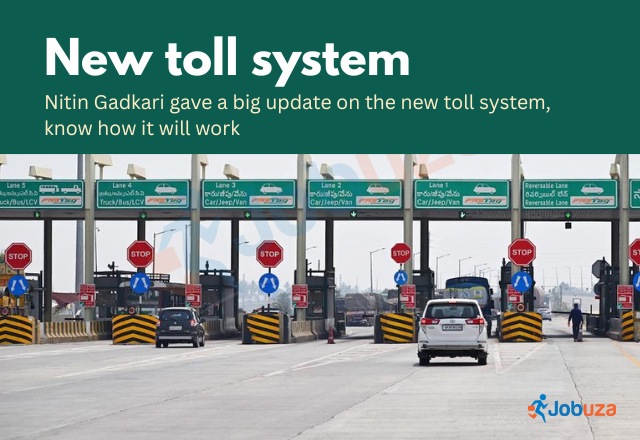
The Indian government is preparing to introduce a new AI-based toll collection system that will completely change the way tolls are collected on national highways. Union Road Transport and Highways Minister Nitin Gadkari has confirmed that this advanced toll system will be implemented by the end of 2026.
Unlike the current FASTag system, the new toll system will not require any chip, sticker, or device to be installed inside vehicles. Instead, it will rely on artificial intelligence and satellite-based technology to collect toll charges automatically.
AI and Satellite Technology to Replace Traditional Toll Booths
Speaking in the Rajya Sabha during Question Hour, Nitin Gadkari said the upcoming toll collection system will be based on satellite and AI technology. One of the biggest advantages of this system is that vehicles will no longer need to stop at toll plazas.
Under the new system, vehicles will be able to pass through toll points at speeds of up to 80 kilometres per hour. This will significantly reduce traffic congestion, waiting time, and fuel consumption on highways.
Government Revenue and Fuel Savings to Increase
The minister highlighted the financial benefits of the AI-based toll system. According to him, the new system will help save fuel worth around ₹1,500 crore every year. In addition, it is expected to increase government revenue by nearly ₹6,000 crore.
This system will be completely different from both FASTag and GPS-based toll collection methods currently in use or under consideration.
How the AI-Based Toll System Will Work
The AI toll system will operate on the Multi-Lane Free Flow (MLFF) model. Under this model, there will be no physical toll booths on highways.
Instead, a metal structure known as a gantry will be installed at entry and exit points of toll sections. These gantries will be equipped with high-resolution cameras and advanced sensors. The cameras will automatically capture vehicle number plates and use AI-based vision technology to identify them.
Once the vehicle enters and exits a toll section, the system will calculate the distance travelled and automatically deduct the toll amount. The entire process will be fully automated, and drivers will not need to slow down or stop anywhere.
Difference Between FASTag, GPS-Based Toll, and AI-Based Toll System
The existing FASTag system uses RFID technology and requires a sticker to be placed on the vehicle’s windscreen. Vehicles usually need to slow down or briefly stop at toll plazas for scanning.
GPS or GNSS-based toll systems depend on satellite tracking and require an on-board unit device to be installed inside the vehicle.
In contrast, the AI-based MLFF toll system will work only through cameras and artificial intelligence. No sticker, chip, or tracking device will be needed. The vehicle’s number plate will be sufficient for toll collection, making the system more convenient and efficient.
What Will Happen to the Existing FASTag System?
Currently, toll collection in India is done through FASTag, which is linked to a prepaid wallet or bank account. If the FASTag balance is insufficient, the tag is blacklisted, and drivers are forced to pay toll charges manually.
With the introduction of the AI-based toll system, FASTag will eventually be phased out once the new system is fully implemented nationwide. However, until the transition is complete, FASTag will continue to operate as usual.
AI-Based Toll System Also Useful for Non-GPS Vehicles
One major advantage of the AI-based system is that it does not depend on GPS devices inside vehicles. This makes it suitable even for vehicles that do not have satellite tracking equipment.
By relying on external cameras and number plate recognition, the AI toll system ensures accurate toll collection without placing any burden on vehicle owners.
A Major Step Towards Smarter Highways
The introduction of the AI-based toll collection system marks a major step toward modernising India’s highway infrastructure. With faster travel, reduced congestion, lower fuel consumption, and higher transparency, the new toll system is expected to benefit both commuters and the government.
As the implementation deadline approaches, this new technology could soon redefine road travel across the country.