by Jobuza Team | May 29, 2026 | BLOG, Trending News

by Jobuza Team | May 29, 2026 | BLOG, Trending News
Tax-Free Income: Filing Income Tax Return (ITR) for the financial year 2025-26 is expected to begin soon, and taxpayers are once again preparing their documents and investment details. Under the old tax regime, annual income up to ₹7 lakh is effectively tax-free after rebate benefits, while under the new tax regime, income up to ₹12 lakh can become tax-free under the revised structure. However, many people are unaware that certain types of income in India are completely exempt from tax regardless of the regime selected.
There are several income sources on which taxpayers do not have to pay even a single rupee as income tax, provided certain conditions are met. These tax-free earnings not only help in reducing overall tax liability but also encourage long-term savings and financial security.
Agricultural Income Is Completely Tax-Free
Income earned through agricultural activities is exempt from income tax in India. Whether a person earns money through crop cultivation, sale of agricultural produce, or agricultural land-related activities, the income remains tax-free.
However, there is an important condition attached. If agricultural income exceeds ₹5,000 and the taxpayer’s non-agricultural income is above the basic exemption limit, the agricultural income may be considered for rate calculation purposes. Even then, the agricultural income itself is not taxed directly.
Public Provident Fund (PPF) Offers Fully Tax-Free Returns
The Public Provident Fund, popularly known as PPF, remains one of the safest long-term investment schemes in India. It currently offers an interest rate of 7.1 percent and comes under the EEE category, which means investment, interest earned, and maturity amount are all exempt from tax.
Investors can deposit up to ₹1.5 lakh annually in a PPF account and also claim deductions under Section 80C of the Income Tax Act. The maturity proceeds received after the lock-in period are fully tax-free.
EPF Withdrawal Becomes Tax-Free After Five Years
Employees’ Provident Fund (EPF) is another major tax-saving and retirement benefit scheme for salaried individuals. If an employee continues service for five consecutive years or more, the EPF withdrawal becomes completely tax-free.
Both the employee’s contribution and employer’s contribution, along with the interest earned, remain tax-exempt after the required holding period. This benefit is available under both the old and new tax regimes, subject to applicable conditions.
Life Insurance Maturity Amount Is Tax-Free
The maturity proceeds received from a life insurance policy are generally exempt from tax under Section 10(10D) of the Income Tax Act.
This benefit applies if the annual premium paid does not exceed 10 percent of the sum assured. In the case of the policyholder’s death, the amount received by the nominee is fully tax-free without any maximum limit.
Life insurance policies not only provide financial security but also help taxpayers save tax legally.
Sukanya Samriddhi Yojana Provides Tax-Free Returns
Sukanya Samriddhi Yojana (SSY) is one of the most popular savings schemes designed for girl children. Parents or guardians can invest up to ₹1.5 lakh annually under this scheme and claim tax deductions under Section 80C.
The scheme also follows the EEE model, which means the invested amount, interest earned, and maturity proceeds are completely tax-free. SSY helps families build a strong financial corpus for a daughter’s future education and marriage while enjoying tax-saving benefits.
Tax-Free Income Helps in Better Financial Planning
Tax-free investment and income options play an important role in long-term financial planning. They not only reduce tax burden but also help individuals create wealth securely over time.
Before filing Income Tax Return for FY 2025-26, taxpayers should carefully review all eligible exemptions and investment options to maximize savings and avoid unnecessary tax payments.
Read More Trending News Updates
by Jobuza Team | May 28, 2026 | BLOG, Trending News
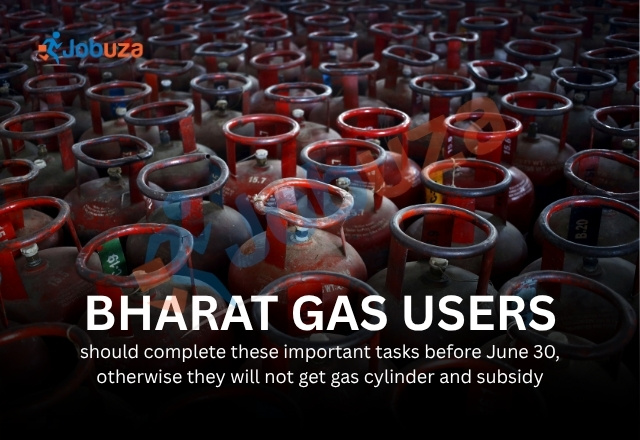
Bharat Gas customers have been advised to complete their eKYC process before June 30, 2026, to continue receiving LPG cylinder services and subsidy benefits without interruption. Bharat Petroleum has issued an important update for all LPG consumers, asking them to complete biometric-based verification as part of the government’s digital authentication initiative.
Customers who fail to complete the eKYC process within the given deadline may face difficulties in receiving LPG subsidies and booking gas cylinders in the future.
Why Bharat Gas eKYC Is Important
The government and oil marketing companies are focusing on digital verification to make LPG distribution more transparent and secure. The eKYC process helps eliminate fake or duplicate gas connections and ensures that subsidies reach genuine consumers only.
Biometric authentication-based verification has now become an important requirement for LPG users across the country.
Bharat Gas Users Can Complete eKYC From Home
Bharat Gas customers no longer need to visit the gas agency for basic verification. The company has introduced a simple online process through the HelloBPCL App, allowing users to complete their eKYC directly from their smartphones.
Customers only need their Aadhaar-linked mobile number and the official HelloBPCL application to complete the process.
How to Complete Bharat Gas eKYC Through HelloBPCL App
Download the HelloBPCL App
First, open the Google Play Store or Apple App Store on your mobile phone. Search for the HelloBPCL App and install it on your device.
Login Using Registered Mobile Number
After opening the app, enter your registered mobile number linked to your Bharat Gas connection. You will receive an OTP for verification. Enter the OTP to log in successfully.
Once logged in, go to the LPG Services or Bharat Gas section available on the homepage.
Select the eKYC Option
Inside the Bharat Gas section, tap on the eKYC or Biometric Authentication option.
Enter your Aadhaar number carefully. An OTP may be sent to the mobile number linked with your Aadhaar card. Complete the verification process by entering the OTP.
In some cases, customers may also be asked for fingerprint verification or face authentication. For biometric verification, users may need to visit the nearest Bharat Gas agency or authorised verification centre.
Submit and Complete Verification
After filling in all the required details, click on the Submit button to complete the eKYC process.
Once verification is successful, customers will receive confirmation through SMS or app notification.
What Happens if eKYC Is Not Completed
Customers who do not complete their Bharat Gas eKYC before June 30, 2026, may face issues with LPG subsidy transfers and gas cylinder services. Oil companies may temporarily suspend subsidy benefits until verification is completed.
Consumers are advised to complete the process as early as possible to avoid last-minute technical issues or delays.
Bharat Gas eKYC 2026 Key Details
Organisation: Bharat Petroleum Corporation Limited (BPCL)
Service: Bharat Gas LPG Connection
Process Required: eKYC Verification
Last Date: June 30, 2026
Mode: Online Through HelloBPCL App
Requirement: Aadhaar-linked mobile number
Purpose: Continue LPG subsidy and gas services without interruption
Read More Trending News Updates
by Jobuza Team | May 28, 2026 | BLOG, Latest Jobs, UPSC Jobs
The Uttar Pradesh Subordinate Services Selection Commission (UPSSSC) has started the online application process for Agriculture Technical Assistant posts under Advertisement No. 6 Exam/2026. Through this recruitment drive, the commission aims to fill 2,759 vacancies across Uttar Pradesh.
Candidates who have completed a degree in Agriculture or related disciplines can apply online through the official UPSSSC website. The online registration process started on May 22, 2026, and candidates are advised to complete their applications before the deadline.
The recruitment offers a great opportunity for candidates looking for government jobs in the agriculture sector in Uttar Pradesh.
UPSSSC AGTA Recruitment 2026 Notification
UPSSSC has released the official notification for Agriculture Technical Assistant Recruitment 2026 on its website. The notification includes complete details related to eligibility criteria, vacancy distribution, educational qualifications, application fee, and the selection process.
Candidates should carefully read the official advertisement before applying online.
UPSSSC AGTA Recruitment 2026 Important Dates
The online application process has already started on the official portal. Candidates are advised to complete the registration process within the prescribed schedule to avoid last-minute issues.
Application Start Date: May 22, 2026
Last Date to Apply Online: As per official schedule
UPSSSC AGTA Recruitment 2026 Vacancy Details
A total of 2,759 Agriculture Technical Assistant vacancies have been announced by UPSSSC.
Category-wise vacancy distribution is given below:
General: 1692 Posts
OBC: 573 Posts
SC: 213 Posts
ST: 6 Posts
EWS: 275 Posts
UPSSSC AGTA Recruitment 2026 Eligibility Criteria
Candidates applying for the Agriculture Technical Assistant posts must fulfill the required educational qualifications and age criteria prescribed by UPSSSC.
Educational Qualification
Applicants should possess a Bachelor’s degree in Agriculture from a recognised university or institute.
Candidates with equivalent qualifications are also eligible to apply, including:
B.Sc. Agriculture
B.Sc. Horticulture
B.Sc. Forestry
B.Tech Agricultural Engineering
B.Sc. Agricultural Science
Candidates are advised to check the official notification for detailed eligibility requirements.
Age Limit
Minimum Age: 21 Years
Maximum Age: 40 Years
Reserved category candidates will receive age relaxation as per Uttar Pradesh government rules.
UPSSSC AGTA Recruitment 2026 Application Fee
Candidates applying for the recruitment are required to pay a nominal application fee.
Application Fee: Rs 25
The fee must be paid through online mode only.
UPSSSC AGTA Recruitment 2026 Selection Process
The selection process for Agriculture Technical Assistant posts will be conducted according to UPSSSC recruitment guidelines.
Candidates will be shortlisted based on the eligibility criteria and further recruitment stages prescribed by the commission.
Detailed information regarding the examination and selection procedure will be available in the official notification.
How to Apply for UPSSSC AGTA Recruitment 2026
Candidates can apply online for the Agriculture Technical Assistant posts by following these simple steps:
Visit the official UPSSSC website at upsssc.gov.in.
Open the Agriculture Technical Assistant Recruitment 2026 application link.
Complete the registration process using valid details.
Fill out the online application form carefully.
Upload the required documents and certificates.
Pay the application fee through online mode.
Submit the application form and save a copy for future reference.
Candidates are advised to apply early to avoid server issues during the last days of registration.
by Jobuza Team | May 28, 2026 | BLOG, IT/Tech Jobs, Latest Jobs
The Naval Materials Research Laboratory (NMRL), a premier laboratory under the Defence Research and Development Organisation (DRDO), has invited applications for its Paid Internship Scheme 2026. The internship program is open for final-year B.E./B.Tech students and second-year M.Sc students from various science and engineering disciplines.
Students selected for the internship will receive a monthly stipend of ₹5,000 for a period of six months. The internship will be conducted at the NMRL campus located in Ambernath, Thane, Maharashtra. Interested candidates must submit their applications through email before June 10, 2026.
The internship program offers students an excellent opportunity to gain practical exposure in defence research and advanced scientific projects under DRDO.
DRDO NMRL Internship 2026 Notification
DRDO NMRL has officially released the notification for its Paid Internship Scheme 2026. The program is designed to provide hands-on research experience to students pursuing engineering and science courses from recognised institutions.
Candidates are advised to read the official notification carefully before applying to understand the eligibility criteria, disciplines offered, stipend details, and selection procedure.
DRDO NMRL Internship 2026 Important Dates
The application process for the internship is currently open through email mode. Candidates should ensure that their applications are submitted before the deadline.
Last Date to Apply: June 10, 2026
Internship Start Date: July 1, 2026
DRDO NMRL Internship 2026 Vacancy Details
A total of 20 internship positions are available under the DRDO NMRL Paid Internship Scheme 2026.
The internship opportunities are available in the following disciplines:
Chemistry
Physics
Biotechnology
Chemical Engineering
Mechanical Engineering
Electrical Engineering
Electronics and Telecommunications
Computer Science Engineering
Information Technology
DRDO NMRL Internship 2026 Eligibility Criteria
Candidates applying for the internship must fulfill the required educational qualifications and age criteria prescribed by NMRL.
Educational Qualification
Final-year B.E./B.Tech students and second-year M.Sc students are eligible to apply.
B.E./B.Tech candidates must have secured a minimum CGPA of 7.0 in previous semesters.
M.Sc candidates should have obtained at least 65% marks in their academic course.
Applicants must be pursuing full-time courses from AICTE or UGC recognised colleges and universities.
Age Limit
The maximum age limit for applicants is 25 years.
Nationality
Only Indian citizens are eligible to apply for the DRDO NMRL Internship 2026.
DRDO NMRL Internship 2026 Stipend and Duration
Selected candidates will receive a stipend of ₹5,000 per month during the internship period.
The internship duration will be six months, offering students valuable practical experience in defence-related research and development projects.
DRDO NMRL Internship 2026 Selection Process
The selection process for the internship will be based on academic performance and online interaction.
Candidates will be shortlisted according to their academic merit and eligibility criteria. Shortlisted applicants may be called for an online interaction before final selection.
How to Apply for DRDO NMRL Internship 2026
Eligible candidates can apply for the internship through email mode only.
Applicants need to prepare their application along with academic documents and send them to the official email address provided by NMRL before the last date.
Application Email ID: mmg.nmrl@gov.in
Candidates are advised to submit their applications early to avoid any last-minute issues.
by Jobuza Team | May 27, 2026 | BLOG, Latest Jobs, SSC Jobs
OSSC CTSRE Recruitment 2026: The Odisha Staff Selection Commission (OSSC) has released the official notification for the Combined Technical Services Recruitment Examination (CTSRE-2025). Through this recruitment drive, the commission aims to fill 646 Group B and Group C posts across various departments and Heads of Departments under the Government of Odisha.
Candidates interested in technical and engineering government jobs can apply online through the official OSSC website from May 30, 2026. The last date to submit the application form is July 2, 2026.
The recruitment includes vacancies for Junior Engineer (Civil), Architectural Assistant, Cameraman, Photographer, Mechanic, Video Film Editor, Junior Draughtsman and several other technical posts.
OSSC CTSRE Recruitment 2026 Notification
OSSC has published the detailed recruitment notification for the Combined Technical Services Recruitment Examination (CTSRE-2025) on its official website. The notification contains complete information regarding vacancies, eligibility criteria, age limit, selection process, important dates, and application guidelines.
Candidates are advised to carefully read the official notification before applying online.
OSSC CTSRE Recruitment 2026 Important Dates
The online registration process for OSSC CTSRE Recruitment 2026 will begin from May 30, 2026. Candidates should complete the application process within the prescribed schedule.
Application Start Date: May 30, 2026
Last Date to Apply Online: June 29, 2026
Correction Window Start Date: July 2, 2026
Correction Window Last Date: July 5, 2026
Vacancy Details
A total of 646 Group B and Group C vacancies will be filled through this recruitment drive across different technical departments in Odisha.
Post-wise vacancy details are given below:
Junior Engineer (Civil) – 24 Posts
Junior Engineer (Civil) – 450 Posts
Junior Engineer (Civil) – 132 Posts
Architectural Assistant – 23 Posts
Cameraman – 2 Posts
Photographer – 1 Post
Sound Recordist – 1 Post
Mechanic – 1 Post
Video Film Editor – 1 Post
Junior Draughtsman (Civil) – 2 Posts
Candidates should check the official notification for department-wise and category-wise vacancy details.
Eligibility Criteria
Candidates applying for OSSC CTSRE Recruitment 2026 must fulfill the required educational qualifications and other eligibility conditions prescribed for the respective posts.
Applicants should possess relevant diploma, engineering qualification, technical certification, or degree from a recognised institution depending on the post applied for.
The detailed post-wise educational qualification and age criteria are available in the official notification.
Selection Process
The selection process for OSSC CTSRE Recruitment 2026 will be conducted as per the rules and guidelines mentioned in the official notification.
Candidates may be shortlisted based on:
Written Examination
Technical Skill Test
Document Verification
Interview or Practical Test, if applicable
The final selection will be based on the candidate’s performance in the required stages of recruitment.
How to Apply
Candidates can apply online for OSSC CTSRE Recruitment 2026 by following these steps:
Visit the official OSSC website at ossc.gov.in.
Open the recruitment section on the homepage.
Click on the CTSRE Recruitment 2026 application link.
Complete the registration process with valid details.
Fill out the online application form carefully.
Upload the required documents, photograph, and signature.
Submit the application form before the last date.
Download and keep a printout of the application form for future use.
Candidates are advised to apply early to avoid last-minute technical issues on the website.
Read More Latest Govt. Jobs