by Jobuza Team | Nov 26, 2025 | BLOG, Trending News
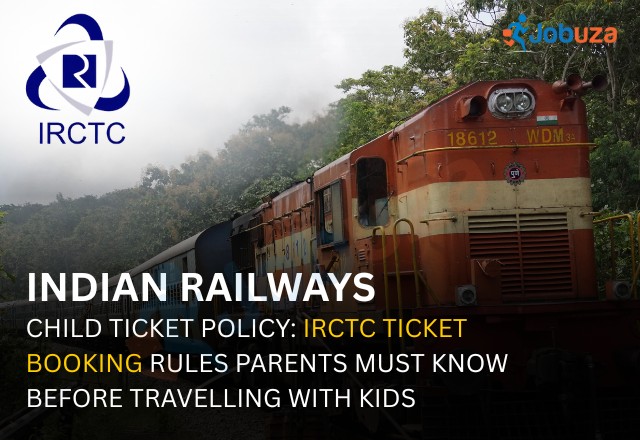
As Indian Railways has started advance ticket bookings for Christmas and New Year holidays, a large number of families are planning trips with their children to popular tourist destinations. With schools closed for winter vacations, train travel remains the most affordable and convenient option for parents.
However, before booking tickets, it is very important for parents to understand the child ticket rules clearly. Many people are still confused about whether a ticket is required for small children and when full fare is applicable.
Indian Railways Child Ticket Policy Explained
According to the official rules, children below five years of age are allowed to travel for free. However, the free travel rule comes with an important condition. If parents demand a separate seat or berth for the child, full adult fare must be paid even if the child is under five years old.
Therefore, parents must fully understand the child fare policy before finalising their journey plans.
Indian Railways Child Ticket Age Limit and Fare Rules
Here is a simple breakdown of Indian Railways child ticket rules based on age:
Children Below 5 Years
Children under five years can travel completely free of cost. No separate seat or berth is provided. If parents want a separate seat or berth for comfort, full adult fare will be charged.
Children Aged 5 to Below 12 Years
If no separate berth or seat is required, child fare is applicable.
If a separate seat or berth is required, full adult fare must be paid.
Children Aged 12 Years and Above
Children aged 12 years and above are treated as adults and must pay the full adult ticket fare without any exemption.
Official Railway Circular on Child Ticket Rules
As per the official circular issued by the Ministry of Railways on March 6, 2020, children below five years are allowed free travel only if they do not occupy a separate seat or berth. If parents voluntarily ask for a separate seat or berth, adult fare becomes mandatory.
IRCTC Child Ticket Booking Guidelines
While booking tickets through IRCTC, parents must ensure that the correct age of the child is entered. If a separate seat or berth is required, the child must be added as a full passenger during the booking process. Incorrect age details can lead to penalties during ticket checking.
Why Parents Should Follow Child Fare Rules Carefully
Many passengers face fines during travel because they assume that all children can travel for free. Railway ticket examiners strictly verify age at the time of journey. If a child is found occupying a seat without a proper ticket, a heavy penalty can be imposed along with recovery of full fare.
Conclusion
Indian Railways provides free travel to small children below five years of age, but only when no separate seat or berth is taken. As soon as a separate seat is required, full adult fare applies. For children between five and twelve years, both options are available based on seat requirement, while children above twelve must always pay full fare.
Before booking your holiday tickets, it is advised to carefully check the child’s age, seating needs, and fare rules to avoid last-minute issues and unnecessary penalties.

by Jobuza Team | Nov 25, 2025 | BLOG, PAN/Aadhar Card Updates, Trending News
The UIDAI has launched a new Aadhaar app on November 9, designed to make storing and sharing your Aadhaar card easier and more secure. Available on both Google Play and the App Store, the app works alongside the mAadhaar app and provides a simple way to keep a digital copy of your Aadhaar for quick verification and paperless transactions. With this app, you no longer need to carry physical photocopies or cards during services that require identity proof.
Features of the New Aadhaar App
The new Aadhaar app complements the existing mAadhaar app but does not replace it. While it does not include features such as downloading a digital card, ordering a PVC Aadhaar, or verifying your email and mobile number, it focuses on secure storage and easy sharing of your Aadhaar details.
The app offers a clean, user-friendly interface with a quick two-step process to access your Aadhaar information. It enhances convenience by allowing citizens to carry and share Aadhaar details directly from their phones, similar to options like PDF downloads or Digilocker.
One of the key highlights is the ability to store up to five Aadhaar profiles on the same device, as long as they are linked to the same mobile number. This makes it ideal for families who want to manage multiple Aadhaar cards in one place.
The app also supports biometric locking, allowing users to protect their Aadhaar data until they decide to unlock it. Profile information automatically updates after any successful change. You can securely share verifiable details and QR codes, and even scan Aadhaar QR codes for faster and smoother verification.
How to Set Up the New Aadhaar App
To start using the new Aadhaar app, download and install it from the Google Play Store or Apple App Store. Choose your preferred language and enter your 12-digit Aadhaar number. Send an SMS from your registered mobile number when prompted. After entering the OTP, complete face authentication and set a six-digit password. Your Aadhaar card will then appear in the app, where you can mask your number, share details, or enable biometric lock.
You can repeat the same process to add up to four more Aadhaar profiles on the same device, making the app a convenient option for managing multiple Aadhaar cards securely.
Click here for more – PAN/Aadhar Card Updates
by Jobuza Team | Nov 25, 2025 | BLOG, Trending News
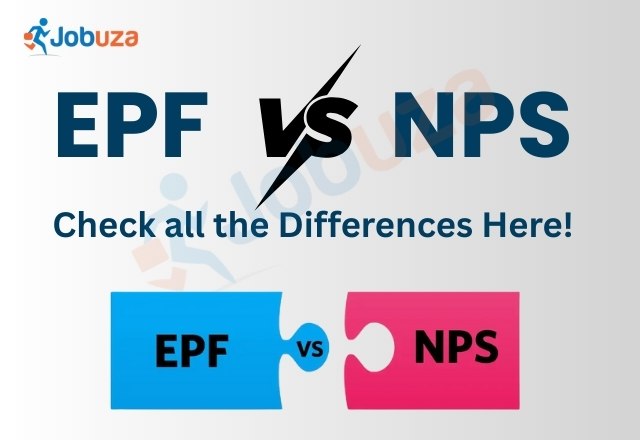
EPF vs NPS: Planning for retirement is one of the most important steps in building long-term financial security. In India, the Employees’ Provident Fund (EPF) and the National Pension System (NPS) are two of the most widely used government-backed schemes. Both help individuals save for their future but differ in how they work, who can invest, the type of returns they offer, and their tax benefits.
EPF vs NPS: EPF mainly targets salaried employees in the organised sector, offering fixed and guaranteed returns. NPS is open to all citizens and provides market-linked returns that can grow significantly over the long term. Understanding these differences helps you choose the plan that matches your financial goals.
Meaning and Objective
EPF (Employees’ Provident Fund)
EPF is a retirement savings scheme managed by the Employees’ Provident Fund Organisation. It provides financial security after retirement. Both employees and employers contribute 12 percent of the employee’s basic salary and dearness allowance each month.
NPS (National Pension System)
NPS is a pension scheme regulated by the Pension Fund Regulatory and Development Authority. It encourages long-term savings for retirement and is open to individuals aged 18 to 70.
Eligibility
EPF
Applicable only to salaried employees working in organisations registered under the EPF Act.
NPS
Open to all Indian citizens, including salaried individuals, self-employed professionals, and those working in the unorganised sector.
Type of Returns
EPF
Offers fixed and guaranteed returns declared annually by the government. The interest rate generally stays between 8 to 8.5 percent.
NPS
Provides market-linked returns based on investments in equity, corporate bonds, and government securities. Long-term returns usually range between 9 to 12 percent.
Tax Benefits
EPF
Employee contributions qualify for tax deductions under Section 80C. The interest earned and the final maturity amount are tax-free if the employee has completed five years of service.
NPS
Offers tax benefits under Section 80CCD(1) and an additional deduction of up to fifty thousand rupees under Section 80CCD(1B). At retirement, sixty percent of the corpus is tax-free, while the remaining forty percent must be used to purchase an annuity, and the pension received is taxable.
Risk Factor
EPF
Low risk, as the returns are government-backed and stable.
NPS
Moderate risk due to market-linked returns. Over time, equity exposure can provide higher growth.
Withdrawal Rules
EPF
Allows full withdrawal at retirement or after two months of unemployment. Partial withdrawals are permitted for specific purposes such as education, home purchase, and medical emergencies.
NPS
Allows partial withdrawals of up to twenty-five percent after three years for specific reasons. At retirement, sixty percent of the corpus can be withdrawn, while forty percent must be invested in an annuity plan.
Flexibility
EPF
Less flexible since it is directly linked to an employee’s organisation and cannot be customised.
NPS
Highly flexible with options to choose fund managers, switch investment preferences, and adjust portfolios as needed.
Returns and Growth Potential
EPF
Provides stable returns due to a fixed interest rate.
NPS
Offers higher long-term growth because of equity exposure, making it suitable for investors comfortable with moderate risk.
Conclusion
Both EPF and NPS help build financial stability after retirement, but they meet different needs. EPF is ideal for individuals seeking safety and guaranteed returns. NPS is better for those who prefer higher growth over the long term and can handle market movement. Many people choose to invest in both to balance stability and growth.
by Jobuza Team | Nov 25, 2025 | BLOG, Latest Jobs
The Rubber Board has opened online applications for Scientist and various other posts on its official recruitment portal. Candidates can now check the official notification, eligibility criteria, age limit, selection process, and complete application guidelines before applying.
The latest Rubber Board Recruitment 2025 notification has been released for 51 vacancies across different posts including Scientist, Systems Assistant, Vigilance Officer, Mechanical Engineer, Statistical Inspector, Electrician, Scientific Assistant and others. Candidates with qualifications such as BE, BTech, Master’s Degree in Remote Sensing, Geology, Physics, Environmental Science, Geography, Disaster Management, Agriculture, Forestry, Horticulture or Geo-informatics can apply depending on the post-specific requirements mentioned in the notification.
Eligible candidates can submit their applications online at the official website before December 01, 2025. The recruitment notification covers key details such as the application process, fees, important dates, vacancy distribution, salary structure, and required qualifications.
Important Dates for Rubber Board Recruitment 2025
The Rubber Board has published the detailed schedule for online applications. Candidates must submit their applications within the given timeframe.
Last date to apply online: December 01, 2025
Rubber Board Recruitment 2025 Vacancy Details
A total of 51 vacancies have been announced across various positions. The post-wise vacancy distribution is as follows:
Scientist A – 5
Scientist B – 19
Scientist C – 5
Assistant Director (Systems) – 1
Mechanical Engineer – 1
Statistical Inspector – 2
Electrician – 3
Scientific Assistant – 10
Hindi Typist – 1
Junior Technical Officer (Housekeeping) – 1
Junior Technical Officer (AC & Refrigeration) – 1
Systems Assistant (Hardware & Networking) – 1
Vigilance Officer – 1
Rubber Board Recruitment 2025 Notification PDF
The official notification PDF contains complete details about eligibility, post-wise qualifications, age criteria, pay scale, selection process and important instructions. Candidates are advised to read the notification thoroughly before submitting their applications.
Rubber Board Recruitment 2025 Eligibility Criteria and Age Limit
The eligibility conditions vary for each post. Candidates must refer to the notification for complete details regarding educational qualifications and work experience.
Educational qualifications include degrees such as BE, BTech, Master’s in relevant disciplines, along with additional criteria specified in the official advertisement.
Rubber Board Recruitment 2025 Application Fee
Applicants need to pay the examination fee according to their category and post group.
Group A: Rs.1500
Group B: Rs.1000
Group C: Rs.500
SC, ST, PwBD and all women candidates are exempted from paying the examination fee. A separate application and fee must be submitted for each post.
How to Apply
Candidates must complete the online application process through the official portal by registering with a valid email ID and password. All required documents such as educational certificates, age proof, category certificate and NOC (if applicable) must be uploaded in self-attested format.
Follow the steps below to apply online:
-
Visit the official website: https://recruitments.rubberboard.org.in
-
Click on the Rubber Board Recruitment 2025 link on the homepage.
-
Fill in the required personal and academic details.
-
Upload the necessary documents.
-
Submit the application form.
-
Download and save the submitted application for future reference.

by Jobuza Team | Nov 18, 2025 | BLOG, Latest Jobs
NABARD Grade A Apply Online 2025 has started on the official website, nabard.org. Candidates who meet the eligibility criteria can now fill the form for 91 Assistant Manager posts. The online application link will stay active until November 30. The direct NABARD Grade A Apply Online 2025 link is available below.
NABARD has opened the online registration for the Grade A examination. Graduates aged between 21 and 30 years can apply through the official portal. This recruitment drive will fill 91 vacancies in Rural Development Banking Service, Legal, and Protocol and Security Service. Candidates must read the eligibility rules carefully before submitting the form.
Below is the complete guide to the NABARD Grade A Apply Online 2025 process, including important dates, eligibility, steps to apply, and application fee.
NABARD Grade A Apply Online 2025
NABARD released the official notification and activated the online application link on November 8. The registration window will remain open until November 30. Applications will only be accepted online, and no offline forms will be allowed. Candidates should apply early to avoid last-minute technical issues.
NABARD Recruitment 2025 Important Dates
Here are the key dates for the NABARD Grade A 2025 recruitment:
NABARD Grade A Notification: 8 November 2025
Online Application Starts: 8 November 2025
Last Date to Apply Online: 30 November 2025
Last Date for Fee Payment: 30 November 2025
Who Can Apply for NABARD Grade A 2025
Candidates must meet the education and age criteria set by NABARD. Educational qualifications vary for each post, so applicants must check the official notification for details.
For most Grade A posts, the age limit is 21 to 30 years as of November 1, 2025. Candidates must have been born between November 2, 1995, and November 1, 2004.
For the Protocol and Security Service post, the age limit is 25 to 40 years with no age relaxation.
NABARD Grade A Apply Online 2025 Link
The direct online application link for NABARD Grade A was activated on November 8. Candidates can visit the official website or use the link provided to complete the registration process.
How to Apply Online for NABARD Grade A 2025
Follow these steps to fill out the online application form:
Step 1: Go to the official website at nabard.org.
Step 2: Click on the apply online link on the homepage.
Step 3: Register using your basic details to create your user ID and password.
Step 4: Log in and open the application form.
Step 5: Fill all required details correctly.
Step 6: Upload scanned documents in the specified format.
Step 7: Pay the application fee and submit the form. Download the final copy for reference.
NABARD Grade A Application Fee 2025
SC, ST, PwBD: Rs 150
All Other Categories: Rs 850
The application will be rejected if the fee is not paid.

by Jobuza Team | Nov 14, 2025 | BLOG, Defence Jobs, Latest Jobs
The Indian Air Force has released the detailed AFCAT 1 2026 notification on November 9, 2025. The online application window will remain open from November 17 to December 14, 2025, for Flying Branch and Ground Duty posts. Eligible candidates who have completed 10+2 with Physics and Maths can apply online through the official website, afcat.cdac.in.
The AFCAT 1 2026 notification includes 340 vacancies for Ground Duty (Technical and Non-Technical) and Gazetted Officer posts in the Flying Branch. Candidates must have secured at least 50% marks in Physics and Maths at the 10+2 level and must also hold a graduation degree with a minimum of 60% marks, or a BE/BTech degree with 60% marks. The AFCAT 1 2026 written exam will be held on January 31, 2026.
AFCAT 1 2026 Overview
AFCAT 1 2026 has been officially released at afcat.cdac.in. The key details are as follows:
-
Exam Name: Air Force Common Admission Test (AFCAT) 1 2026
-
Conducting Body: Indian Air Force
-
Posts: Flying Branch, Ground Duty (Technical & Non-Technical)
-
Total Vacancies: 340
-
Application Mode: Online
-
Registration Dates: November 17 to December 14, 2025
-
Exam Date: January 31, 2026
-
Selection Process: Written Test, AFSB Interview, Medical Examination
-
Course Commencement: January 2027
-
Official Website: afcat.cdac.in
AFCAT 1 2026 Notification PDF
The detailed AFCAT 1 2026 PDF is available on the official website. The notification includes post-wise eligibility, age limits, branch-wise vacancies and detailed syllabus. Candidates should read the notification before applying to ensure they meet all requirements.
AFCAT 1 2026 Important Dates
-
Short Notification: November 3, 2025
-
Detailed Notification: November 9, 2025
-
Application Form Begins: November 17, 2025
-
Last Date to Apply: December 14, 2025
-
AFCAT 1 2026 Exam Date: January 31, 2026
-
Result: March 2026 (tentative)
-
Course Commencement: January 2027
AFCAT 1 2026 Vacancy Details
The Indian Air Force has announced 340 vacancies for Flying Branch and Ground Duty posts. The Flying Branch includes 34 vacancies for men and 4 for women. A detailed vacancy breakup is available in the official notice.
AFCAT 1 2026 Eligibility Criteria
Candidates must meet the nationality, age and educational requirements to apply.
Nationality and Marital Status
Age Limit (as on January 1, 2027)
Flying Branch:
Ground Duty (Technical & Non-Technical):
Educational Qualifications
Flying Branch
Ground Duty (Technical)
Ground Duty (Non-Technical)
-
Admin & Logistics: Graduation with 60%
-
Accounts: B.Com with 60%
-
Education: PG with 50% and Graduation with 60%
-
Meteorology: 10+2 and BSc with Physics and Maths (60%) or a four-year Engineering degree with 60%
How to Apply for AFCAT 1 2026
Candidates can apply online from November 17, 2025, by following these steps:
-
Visit afcat.cdac.in
-
Click on the “Candidate Login” tab
-
Select “AFCAT 1/2026” and register as a new user
-
Fill in the required basic details
-
Log in with your registration credentials
-
Complete the application form
-
Upload the required documents in the correct format
-
Pay the application fee
-
Submit the form and download a copy for future use
Application Fee
-
AFCAT Entry Fee: Rs. 550 plus GST
-
Payment Mode: Debit card, credit card or net banking
-
NCC Special Entry candidates are exempt from the fee
AFCAT 1 2026 Selection Process
The selection process consists of three stages:
-
Online Written Exam (AFCAT & EKT)
Candidates applying for the Technical branch must also appear for the Engineering Knowledge Test (EKT).
-
AFSB Interview
Candidates who clear the written exam will be called for the Air Force Selection Board Interview at designated centres.
-
Medical Examination
Candidates recommended by AFSB will undergo a detailed medical examination.
The final merit list will be prepared based on performance in the written exam and AFSB interview, subject to medical fitness.
AFCAT 1 2026 Exam Pattern
AFCAT Exam
-
Questions: 100
-
Marks: 300
-
Duration: 2 hours
EKT (for Technical Branch)
-
Questions: 50
-
Marks: 150
-
Duration: 45 minutes
Candidates will receive 3 marks for each correct answer and 1 mark will be deducted for each incorrect answer.