by Jobuza Team | Nov 4, 2025 | BLOG, Latest Jobs, State Govt Job
The India Post Payments Bank (IPPB) has officially released the IPPB Recruitment 2025 notification for the appointment of 348 Executive posts. These positions are being offered for the engagement of Gramin Dak Sevaks (GDS) from the Department of Posts (DoP). Interested and eligible candidates can apply online between October 9 and October 29, 2025 through the official website, ippbonline.com.
IPPB Executive Recruitment 2025 Overview
The recruitment aims to select qualified candidates for Executive roles to support the operations of India Post Payments Bank across various offices in the country. The selection process will be based on merit, determined by the marks obtained in graduation. However, the bank reserves the right to conduct an online test if necessary.
Candidates are advised to carefully review the eligibility criteria before submitting their applications, as incomplete or ineligible applications will not be considered.
Key Highlights:
-
Organization: India Post Payments Bank (IPPB)
-
Post Name: Executive (Engagement from Gramin Dak Sevaks)
-
Total Vacancies: 348
-
Application Mode: Online
-
Official Website: ippbonline.com
-
Application Dates: October 9 to October 29, 2025
-
Selection Process: Based on Graduation Marks (Merit List)
IPPB Recruitment 2025 Eligibility Criteria
Candidates applying for the IPPB Executive Recruitment 2025 must meet the required educational qualifications and age limit as specified in the official notification.
Educational Qualification:
Applicants must have completed a graduation degree in any discipline from a university or institution recognized by the Government of India or approved by a Government Regulatory Body. Both regular and distance learning modes are accepted.
Age Limit:
The candidate’s age should be between 20 and 35 years as of August 1, 2025. Age relaxation will be applicable as per government norms.
How to Apply Online for IPPB Recruitment 2025
Candidates who meet the eligibility criteria can follow the steps below to apply online for IPPB Executive Recruitment 2025:
-
Visit the official website of IPPB at ippbonline.com.
-
Go to the ‘Careers’ section on the homepage.
-
Click on the link for IPPB Executive Recruitment 2025 – Apply Online.
-
Fill in all the required personal, academic, and communication details in the online form.
-
Upload scanned copies of your photograph, signature, and relevant documents.
-
Pay the application fee according to your category.
-
Review the form carefully and submit it.
-
Download and print the final application form for future reference.
IPPB Notification 2025 PDF Download
Before applying, candidates should read the official IPPB Executive Notification 2025 PDF to understand the detailed eligibility criteria, selection process, and other important guidelines. The direct link to download the notification PDF is available on the IPPB official website.
Summary
The IPPB Recruitment 2025 offers a great opportunity for Gramin Dak Sevaks to advance their careers by joining India Post Payments Bank as Executives. With 348 vacancies available across multiple locations, this recruitment drive provides a secure and promising role within the banking sector. Candidates are encouraged to complete their applications before the deadline on October 29, 2025.

by Jobuza Team | Nov 3, 2025 | BLOG, Central Govt Job, Latest Jobs
The Bihar Staff Selection Commission (BSSC) has announced the Sports Trainer Recruitment 2025 for 379 vacancies. Interested candidates can apply online from October 9 to November 11, 2025. This is a great opportunity for sports graduates and professionals to join the Bihar government as Khel Prashikshak (Sports Trainers).
BSSC Sports Trainer 2025: Key Highlights
The recruitment notification is available on the official website bssc.bihar.gov.in. Candidates should read it carefully for details on eligibility, application steps, and selection process.
| Feature |
Details |
| Recruiting Body |
Bihar Staff Selection Commission (BSSC) |
| Post Name |
Sports Trainer (Khel Prashikshak) |
| Total Vacancies |
379 |
| Notification Number |
Adv No. 08/25 |
| Application Start Date |
9th October 2025 |
| Last Date to Apply |
11th November 2025 |
| Age Limit |
21 to 37 years (relaxation for reserved categories) |
| Educational Qualification |
Graduation + Diploma/PG in Sports Coaching + National/International sports participation |
| Selection Process |
Written Exam and Interview |
Eligibility Criteria
Candidates must meet the following requirements:
Educational Qualification:
-
A Bachelor’s degree from a recognized university.
-
A Diploma or Postgraduate Diploma in Sports Coaching from a recognized institute such as NSNIS, LNIPE Gwalior, Central Sports University, or any UGC-recognized university.
-
Participation in National or International sports events is mandatory.
Age Limit:
How to Apply for BSSC Sports Trainer 2025
To apply, follow these simple steps:
-
Visit bssc.bihar.gov.in.
-
Go to the “Recruitment” or “Notifications” section.
-
Click on the Sports Trainer Recruitment 2025 link.
-
Read the official notification carefully.
-
Fill in the online application form with correct details.
-
Upload necessary documents, certificates, and photographs.
-
Submit the form and save the confirmation for future reference.
Notification PDF:
Candidates can download the full BSSC Sports Trainer 2025 Notification PDF from the official website to check all details.
Selection Process
The recruitment will be based on:
-
Written Examination – Tests general knowledge, sports theory, and related subjects.
-
Interview – Shortlisted candidates will be assessed for their practical skills and suitability as Sports Trainers.
Conclusion
The BSSC Sports Trainer Recruitment 2025 is a golden opportunity for sports graduates and professionals who want to work in government sports programs. With 379 vacancies, candidates have a good chance to secure a government role in sports coaching.
Make sure to apply online before November 11, 2025, through the official website bssc.bihar.gov.in.

by Jobuza Team | Nov 3, 2025 | BLOG, Central Govt Job, Defence Jobs, Latest Jobs
The Indian Army has announced the DG EME Group C Recruitment 2025, offering 69 civilian job vacancies across India. These include posts like Multi Tasking Staff (MTS), Lower Division Clerk (LDC), Washerman, Stenographer Grade-II, and Junior Technical Training Instructor.
Eligible candidates can apply online from October 11 to November 15, 2025, through the official website joinindianarmy.nic.in. The selection process will include a written test, skill test, document verification, and medical examination.
Overview of Indian Army DG EME Recruitment 2025
This recruitment drive is being conducted by the Directorate General of Electronics and Mechanical Engineers (DG EME) under the Indian Army. All posts are non-gazetted civilian roles and can be posted anywhere in India.
| Particulars |
Details |
| Organization |
Indian Army – DG EME |
| Post Name |
Group C Civilian Posts |
| Total Vacancies |
69 |
| Application Mode |
Online/Offline |
| Application Dates |
October 11 to November 15, 2025 |
| Official Website |
joinindianarmy.nic.in |
| Job Location |
Across India |
Important Dates
Here are the key dates you should remember for the DG EME Group C recruitment:
| Event |
Date |
| Notification Released |
October 11, 2025 |
| Application Start Date |
October 11, 2025 |
| Last Date to Apply |
November 15, 2025 |
| Written Exam Date |
To be announced |
| Skill Test Date |
To be announced |
How to Apply
Follow these steps to apply for the Indian Army DG EME Group C posts:
-
Visit joinindianarmy.nic.in.
-
Go to the “Recruitment” or “What’s New” section.
-
Click on DG EME Group C Recruitment 2025 Apply Online.
-
Read the notification carefully before applying.
-
Fill in your personal and educational details correctly.
-
Upload your photograph, signature, and required documents.
-
Review your form and click Submit.
-
Save and print the confirmation page for future use.
Application Fee
There is no application fee for any category. All candidates — General, OBC, EWS, SC, ST, and PWD — can apply free of cost. This makes the recruitment fair and accessible to everyone.
Eligibility Criteria
Candidates must check the required age limit and educational qualifications before applying:
| Post Name |
Vacancies |
Age Limit |
Qualification |
| Junior Technical Training Instructor |
2 |
21–30 years |
Degree/Diploma in relevant field |
| Stenographer Grade-II |
2 |
18–25 years |
12th Pass with stenography skills |
| Lower Division Clerk (LDC) |
25 |
18–25 years |
12th Pass with typing skills |
| Multi Tasking Staff (MTS) |
37 |
18–25 years |
10th Pass |
| Washerman |
14 |
18–25 years |
10th Pass |
Selection Process
The Indian Army will conduct multiple stages to select the right candidates for these posts:
-
Written Test – Based on general awareness, reasoning, and relevant subjects.
-
Skill Test or Trade Test – For roles like clerk, stenographer, or technician.
-
Document Verification – To confirm educational and identity details.
-
Medical Examination – Final fitness check before joining.
Vacancy Details
The DG EME Group C recruitment includes both technical and non-technical positions:
| Post |
Vacancy |
Type |
| Multi Tasking Staff (MTS) |
37 |
Support Staff |
| Lower Division Clerk (LDC) |
25 |
Clerical Staff |
| Washerman |
14 |
Maintenance Staff |
| Stenographer Grade-II |
2 |
Administrative |
| Junior Technical Training Instructor |
2 |
Technical |
Conclusion
The Indian Army DG EME Group C Recruitment 2025 is a great opportunity for those looking for a secure government job. With no application fee, a simple selection process, and vacancies across India, it’s a chance to build a career while serving under the Indian Army.
Make sure to complete your application before November 15, 2025, on joinindianarmy.nic.in, and keep an eye on the website for updates on the exam date and admit card release.
by Jobuza Team | Oct 31, 2025 | BLOG, Latest Jobs, State Govt Job
The Securities and Exchange Board of India (SEBI) has announced 110 vacancies for Officer Grade A (Assistant Manager) posts. The detailed notification will be available on October 30, 2025, at the official website sebi.gov.in.
These positions are open in multiple streams — General, Legal, Information Technology, Research, Official Language, Engineering (Electrical), and Engineering (Civil). Candidates who meet the eligibility criteria can apply online once the registration link becomes active after October 30.
This recruitment offers an excellent opportunity for candidates seeking a stable and rewarding career in India’s financial sector.
SEBI Grade A Recruitment 2025 Overview
| Particulars |
Details |
| Organization |
Securities and Exchange Board of India (SEBI) |
| Post Name |
Officer Grade A (Assistant Manager) |
| Total Vacancies |
110 |
| Streams |
General, Legal, IT, Research, Official Language, Engineering (Electrical/Civil) |
| Exam Mode |
Online (Computer-Based Test) |
| Selection Process |
Phase I, Phase II, and Interview |
| Age Limit |
Up to 30 years |
| Pay Scale |
₹62,500 – ₹1,26,100 per month |
| Official Website |
https://www.sebi.gov.in |
How to Apply for SEBI Grade A 2025
Candidates can apply online through the SEBI website once the application window opens. Follow these simple steps to register:
-
Visit the official website – www.sebi.gov.in.
-
Go to the “Careers” section.
-
Open the link for “SEBI Recruitment Exercise – Officer Grade A (Assistant Manager) 2025.”
-
Click on “Apply Online” and choose “Click Here for New Registration.”
-
Enter your details and save your application.
-
Upload your photo, signature, left thumb impression, and handwritten declaration.
-
Review your details carefully before final submission.
-
Pay the application fee and click on Submit.
Only online applications will be accepted. No other mode of submission will be considered.
SEBI Grade A 2025 Selection Process
The selection process will be conducted in three stages:
Candidates who qualify in Phase I will appear for Phase II. The final merit list will be prepared based on Phase II and the Interview performance.
SEBI Grade A 2025 Exam Pattern (Phase I)
The Phase I exam will consist of two papers — both conducted online.
| Paper |
Subjects |
Marks |
Duration |
Minimum Cut-Off |
| Paper 1 |
General Awareness (including Financial Sector), English Language, Quantitative Aptitude, Reasoning |
100 |
1 Hour |
30% |
| Paper 2 |
Subject-related questions from the chosen stream |
100 |
40 Minutes |
40% |
There will be negative marking (¼ mark per wrong answer). Candidates must score a minimum of 30% in Paper 1 and 40% in Paper 2 to qualify for Phase II.
Application Fee
| Category |
Application Fee (Including GST) |
| General / OBC / EWS |
₹1,000 + 18% GST |
| SC / ST / PwBD |
₹100 + 18% GST |
The fee is non-refundable and must be paid online while submitting the application.
Pay Scale and Benefits
Candidates selected as Grade A Officers will receive a starting basic pay of ₹62,500 per month in the pay scale:
₹62500 – 3600 (4) – 76900 – 4050 (7) – 105250 – EB – 4050 (4) – 121450 – 4650 (1) – 126100 [17 years]
With allowances such as DA, HRA, and other benefits, the gross monthly salary will be around ₹1.4 lakh.
Streams Available
-
General Stream
-
Legal Stream
-
Information Technology Stream
-
Research Stream
-
Official Language Stream
-
Engineering (Electrical) Stream
-
Engineering (Civil) Stream
Important Highlights
-
Total Vacancies: 110
-
Application Start Date: After October 30, 2025
-
Exam Mode: Online
-
Selection Process: Three Phases (Phase I, Phase II, Interview)
-
Official Website: sebi.gov.in
Final Words
The SEBI Grade A Recruitment 2025 is one of the most awaited opportunities for aspirants aiming to work in India’s financial and regulatory sector. With 110 vacancies across various streams, candidates should start preparing early to secure a position. The recruitment process is competitive, but those with the right preparation and understanding of the exam pattern can succeed.
by Jobuza Team | Oct 31, 2025 | BLOG, Trending News
Imagine becoming a crorepati just by saving money in a safe, government-backed scheme. Sounds impossible? It isn’t. With the Public Provident Fund (PPF) and a smart savings approach called the 15+5+5 formula, your yearly savings of ₹1.5 lakh can grow into ₹1 crore — without taking any risk.
Let’s see how this plan works and why it’s a simple, steady way to build long-term wealth.
What Is PPF and Why Do People Trust It?
The Public Provident Fund (PPF) is a savings scheme launched by the Government of India to help people build wealth safely over time. It’s one of the most reliable investment options for those who prefer security over market risk.
Here’s what makes PPF special:
-
It’s completely risk-free because it’s backed by the government.
-
Offers an attractive interest rate, currently around 7.1% per year.
-
You can claim tax benefits under Section 80C of the Income Tax Act.
-
The interest and maturity amount are fully tax-free.
A PPF account runs for 15 years, but you can extend it in blocks of 5 years — and that’s the real secret behind the 15+5+5 formula.
How You Can Extend Your PPF Account
After 15 years, you get two choices:
-
Without adding new money: Just let your balance grow with interest.
-
With continued deposits: Keep investing every year to earn interest on both old and new savings.
If your goal is to create big wealth, the second option — continuing deposits — is the smarter path.
The Power of the 15+5+5 Formula
This formula is simple:
Here’s how your money can grow if you invest ₹1.5 lakh every year at an average interest rate of 7.1%:
-
After 15 years: You invest ₹22.5 lakh and get around ₹40.68 lakh.
-
After 20 years (first extension): You invest ₹30 lakh and get around ₹70 lakh.
-
After 25 years (second extension): You invest ₹37.5 lakh and end up with ₹1.02 crore.
That’s how consistent savings, patience, and compounding work together to create real wealth.
Earn Monthly Income After Reaching ₹1 Crore
Once your PPF balance touches ₹1 crore, you can stop investing and still let the money grow. At 7.1% interest, ₹1 crore will earn about ₹7.1 lakh per year — or roughly ₹60,000 per month.
And the best part? It’s completely tax-free. This makes PPF a great option for retirement income or long-term financial security.
Tips to Get the Best Out of Your PPF
-
Invest regularly: Deposit ₹1.5 lakh every year without fail.
-
Avoid early withdrawals: Let your money stay invested for the full period.
-
Add a nominee: So your family can access the funds easily.
-
Check updates: The government revises interest rates every quarter, so stay informed.
Final Thoughts
PPF isn’t just a savings scheme — it’s a powerful tool for building long-term, tax-free wealth. The 15+5+5 strategy shows how small, steady contributions can turn into ₹1 crore with time and discipline.
If you’re looking for a safe, tax-efficient, and guaranteed way to grow your money for the future, the Public Provident Fund is one of the best options you can choose.
by Jobuza Team | Oct 30, 2025 | BLOG, Trending News
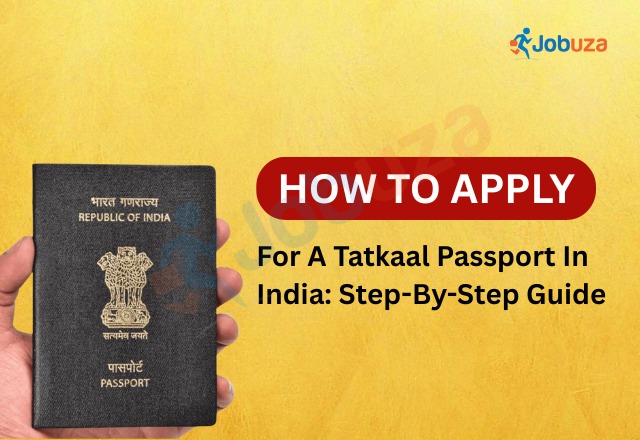
If you’ve been following travel trends, you might have noticed the Tatkaal passport service making headlines. Why the buzz? Indians are travelling more than ever—be it for business trips, family vacations, or urgent medical needs. When time is tight, the Tatkaal passport acts like a fast-track solution, cutting down waiting periods drastically.
But what exactly is a Tatkaal passport, and how can you apply without getting lost in government jargon? Here’s a clear, step-by-step guide.
What Is a Tatkaal Passport?
Tatkaal literally means “immediate.” Unlike a regular passport, which can take weeks or even months to process, a Tatkaal passport is usually issued within three working days, provided your documents and police verification are in order.
The speed comes at a cost—Tatkaal passport fees are higher than a regular passport. However, for urgent travel, it offers peace of mind and fast approval.
Who Can Apply for a Tatkaal Passport?
Tatkaal passports are meant for individuals with genuine urgent travel needs. This includes students travelling abroad, professionals with tight deadlines, or families handling emergencies. Authorities carefully scrutinize each application, so it’s important to provide accurate documents and valid proof of urgency.
Tatkaal vs Normal Passport
| Feature |
Tatkaal Passport |
Normal Passport |
| Processing Time |
1–3 working days |
Several weeks or months |
| Cost |
Higher |
Standard fee |
| Purpose |
Urgent travel |
Regular travel |
Step-by-Step Guide to Applying for a Tatkaal Passport
Step 1: Register Online
Visit the official Passport Seva website and create an account. Once registered, you’ll receive login credentials to start your application.
Step 2: Fill Out the Application Form
Select the Tatkaal option and complete the form carefully. Even minor errors can lead to delays, so double-check every detail.
Step 3: Upload Required Documents
Upload scanned copies of identity proof, address proof, and date of birth. For Tatkaal, you also need to submit proof of urgency, such as a booked ticket or a formal letter explaining your situation.
Step 4: Pay the Fees
Tatkaal fees are higher than standard passports. Payments can be made via UPI, net banking, debit or credit card, or SBI challan. Keep the receipt safe—it is required at the Passport Seva Kendra.
Step 5: Book an Appointment
Choose a convenient slot at your nearest Passport Seva Kendra. You’ll receive confirmation via SMS or email.
Step 6: Attend Your Appointment
Visit the PSK with your original documents, printed application, and payment receipt. After verification and biometrics, your application is processed. If all documents are in order, your Tatkaal passport will be issued in record time.
Final Thoughts
The Tatkaal passport is designed for urgent travel and can be a lifesaver when time is critical. While it costs more than a regular passport, the speed, convenience, and stress-free experience make it worthwhile. By following the steps carefully, you can ensure a smooth Tatkaal passport application process.