by Jobuza Team | Jul 31, 2025 | BLOG, Trending News
PM Viksit Bharat Rozgar Yojana to Launch on August 1: First-Time Workers to Get ₹15,000 Incentive
The Government of India is set to launch a new employment scheme called Pradhan Mantri Viksit Bharat Rozgar Yojana (PMVBRY) starting August 1, 2025. This initiative, announced by the Ministry of Labour and Employment, aims to boost job creation and support economic growth by offering incentives to first-time workers and the employers who hire them.
What is PM Viksit Bharat Rozgar Yojana?
This scheme is part of the broader Viksit Bharat mission and focuses on creating jobs in a sustainable and inclusive way, especially in the manufacturing sector. The goal is to create 3.5 crore jobs in two years, with a budget of ₹99,446 crore.
Of these, nearly 1.92 crore individuals are expected to be first-time workers entering formal employment.
Scheme Duration
-
Starts: August 1, 2025
-
Ends: July 31, 2027
Scheme Benefits
Part A – For First-Time Employees
-
First-time jobholders registered under EPFO (Employees’ Provident Fund Organisation) can get up to ₹15,000 in two instalments.
-
Monthly salary must be ₹1 lakh or less.
-
1st instalment after 6 months of continuous employment.
-
2nd instalment after 12 months, along with a basic financial literacy session.
-
A part of the amount will be saved in a deposit account, which can be withdrawn later.
-
Payment will be made through Direct Benefit Transfer (DBT) using the Aadhar-based payment system.
Part B – For Employers
-
Employers hiring new employees (with a monthly salary of ₹1 lakh or less) will get ₹3,000 per employee per month for 2 years.
-
In the manufacturing sector, this support will also continue for the 3rd and 4th year.
-
To qualify:
-
Companies with less than 50 employees must hire at least 2 new workers.
-
Companies with 50 or more employees must hire at least 5 new workers.
-
New hires must stay on the job for at least 6 months.
-
Incentives will be transferred directly to the employer’s PAN-linked account.
Who is Eligible?
Employees:
-
Must be joining the workforce for the first time.
-
Must be registered with EPFO.
-
Monthly salary should be ₹1 lakh or below.
Employers:
Summary
The PM Viksit Bharat Rozgar Yojana is a major step toward boosting employment in India. With direct benefits for both workers and employers, the scheme is expected to improve job opportunities, formalise the workforce, and drive long-term growth — especially in key sectors like manufacturing.

by Jobuza Team | Jul 28, 2025 | BLOG, PAN/Aadhar Card Updates, Trending News
Lost Your Wallet? Here’s How to Recover Aadhaar, PAN, Driving License, and Bank Cards Quickly
In today’s fast-paced world, especially while using public transport or walking through crowded streets, losing a wallet or becoming a victim of theft is not uncommon. But the real panic begins when you realise it’s not just about losing some cash — it’s about losing essential identity documents like your Aadhaar card, PAN card, driving license, and bank cards.
Misplacing these documents can be stressful, but the good news is: you can take quick steps to secure yourself and start the recovery process without too much hassle.
1. File an FIR Immediately
Your very first step should be to visit the nearest police station and file a First Information Report (FIR). This document is crucial. It officially records the theft or loss and acts as proof while applying for reissued identity documents. More importantly, it protects you from potential identity misuse or fraudulent activity.
2. Block All Lost Bank Cards
If your wallet also had debit or credit cards, act fast. Call your bank’s customer care number immediately and get all the cards blocked to prevent unauthorized transactions. Most banks have 24×7 helpline numbers and also allow you to block or replace cards via mobile banking or internet banking.
3. How to Recover Lost Identity Documents
Here’s how you can reapply for the major documents typically found in a wallet:
Aadhaar Card
If your mobile number is linked to your Aadhaar, you can easily request a reprint online through the UIDAI website. Alternatively, visit your nearest Aadhaar Seva Kendra for assistance. The UIDAI also allows you to download an e-Aadhaar anytime, which can be used as a valid document.
PAN Card
For a lost or stolen PAN card, head to the NSDL or UTIITSL website. Use the ‘Reprint PAN’ or ‘Request for Duplicate PAN’ option. You may need to verify your identity through OTP or document upload, and sometimes a copy of the FIR may be required.
Driving License
Visit the official Parivahan Sewa website (parivahan.gov.in) to apply for a duplicate driving license. You’ll need to upload supporting documents including your FIR copy, identity proof, and a passport-size photo. Many state transport departments also offer this service offline at RTO offices.
ATM or Credit Cards
If not done already, request new cards from your bank. You can do this by visiting a branch or using mobile/net banking platforms. Depending on your bank’s policy, the reissued cards may reach your registered address within a few days.
Final Tips to Stay Prepared in the Future
-
Keep a digital backup of important identity documents in a secure cloud storage or DigiLocker.
-
Avoid carrying all original documents together in one wallet.
-
Use a minimal wallet when travelling or commuting in crowded areas.
Conclusion
Lost Your Wallet — but with the right steps, you can control the situation. Acting quickly to file an FIR, block your bank cards, and begin reapplying for lost documents ensures you’re not left vulnerable for long. And by staying prepared, you can avoid even bigger troubles down the line.
by Jobuza Team | Jul 24, 2025 | BLOG, Trending News
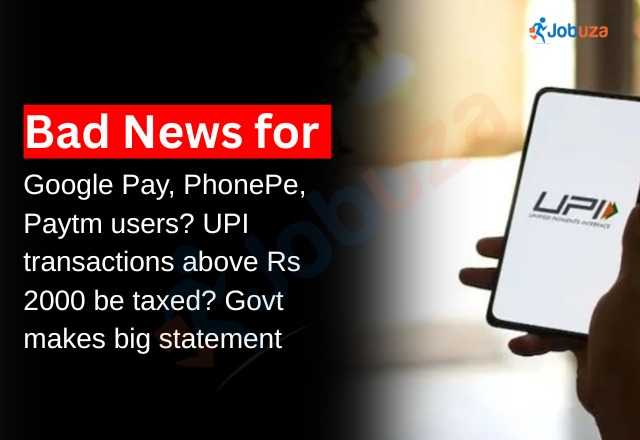
No GST on UPI Transactions Above ₹2000: Government Clears the Air
Big Update on UPI: There’s good news for users of Google Pay, PhonePe, Paytm, and other UPI apps — the government has confirmed that no GST will be charged on UPI payments over ₹2000.
Recent rumours had caused panic, with reports claiming that high-value UPI transactions might soon be taxed. But the Finance Ministry has called these reports completely false and baseless.
Why the Rumours Started
According to a report by Financial Express, MP Anil Kumar Yadav raised a question in the Rajya Sabha asking whether the government planned to impose GST on UPI payments above ₹2000. He also wanted to know if any public objections had been received.
In response, Minister of State for Finance Pankaj Chaudhary clarified that:
-
No such tax is being considered.
-
Any decision on GST is taken only by the GST Council.
-
So far, the Council has not made any recommendation to tax UPI.
No Tax on UPI, No Matter the Amount
Big Update on UPI: The government made it clear that there is no GST on UPI transactions, whether it’s a payment between two individuals or from a person to a merchant — regardless of the amount.
So whether you’re transferring ₹100 or ₹10,000 via UPI, you won’t be taxed.
Government Backs Digital Payments
This clarification also shows the government’s support for digital payment platforms. UPI is one of India’s biggest success stories — fast, secure, and easy to use. It’s used everywhere now, from street vendors to e-commerce apps, and often comes with cashback and rewards too.
By keeping UPI tax-free, the government aims to further boost digital transactions and make cashless payments accessible for all.
Final Word
There is no GST on UPI payments above ₹2000 — or on any UPI payments at all. You can continue using Google Pay, PhonePe, Paytm, and other apps without any extra charges.
The government has put all rumours to rest, confirming its commitment to promoting UPI and other digital payment options across the country.
by Jobuza Team | Jul 23, 2025 | BLOG, Trending News
How to File Your ITR Without Form 16 for AY 2024–25
Filing your Income Tax Return (ITR) without Form 16 might seem challenging—especially for salaried individuals—but it is entirely doable with the right documents. For the Assessment Year (AY) 2024–25, i.e. Financial Year (FY) 2023–24, the deadline to file your ITR without penalty is 31st July 2025. Even if you haven’t received Form 16 from your employer, you can still file your return accurately using alternative sources.
What Is Form 16 and Why You Might Not Have It
Form 16 is a certificate issued by your employer. It contains details of your salary and the Tax Deducted at Source (TDS) during the financial year. You may not have Form 16 if:
-
Your employer didn’t issue it on time
-
You’ve changed jobs and didn’t collect it from your previous company
-
The company has shut down
If that’s the case, don’t worry—you can still file your return based on your salary slips, bank statements, and Form 26AS.
Step 1: Gather Salary and TDS Details from Alternative Sources
Start by collecting your monthly salary slips to calculate your total annual salary. Include:
Next, check your bank account statements for monthly salary credits. This helps verify the income you’ve received.
Then, log in to the Income Tax e-filing portal and download your Form 26AS or Annual Information Statement (AIS). These documents show all TDS entries made against your PAN by employers and other institutions like banks.
Step 2: Compute Total Income and Claim Deductions
Now, compute your gross income. Include:
After calculating gross income, apply eligible deductions under various sections such as:
-
Section 80C – LIC, PPF, ELSS, EPF, etc.
-
Section 80D – Medical insurance premiums
-
Section 24(b) – Home loan interest
Keep supporting documents and receipts ready in case the Income Tax Department asks for them later.
Step 3: Choose the Correct ITR Form
Most salaried individuals can file using ITR-1 (Sahaj). However, if you have:
…you’ll need to choose ITR-2 or ITR-3, depending on your income sources.
You can then either manually fill the form on the e-filing portal or pre-fill data using the AIS and TIS (Taxpayer Information Summary).
Step 4: File and E-Verify Your ITR
Once you’ve entered all the details and verified your tax payable or refund, submit your ITR online. But remember—your job isn’t done yet. You must e-verify your return within 30 days to complete the process. You can e-verify using:
If you don’t verify, your ITR will be considered invalid.
Final Thoughts: Filing Without Form 16 Is Absolutely Possible
Form 16 makes the process easier, but it’s not essential. As long as you have access to salary slips, bank records, and Form 26AS/AIS, you can file your ITR accurately. Just ensure that all entries are cross-verified, and keep documentation handy. Filing on time without Form 16 is completely legal—and well within your reach.
by Jobuza Team | Jul 22, 2025 | BLOG, Trending News
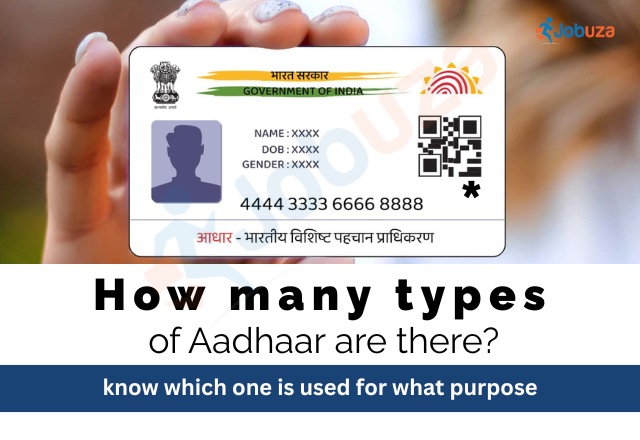
Types of Aadhaar Card: Which One Do You Need and What Is It Used For?
In India today, whether you’re booking a train ticket, catching a flight, or applying for any government or private service, one thing is almost always required—your Aadhaar card. It serves as a strong proof of identity and is used across countless sectors. But did you know that Aadhaar is available in four different formats?
The Unique Identification Authority of India (UIDAI) offers Aadhaar in multiple formats to suit different needs and preferences. All these formats are legally valid and accepted as proof of identity across India. Let’s understand the four types of Aadhaar cards and their specific uses.
1. Aadhaar Letter
The Aadhaar Letter is the traditional version of the Aadhaar card. It’s a paper-based, laminated letter that comes with a printed QR code, issue date, and printed date.
If your Aadhaar letter is lost or damaged, you can reprint it by visiting the UIDAI website and placing an online request.
2. Aadhaar PVC Card
The Aadhaar PVC Card is a compact, durable, and more secure version of the Aadhaar card. It’s similar to a debit or credit card and is printed on plastic (PVC).
You can apply for it online using your Aadhaar number, Virtual ID, or Enrolment ID.
3. mAadhaar (Mobile Aadhaar)
mAadhaar is the digital version of Aadhaar that lives in your smartphone. It’s an official mobile application developed by UIDAI.
You can download the app from the Play Store or App Store and log in using your registered mobile number.
4. eAadhaar (Electronic Aadhaar)
eAadhaar is a digitally signed, password-protected electronic version of the Aadhaar card.
-
Download from: UIDAI official website
-
Cost: Free
-
Key Features:
-
Can be downloaded instantly after enrolment or update
-
Digitally signed and accepted everywhere
-
Includes QR code and complete Aadhaar details
-
Best For: Instant download, official online submissions, and backups
You can access it using your Aadhaar number and OTP received on your registered mobile number.
Which Aadhaar Format Should You Choose?
All four Aadhaar formats—Aadhaar Letter, PVC Card, mAadhaar, and eAadhaar—are equally valid and serve different preferences:
| Format |
Ideal For |
| Aadhaar Letter |
Traditional use, general ID proof |
| PVC Card |
Wallet-sized, travel-friendly option |
| mAadhaar |
Digital-first users, mobile access |
| eAadhaar |
Instant download, online submissions |
No matter which format you use, your Aadhaar number remains the same, and it can be used for all legal and official purposes.
by Jobuza Team | Jul 21, 2025 | BLOG, Trending News
ITR Refund Delayed in 2025? These 8 Common Mistakes Could Be the Reason
If you’re still waiting for your Income Tax refund for the financial year 2024–25, you’re not alone. While many taxpayers have already received their refunds, others are experiencing unexpected delays. The Income Tax Department processes verified returns quickly, but certain common mistakes can cause your refund to get stuck.
Here are the top reasons why your ITR refund might be delayed in 2025:
1. Incorrect Deduction Claims
Claiming deductions under sections like 80C, HRA, or medical insurance without valid proof can lead to trouble. If the Income Tax Department finds your claims suspicious or unsupported, they may hold back your refund and send a notice asking for clarification or documents.
2. Mismatch in AIS (Annual Information Statement)
AIS includes details of your income such as savings interest, dividends, and other financial transactions. If the data in your ITR doesn’t match with the AIS, even by a small margin, the system may flag it for review. This mismatch can result in refund delays until the discrepancy is resolved.
3. TDS Credit Not Matching with Form 26AS
Form 26AS and AIS reflect the TDS deducted by employers, banks, or clients. If the deducted tax shown in your form does not match what you’ve reported, the refund will not be released. This is common among freelancers and contractual workers whose clients fail to report TDS on time.
4. Bank Account Not Verified
Your refund is directly transferred to your registered bank account. If your account is not e-verified, linked correctly, or KYC-compliant, the refund will fail. Always ensure that your bank details are updated and verified on the Income Tax portal.
5. Delay in Refund Processing
Even after successful filing and verification, refund processing can take a few weeks. The status may show as “under processing” for up to 30 to 45 days. This is considered normal and usually doesn’t require any action from your side.
6. Refund Generated but Not Credited
In some cases, the Income Tax Department issues the refund, but the money doesn’t reflect in your account. This can happen if your bank account has become inactive, the IFSC code has changed, or your KYC is incomplete. You may need to submit a refund reissue request through the income tax portal.
7. ITR Selected for Scrutiny or Assessment
If your ITR has been flagged for further review or scrutiny, the refund will be kept on hold until the verification process is complete. This process can take longer depending on the nature of the assessment and the response time from the taxpayer.
8. Past Tax Dues Adjusted Against Refund
If you have any outstanding tax liabilities from previous years, the department has the authority to adjust the amount from your current refund. You will usually receive an email or SMS notification explaining the deduction.
Final Words
A delayed ITR refund can be frustrating, but in most cases, it’s due to correctable issues. Always double-check your ITR before submission, match your income details with AIS and Form 26AS, and ensure your bank account is fully verified. If everything is in order and your refund is still pending, it’s worth waiting at least 30–45 days before raising a grievance or reissue request.