by Jobuza Team | Jun 26, 2025 | BLOG, Trending News
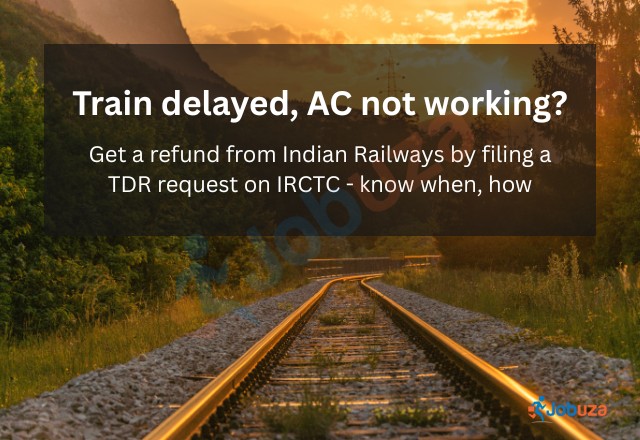
Train Delayed or AC Not Working? Here’s How to Get a Refund from IRCTC by Filing a TDR
If you’ve recently travelled by Indian Railways and had a bad experience—like a delayed train, broken AC, or a changed route—you might be eligible for a refund. Not many people know this, but IRCTC allows passengers to file a Ticket Deposit Receipt (TDR) and claim their money back in certain situations.
So if your train was more than 3 hours late, your coach was missing, or the AC didn’t work, here’s everything you need to know about how to file a TDR and get a refund.
When Can You File a TDR?
Below are the main situations where IRCTC allows refunds through TDR, along with the deadlines:
| Reason |
When to File |
| Train delayed by 3+ hours and passenger did not travel |
Before actual departure of the train |
| AC not working |
Within 20 hours after train reaches your destination |
| Coach not attached, travelled in lower class |
Within 2 days (excluding date of certificate issue) |
| All confirmed passengers didn’t travel |
At least 4 hours before departure |
| Train diverted and you didn’t travel |
Within 72 hours of scheduled departure |
| Train diverted and didn’t touch your boarding station |
Within 72 hours of scheduled departure |
| Train diverted and didn’t touch your destination |
Within 72 hours of scheduled departure |
| Waitlisted/partially confirmed ticket, and no one travelled |
Within 72 hours after train reaches destination |
| Partially confirmed ticket, and no one travelled |
At least 30 minutes before departure |
| Fare difference due to lower class travel |
Within 2 days (excluding certificate issue date) |
| Partially used ticket |
Within 72 hours of scheduled departure |
| Reservation downgraded to lower class |
Within 3 hours of actual departure |
| Couldn’t travel due to coach damage |
Within 3 hours of actual departure |
| Train ended before destination |
Within 72 hours of scheduled arrival |
Note: Refunds are not allowed for connecting trains booked separately.
How to File a TDR on IRCTC (Step-by-Step)
-
Go to www.irctc.co.in and log in.
-
Click on ‘My Account’ → ‘My Transactions’ → ‘File TDR’.
-
Choose the PNR you want to file TDR for.
-
Select the reason for refund from the dropdown list.
-
Choose the passenger(s) and click ‘File TDR’.
-
Read the terms, click ‘Yes’ to confirm.
-
You’ll see a success message once your TDR is submitted.
Final Words
If your train journey didn’t go as planned, don’t ignore it. Filing a TDR is simple, and in many cases, you’re entitled to a refund. Just remember to file it on time, based on the reason.
So next time you face a train delay, a coach problem, or service failure—log in to IRCTC and file your TDR.
by Jobuza Team | Jun 25, 2025 | BLOG, Trending News
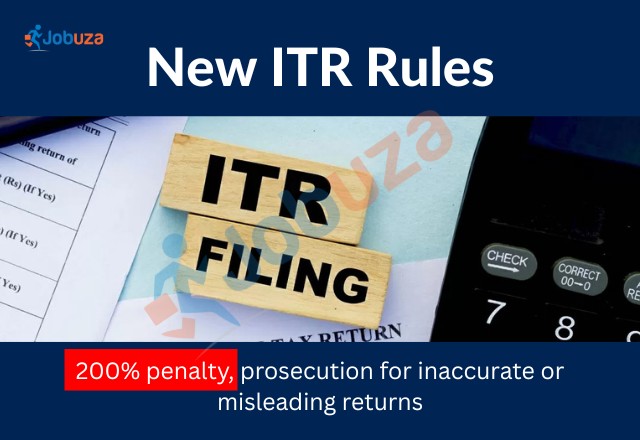
New ITR Rules: Up to 200% Penalty and Prosecution for False Claims or Misreporting Income
New ITR Rules: The Income Tax Department has announced strict new regulations for the 2024-25 assessment year. Taxpayers who misreport income, claim false deductions, or submit inaccurate Income Tax Returns (ITRs) could face a penalty of up to 200% of the tax due. Additionally, 24% annual interest and even prosecution under Section 276C of the Income Tax Act may apply.
This move aims to improve accuracy and transparency in tax filings. All taxpayers, regardless of income type or filing method, are expected to comply strictly with the new norms.
Taxpayer Responsibility
One of the key highlights of the new rule is that the taxpayer alone is held responsible for any errors, even if the mistake was made by a chartered accountant or tax consultant. This means:
- Double-check every entry before filing.
- Ensure all deductions and exemptions are legitimate and backed by documents.
- Do not rely blindly on third-party preparers.
Who Does This Apply To?
The rule applies across all categories:
- Salaried employees
- Freelancers
- Professionals
- Businesses
Everyone is equally liable for incorrect returns.
Common Mistakes to Avoid
Taxpayers should be cautious to avoid errors that may trigger penalties:
- Selecting the wrong ITR form
- Claiming deductions without proper proof
- Hiding secondary income sources
- Misclassifying personal expenses as business-related
Even if a revised return is filed, the penalty will still apply if the original submission had false information. Simply correcting it later does not cancel the consequences.
How to Stay Compliant
To avoid penalties and legal trouble:
- Match all income details with your Annual Information Statement (AIS)
- Keep valid proof for every deduction claimed
- Maintain organized records
- Meet all filing deadlines
Choosing the Right ITR Form
Filing with the wrong form can invalidate your return. Here is a quick overview of the forms and their correct usage:
ITR-1 (Sahaj) For resident individuals earning up to ₹50 lakh from salary, one house property, and other sources.
ITR-2 For individuals and HUFs with income over ₹50 lakh or more than one house property. Not for business income.
ITR-3 For individuals and HUFs with income from business or profession.
ITR-4 (Sugam) For resident individuals, HUFs, and firms with presumptive income up to ₹50 lakh.
ITR-5 For firms, LLPs, AOPs, and BOIs.
ITR-6 For companies not claiming exemption under Section 11.
ITR-7 For entities like charitable trusts, political parties, scientific institutions, and educational institutions.
Final Advice
Taxpayers should:
- Never file returns in haste.
- Consult a trusted tax advisor.
- Keep personal and financial data updated across all records.
Understanding the new rules and filing carefully is essential. A small error can now result in serious financial and legal consequences.
To ensure compliance, stay informed and make accuracy your top priority during this ITR season.
by Jobuza Team | Jun 24, 2025 | BLOG, Trending News
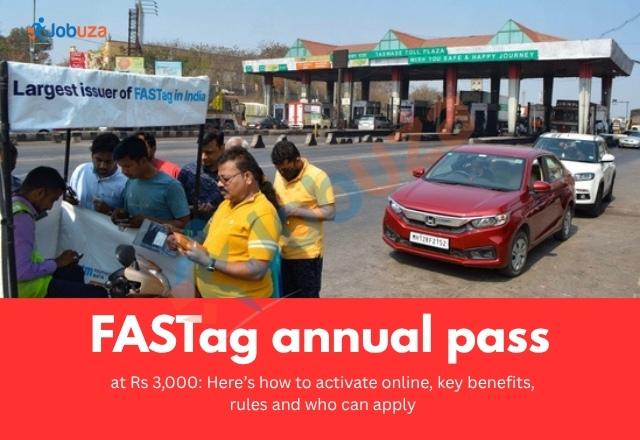
The Government of India is introducing the FASTag Annual Pass starting August 15, 2025. This new prepaid toll system is being rolled out by the National Highways Authority of India (NHAI) to make highway travel more affordable, digital, and hassle-free.
Announced by Union Minister Nitin Gadkari, the scheme offers private vehicle owners the option to pay ₹3,000 for either 200 toll-free trips or unlimited travel for one year on all National Highways (NH) and National Expressways (NE).
It aims to reduce toll plaza congestion, simplify toll payments, promote digital infrastructure, and deliver substantial savings for frequent commuters.
What Is the FASTag Annual Pass?
The FASTag Annual Pass is a prepaid toll payment plan designed for private, non-commercial vehicles such as cars, jeeps, and vans. Instead of paying tolls every time you travel, this pass lets you pay once and drive worry-free for up to a year.
With India’s rapidly growing highway network and rising intercity travel, this move supports a cashless, efficient, and eco-friendly toll collection system.
Key Benefits of the FASTag Annual Pass
-
One-time payment of ₹3,000 for 200 trips or one-year usage
-
Saves up to ₹7,000 annually for frequent travellers
-
Eliminates repeated recharges and top-ups
-
Faster travel with reduced congestion at toll plazas
-
Real-time SMS alerts for usage and balance updates
-
Supports Digital India and reduces fuel wastage at toll booths
-
Ideal for daily commuters, intercity travellers, and long-distance drivers
Who Can Apply for the FASTag Annual Pass?
Only private four-wheelers (cars, jeeps, vans) are eligible.
Eligibility Criteria:
-
FASTag must be active and properly installed on the windshield
-
It should be linked to a valid Vehicle Registration Number (VRN)
-
The tag must not be blacklisted or disputed
-
Vehicles with only chassis numbers must update to full VRNs to qualify
How to Activate the FASTag Annual Pass Online
Step-by-Step Guide:
-
Check FASTag status
Make sure your FASTag is active and linked to a valid VRN.
-
Visit official platforms
Go to the Rajmarg Yatra app or NHAI website.
-
Enter details
Submit your Vehicle Registration Number and FASTag ID.
-
Pay ₹3,000 online
Use a secure online payment method.
-
Receive confirmation
Once verified, you’ll receive an SMS confirming activation.
Important: Avoid third-party or unofficial websites to prevent fraud.
Where the FASTag Annual Pass Is Valid
You can use the pass on:
Not Valid On:
-
State highways
-
Private toll roads
-
State-run expressways
How Are Trips Counted?
For Open System Toll Plazas:
For Closed System Toll Plazas:
This ensures fair usage for both short and long-distance commuters.
What Happens After 200 Trips or One Year?
Once either limit is reached:
-
Your FASTag switches back to normal pay-per-use mode
-
No tag replacement is needed
-
You can purchase a new annual pass online instantly
Is the FASTag Annual Pass Mandatory?
No. The FASTag Annual Pass is completely voluntary.
It’s best for:
If you drive only occasionally, your regular FASTag will still work with pay-per-use mode.
FASTag Annual Pass: FAQs
What is the FASTag Annual Pass?
A prepaid toll plan for private vehicles offering 200 toll-free trips or 1 year of unlimited travel on NH and NE highways for ₹3,000.
Who is eligible?
Only non-commercial four-wheelers (cars, jeeps, vans) with active FASTag linked to a valid VRN.
How to activate?
Use the Rajmarg Yatra app or NHAI website, enter vehicle details, verify FASTag, and pay ₹3,000 online.
How long is it valid?
Until you either complete 200 trips or reach 1 year from the activation date — whichever comes first.
Where is it valid?
Only on NHAI-run toll booths. Not valid on state roads or private tollways.
Can I transfer the pass to another vehicle?
No. The pass is non-transferable and tied to a specific vehicle’s FASTag.
Final Thoughts
The FASTag Annual Pass is a revolutionary step in India’s highway travel system. By offering a simple, prepaid toll system with massive savings and convenience, it’s the perfect solution for those who travel regularly on India’s national roadways.
For smooth travel, digital payments, and better savings — activate your FASTag Annual Pass today via the Rajmarg Yatra app or the NHAI website starting August 15, 2025.
by Jobuza Team | Jun 23, 2025 | BLOG, Trending News
Delhi Bans Fuel for 10-Year Diesel, 15-Year Petrol Vehicles from July 1: All You Need to Know
Delhi Fuel Ban: Starting July 1, 2025, Delhi will no longer allow fuel refilling for End-of-Life (EoL) vehicles—which include diesel vehicles older than 10 years and petrol vehicles older than 15 years. This strict step has been announced by the Commission for Air Quality Management (CAQM) to combat rising pollution levels.
Fuel Ban to Be Enforced Using ANPR Cameras
To ensure compliance, over 500 fuel stations across Delhi are now equipped with Automatic Number Plate Recognition (ANPR) cameras. These cameras automatically scan vehicle license plates as they enter the fuel station. The system then checks the vehicle details against the VAHAN database—which includes registration info, vehicle age, and fuel type.
If a vehicle is found to be beyond the permissible age limit, it will be flagged as End-of-Life (EoL). Once flagged, an automatic alert is sent to the fuel pump, and the vehicle will be denied fuel.
Expansion to NCR from November and 2026
CAQM member Dr. Virendra Sharma confirmed that this initiative is just the beginning. The same rule will be extended to:
-
Gurugram, Faridabad, Ghaziabad, Gautam Budh Nagar, and Sonipat from November 1, 2025
-
Rest of the NCR region from April 1, 2026
Over 3.6 Crore Vehicles Scanned, 4.9 Lakh Flagged
So far, the ANPR system has scanned more than 3.63 crore vehicles in Delhi. Out of these, 4.90 lakh vehicles have been identified as End-of-Life. Dr. Sharma also highlighted that 29.52 lakh vehicles have renewed their Pollution Under Control Certificates (PUCC), resulting in challans worth ₹168 crore.
100 Enforcement Teams Deployed
To boost enforcement, the Delhi Transport Department has deployed 100 dedicated teams. These teams will monitor flagged vehicles, analyze fuel stations with the most EoL traffic, and ensure that the fuel ban is strictly followed.
Why This Step Matters
Old vehicles, especially those that don’t meet newer BS (Bharat Stage) emission standards, are a major source of air pollution in Delhi and the surrounding NCR region. By removing such vehicles from regular circulation, authorities aim to significantly improve air quality.
Dr. Sharma stated
It is very important to remove old BS standard vehicles to clean the air of Delhi and NCR. These vehicles play a big role in air pollution. With a transparent, digital and accountable system in place, this move will now extend even to toll centres to make enforcement more effective.”
What Happens If You Own an End-of-Life Vehicle?
If your vehicle is flagged as EoL:
-
You won’t be able to refuel at Delhi petrol pumps.
-
Your vehicle may be impounded or marked for scrapping.
-
You could face fines and penalties.
How to Check If Your Vehicle Is Affected
Use the VAHAN portal to check your vehicle age and status. If your car is diesel and older than 10 years, or petrol and older than 15 years, you may fall under the EoL category.
Bottom Line
Delhi Fuel Ban: From July 1, Delhi residents must ensure that their vehicles comply with the age limits to avoid inconvenience. With digital surveillance, smart tracking, and strict enforcement, authorities are pushing for cleaner air and responsible vehicle usage across the city.
by Jobuza Team | Jun 23, 2025 | BLOG, Trending News
Bank ATM Charges Hike: Starting July 1, 2025, some of India’s leading private banks — including ICICI Bank, Axis Bank, and Federal Bank — will revise their service charges, making basic banking services like ATM withdrawals, cash deposits, IMPS, NEFT, and demand drafts more expensive for customers.
These changes come soon after many PSU banks updated their ATM transaction charges following the RBI’s new guidelines. Now, with private sector banks also revising fees, the impact will be felt more widely by the common account holder.
ICICI Bank: New Charges Effective from July 1, 2025
ICICI Bank has notified its customers that the following revised charges will apply from July 1:
ATM Transaction Charges at Non-ICICI ATMs
-
Free Transactions:
-
First 3 transactions per month (financial + non-financial) in metro cities: Mumbai, Delhi, Chennai, Kolkata, Bengaluru, Hyderabad
-
First 5 transactions per month in non-metro locations
-
Post Free Limit:
-
Rs 21 per financial transaction
-
Rs 8.50 per non-financial transaction
-
18% GST extra on all charges
International ATM Withdrawals
-
Rs 125 per financial transaction
-
3.5% currency conversion fee
-
Rs 25 for non-financial transactions
-
Senior citizens are exempt from these charges
Demand Draft (DD) and Pay Order (PO) Charges
Standard Charges
-
Up to Rs 10,000: Rs 50
-
Above Rs 10,000: Rs 5 per Rs 1,000 (Minimum Rs 75, Maximum Rs 15,000)
Discounted Charges for Senior Citizens, Students, Rural Customers
-
Up to Rs 10,000: Rs 40
-
Rs 10,001 to Rs 50,000: Rs 60
-
Above Rs 50,000: Rs 5 per Rs 1,000 (Max Rs 15,000)
IMPS Charges (Effective May 1, 2024)
-
Up to Rs 1,000: Rs 2.50
-
Rs 1,001 to Rs 25,000: Rs 5
-
Rs 25,001 to Rs 5 lakh: Rs 15
NEFT Charges (Outward)
RTGS Charges (Outward)
Axis Bank: Charges Effective July 1, 2025
Axis Bank has also updated its charges for savings, NRI, Trust, Priority, and Burgundy customers.
-
ATM Free Limit:
-
Post Free Limit Charges:
Federal Bank: Revised Charges from June 1, 2025
-
ATM Charges:
-
Cash Handling:
-
Locker Fees:
HDFC, SBI, PNB, Yes Bank, IndusInd: New Charges from May 2025
As per RBI guidelines, major banks revised their charges in May 2025.
Kotak Mahindra Bank: Charges from May 2025
What Should Customers Do?
With rising charges across banks, customers need to manage their banking habits more wisely. Here are a few tips:
-
Track your free transaction limits and plan accordingly
-
Use UPI, mobile banking, or internet banking for most payments
-
Avoid unnecessary ATM visits, especially at non-home bank ATMs
-
Consider switching to a premium savings account with more free transactions if you regularly exceed limits
-
For those using cash frequently, choose banks with better free transaction limits or relaxed fee structures
Final Takeaway
Bank ATM Charges Hike: The latest hike in ATM withdrawal charges, IMPS fees, and DD rates is set to impact day-to-day banking for many Indians. With fees increasing across both public and private sector banks, it’s more important than ever for customers to adapt. Shifting towards digital payments and managing cash usage smartly can help avoid these additional costs.
by Jobuza Team | Jun 23, 2025 | BLOG, Trending News
Voter ID Cards to Be Delivered in 15 Days: How to Apply and Track Online
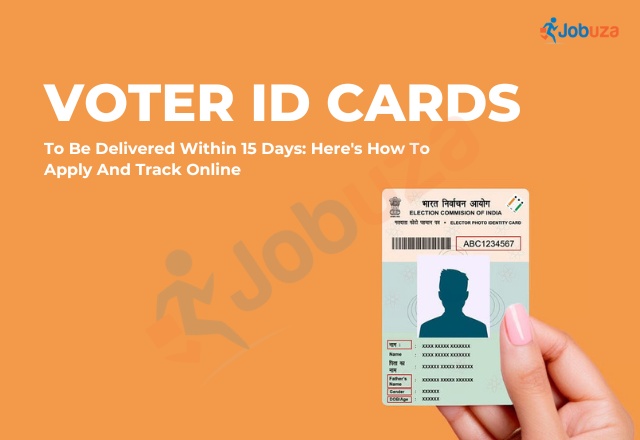
The Election Commission of India (ECI) has announced a new system under which Voter ID cards (EPIC) will be delivered to applicants within 15 days of updating their name in the electoral rolls. Earlier, it used to take more than a month. This move is aimed at improving convenience, transparency, and speed in voter services.
Here’s everything you need to know about the new Voter ID delivery process, including how to apply and track your application online.
What’s New in Voter ID Delivery?
The ECI has rolled out a new digital system that enables real-time tracking and faster processing. Here’s how it works:
1. Real-Time Tracking
Your Voter ID can now be tracked from the moment it’s generated to its delivery. You can check the status anytime.
2. SMS Notifications
You’ll receive SMS updates at every stage—application, processing, printing, dispatch, and delivery—keeping you informed throughout.
3. Integrated IT Platform
A dedicated IT module has been launched on the ECINet platform, connected with the India Post system for smooth and timely delivery.
4. Improved Workflow
The new system is designed to reduce delays and errors, while ensuring the security of voter data. It’s more efficient than the older manual process.
How to Apply for a Voter ID Card Online
You can apply for a new Voter ID or make corrections online through the National Voters’ Services Portal (NVSP). Here’s a step-by-step guide:
Step 1: Visit NVSP Portal
Go to the official website: https://www.nvsp.in
Step 2: Sign Up
Click on “Sign-Up” at the top-right corner. Enter your mobile number, email ID, and captcha.
Step 3: Create Your Account
Fill in your name, choose a password, confirm it, and click to receive an OTP.
Step 4: Verify OTP
Enter the OTP sent to your mobile and email to verify your identity.
Step 5: Log In
Now, log in using your mobile number, password, captcha code, and verify with the OTP again.
Step 6: Fill Form 6
Click on “Fill Form 6” for new voter registration. Fill in your personal details, contact information, address, and family reference.
Step 7: Upload Documents
Upload scanned copies of:
-
A recent passport-size photo
-
Proof of age (e.g., birth certificate)
-
Proof of address (e.g., Aadhaar card, electricity bill)
Step 8: Preview and Submit
Double-check all your details. Once confirmed, submit the form.
How to Track Voter ID Application Status
After submitting your application, you can track its status easily:
Step 1: Visit NVSP Portal
Go to https://www.nvsp.in and log in.
Step 2: Click on ‘Track Application Status’
You’ll find this option in the dashboard after login.
Step 3: Enter Your Reference Number
This number is given to you after submitting Form 6 or Form 6A.
Step 4: Select Your State
Choose your state from the dropdown list.
Step 5: Click Submit
You’ll now see the real-time status of your Voter ID application.
Final Words
With this upgrade, the ECI has taken a big step forward in improving citizen services. Applying for a Voter ID is now easier, faster, and more transparent. If you’re 18 or above and eligible to vote, make sure your name is on the electoral roll—and apply today.
For more details or to begin your application, visit the NVSP official portal.