by Jobuza Team | Jun 13, 2025 | BLOG, Trending News
Indian Railways’ New Rule: Waitlisted Passengers to Get Confirmation Updates 24 Hours in Advance
Train Ticket: If you often travel by train and rely on last-minute bookings like Tatkal, here’s some welcome news. Indian Railways has rolled out a new initiative aimed at reducing uncertainty and stress for waitlisted passengers. Under this change, the final reservation chart will now be prepared 24 hours before a train’s departure, instead of just a few hours before.
This move is already being tested in the Bikaner division from June 6, and the early feedback has been very positive.
What’s Changing for Train Passengers?
Traditionally, the final reservation chart was created just 2.5 to 4 hours before departure. This left very little time for passengers with waitlisted tickets to find alternatives if their seats weren’t confirmed.
With the new system, passengers will now know their booking status a full day in advance. This will give them more time to either make alternate travel plans or prepare accordingly. For those traveling on high-demand routes like Delhi-Bihar, UP-Mumbai, or Bengal-Gujarat, where waiting lists often exceed hundreds, this change can be a game-changer.
Benefits for Passengers and Railways
Train Ticket: In the first four days of the trial, passengers reported having more clarity and peace of mind. They could plan better without the stress of last-minute surprises.
The new charting system also benefits Indian Railways. With early insights into confirmed bookings and pending waitlists, authorities can proactively add extra coaches, run special or clone trains, or make other logistical arrangements in time to manage the passenger load.
No Change to Existing Booking Rules
It’s important to note that there is no change in existing ticketing rules, including Tatkal bookings. The reservation system, ticket quotas, and cancellation policies remain the same. The only difference is that now passengers will get the final status of their tickets 24 hours earlier than before.
How Did the Idea Start?
This initiative was first suggested by local railway officials during Railway Minister Ashwini Vaishnaw’s visit to Bikaner on May 21. The idea was to reduce last-minute chaos and confusion among passengers. The Minister immediately approved the suggestion, and the system was implemented on a pilot basis.
What’s Next?
Given the success of the trial in the Bikaner division, Indian Railways is planning to extend this initiative to other busy routes across the country. If rolled out nationwide, this new approach could revolutionize the travel experience by offering passengers more certainty, better options, and less last-minute stress.
Conclusion
With the final chart now being prepared 24 hours in advance, waitlisted passengers will no longer be left hanging. This change brings much-needed transparency and flexibility to train travel in India. As the system expands, both passengers and Indian Railways stand to benefit significantly.

by Jobuza Team | Jun 10, 2025 | BLOG, Trending News
India Launches DIGIPIN: A Smarter, Digital Way to Locate Your Home
DIGIPIN Replaces: New Delhi – The Indian government is transforming the way addresses work with the introduction of DIGIPIN, a new digital address system designed to replace traditional PIN codes. Launched by the Department of Posts, DIGIPIN aims to bring precision, speed, and intelligence to postal services, navigation, and service delivery across the country.
What Is DIGIPIN?
DIGIPIN stands for Digital Postal Index Number. Unlike the old six-digit PIN codes that cover large areas, DIGIPIN is a unique 10-digit code that accurately identifies the exact location of a property. Whether you’re in a bustling city or a remote village, this system allows your home or business to be mapped with pinpoint accuracy.
How Does It Work?
India has been divided into small digital grids, and each grid has been assigned a 10-digit DIGIPIN based on its latitude and longitude. This means every property has a unique, location-based code. The result is a digital address that points precisely to your location on a map—no confusion, no overlaps.
According to a Ministry of Communications release dated May 27, 2025, DIGIPIN is an open-source, geo-coded address system. It’s platform-independent and supports an “Address-as-a-Service” (AaaS) model, enabling seamless coordination between citizens, government services, and private sectors.
Why DIGIPIN Matters
DIGIPIN is a major step forward in India’s digital transformation. Here’s why it’s beneficial:
-
Provides accurate and unique addresses, reducing delivery errors
-
Simplifies last-mile logistics in both urban and rural areas
-
Speeds up emergency services by identifying exact locations
-
Supports Geographic Information System (GIS) integration for better planning
-
Enables secure and smooth interactions between people and institutions
-
Reduces confusion caused by similar or duplicate traditional addresses
How to Get Your DIGIPIN
DIGIPIN Replaces: To find your unique digital address, visit the official DIGIPIN portal at https://dac.indiapost.gov.in/mydigipin/home. Enter your details, and the system will generate your 10-digit DIGIPIN, marking your exact location digitally.
DIGIPIN is not just an update—it’s the future of address systems in India.

by Jobuza Team | Jun 10, 2025 | BLOG, PAN/Aadhar Card Updates, Trending News
Ration Card e-KYC Deadline Extended to June 30: Complete Now to Avoid Deactivation
The government has made it mandatory for all ration card holders to complete their e-KYC process by June 30, 2025. If this is not done within the deadline, beneficiaries risk removal from the ration card and may lose access to subsidized ration.
This move is part of the government’s initiative to improve the public distribution system and ensure that benefits reach only the rightful and needy individuals. e-KYC is done using the Aadhaar card, verifying the identity of the ration cardholder and all listed family members.
Earlier, the deadline was set as March 31, 2025, but it has now been extended due to widespread technical issues and lack of awareness among users.
How to Complete Ration Card e-KYC
You can complete the process either online or offline:
Offline Process:
Visit your nearest ration shop or public service center. Carry your ration card and Aadhaar cards of all family members. Your biometric verification—such as fingerprint or face scan—will be done via POS machine. Once verified, your ration card will be linked with Aadhaar.
Online Process:
Download the Mera Ration app or Aadhaar Face RD app from the Google Play Store. Enter your Aadhaar number and complete OTP-based verification. Enable your phone’s camera for face scanning to finish the process.
What Happens If You Miss the Deadline?
If you fail to complete e-KYC by June 30, your ration card may be cancelled or deactivated. This could lead to a loss of free or subsidized ration and removal from government welfare schemes.
To avoid disruption in your ration supply and government benefits, it is advised to complete the e-KYC process as early as possible.
Ration Card eKYC: If you do not complete the e-KYC by the deadline, your ration card may be deactivated or cancelled, and you may lose access to free or subsidized ration. In such cases, reactivation will require applying to the Food Department.
Ration Card eKYC: To continue receiving benefits without any interruption, complete your ration card e-KYC well before the deadline.

by Jobuza Team | Jun 10, 2025 | BLOG, Trending News
Tatkal Booking Rules Change from July 1: Aadhaar Now Mandatory for IRCTC Tatkal Tickets
Tatkal Booking New Rules: The Indian Railways has announced a major update to the Tatkal ticket booking process. Starting July 1, 2025, only Aadhaar-verified users will be able to book Tatkal train tickets online through the IRCTC website or mobile app. This new rule aims to reduce fraudulent bookings and ensure genuine passengers get fair access to Tatkal tickets.
A directive was issued by the Railway Ministry on June 10, 2025, to all railway zones outlining the mandatory Aadhaar authentication for online Tatkal ticket bookings. The move is designed to enhance transparency and prevent misuse of the Tatkal quota by bots and fake user accounts.

What’s Changing in Tatkal Booking from July 1, 2025?
1. Aadhaar Mandatory for Online Bookings
Only users who have completed Aadhaar authentication will be allowed to book Tatkal tickets online via IRCTC.
2. OTP-Based Aadhaar Verification from July 15
An additional OTP authentication linked to Aadhaar will be introduced for online Tatkal bookings from July 15, 2025.
3. OTP Required for Counter Bookings
For Tatkal tickets booked at railway counters, a mobile number will be required to receive an OTP. Tickets will only be issued after successful verification.
Key Reforms Introduced by Indian Railways
-
2.5 Crore Fake IDs Blocked: Indian Railways has already deactivated over 2.5 crore fake or suspicious IRCTC accounts to curb misuse via bots and illegal software.
-
First 30 Minutes Reserved for Individuals:
To ensure fair access, the first 30 minutes of Tatkal booking will be exclusive to individual users:
-
Restrictions for Travel Agents:
Travel agents and booking agencies can only book after the first 30-minute window:
-
Limited Booking Options for Non-Aadhaar Users:
Those without Aadhaar can still book Tatkal tickets, but only at PRS counters or through authorised agents. Online booking will not be allowed without Aadhaar verification.
Quick Comparison: Old vs. New Tatkal Rules
| Feature |
Until June 30, 2025 |
From July 1, 2025 |
| Aadhaar Requirement |
Optional |
Mandatory for online Tatkal bookings |
| OTP Verification |
Not applicable |
Required from July 15 |
| First 30 mins Booking |
Open to all |
Only individual users and counters |
| Travel Agents Access |
Immediate |
Delayed by 30 mins |
| Counter Booking Verification |
Basic ID check |
Mobile number + OTP |
| Anti-bot Measures |
Minimal |
2.5 crore fake IDs blocked |
How to Book Tatkal Tickets on IRCTC (From July 1)
-
Log in to your Aadhaar-linked IRCTC account at www.irctc.co.in or via the IRCTC app.
-
Select departure and arrival stations, journey date, and click “Find Trains.”
-
Choose your train and class, and select the Tatkal quota.
-
Enter passenger details including Aadhaar numbers.
-
From July 15, complete Aadhaar-linked OTP verification.
-
Proceed to make the payment.
-
Receive confirmation and e-ticket via SMS/email.
What You Need Before Booking Tatkal Tickets
-
An IRCTC registered account
-
Aadhaar numbers for all passengers (mandatory for online Tatkal)
-
A valid payment method (debit card, credit card, UPI, or net banking)
Final Word
These reforms mark a significant step by Indian Railways to ensure a secure, transparent, and fair Tatkal booking experience. By giving individual users priority and blocking bots, the new system is set to make Tatkal bookings smoother for genuine passengers.
Make sure to link your Aadhaar with your IRCTC account well before July 1, 2025, to avoid last-minute issues during Tatkal booking.
by Jobuza Team | Jun 9, 2025 | BLOG, Trending News
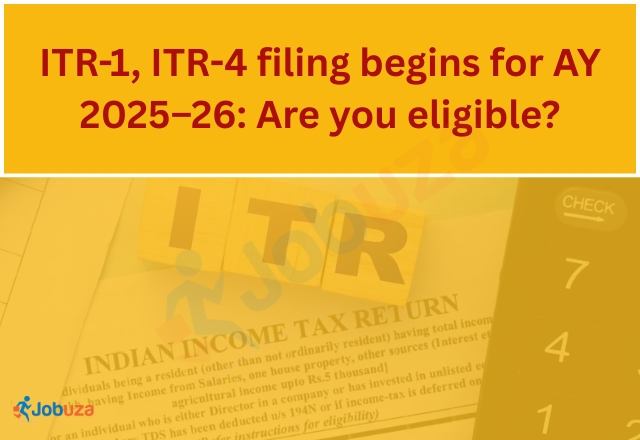
ITR-1 and ITR-4 Filing Starts for AY 2025–26: Check Eligibility Before You File
The Income Tax Department has officially opened the window for filing Income Tax Returns (ITR) for the assessment year 2025–26. Taxpayers can now file their returns online using ITR-1 and ITR-4 forms via the official e-filing portal. These forms come with key details prefilled, making the process faster and easier.
This development follows the recent release of the Excel utilities for both ITR-1 and ITR-4. In a welcome move, the department has also extended the deadline for filing returns to September 15, 2025, giving individuals more time to adapt to updated forms and portal enhancements. This extension provides relief during the busy tax-filing season, which typically ends in July.
Who Can File ITR-1?
ITR-1 (Sahaj) is meant for resident individuals whose total income does not exceed Rs 50 lakh during the financial year. It is suitable for those who earn:
-
Income from salary or pension
-
Income from one house property
-
Family pension
-
Agricultural income up to Rs 5,000
-
Interest from savings, fixed deposits, or tax refunds
Who Cannot File ITR-1?
You are not eligible for ITR-1 if you:
-
Earn income from business or capital gains
-
Own more than one house property
-
Have income from lottery, race horses, or similar sources
-
Are taxed under special provisions like section 115BBDA or 115BBE
Who Can File ITR-4?
ITR-4 is applicable for resident individuals, HUFs, and firms (other than LLPs) with income up to Rs 50 lakh from:
-
Business or profession under the presumptive taxation scheme (sections 44AD, 44ADA, or 44AE)
-
Salary or pension
-
Interest income
-
Agricultural income up to Rs 5,000
Who Cannot File ITR-4?
You cannot use ITR-4 if you:
-
Are a non-resident or resident but not ordinarily resident
-
Are a director in a company
-
Own more than one house property
-
Have held unlisted equity shares
-
Have deferred tax on ESOPs from eligible startups
-
Have income from lottery, betting, or horse racing
Final Words
Choosing the correct ITR form is essential for smooth and compliant tax filing. With prefilled data and extended deadlines, the 2025–26 filing process is designed to be simpler and more user-friendly. Take the time to review your income sources and select the right form to avoid errors and future complications.
by Jobuza Team | Jun 9, 2025 | BLOG, Trending News
After PF Withdrawal, Is Your EPS Safe? Learn How to View Your EPS Pension Record Online
Many employees withdraw their Provident Fund (PF) amount after leaving a job, but a common question that arises is: what happens to the Employees’ Pension Scheme (EPS) money? While your PF and EPS are linked, they are not the same. Understanding how EPS works and how to check your pension status online is important for planning your future retirement.
What Happens to EPS After PF Withdrawal?
When you withdraw your PF, only your contribution and the employer’s contribution towards PF are credited to your account. The portion of the employer’s contribution that goes into EPS (usually 8.33% of your basic salary) is not paid directly to you unless certain conditions are met.
If you have worked for less than 10 years, you can apply for an EPS withdrawal by submitting Form 10C along with your PF withdrawal. In that case, your EPS amount will be paid out.
If your service is 10 years or more, then you are eligible for a pension after the age of 58, and the EPS amount is not paid as a lump sum. Instead, it remains with the EPFO until you claim your pension.
How to Check Your EPS Pension Record Online
-
Visit the official EPFO Member Passbook portal: passbook.epfindia.gov.in
-
Log in using your UAN and password
-
Select your Member ID
-
Check the Employer Share and Pension Contribution columns
These entries show the amount being deposited into your EPS account during your employment.
Final Thoughts
It is important to track your EPS contributions, especially if you are planning long-term financial goals. Always keep your UAN active and your employment history updated to avoid issues in future pension claims. If you don’t have your UAN or past PF details then visit the UAN retrieval page and click on Know Your UAN. Enter your Aadhaar-linked phone number. The EPFO will send the details via SMS.