by Jobuza Team | May 28, 2025 | BLOG, PAN/Aadhar Card Updates, Trending News
Update Your Aadhaar Online for Free Before June 14: Step-by-Step Guide
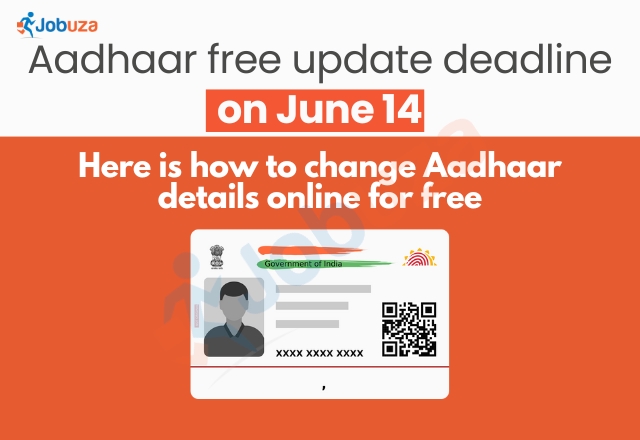
If you’ve been thinking about updating your Aadhaar details, now is the time. The Unique Identification Authority of India (UIDAI) is offering a free online Aadhaar update service until June 14, giving you a chance to update key information without visiting a physical center or paying the usual ₹50 fee.
This special offer was introduced to help citizens keep their Aadhaar records up to date. Although the deadline has already been extended a few times, it is currently set to end on June 14.
Why It’s Important to Update Your Aadhaar
As per the Aadhaar Enrolment and Update Regulations, 2016, residents are required to update their Proof of Identity (PoI) and Proof of Address (PoA) every 10 years. Keeping these details current ensures that your Aadhaar remains valid for essential services such as government subsidies, banking, and other KYC processes.
Neglecting regular updates may lead to service disruptions, delays, or rejections when accessing public services. It also helps the government maintain accurate demographic records and prevent misuse or fraudulent activities.
What Can Be Updated Online
UIDAI allows individuals to update certain demographic information online through the myAadhaar portal. These include:
Note: Biometric updates, such as fingerprints, iris scans, and photographs, cannot be done online. These require a visit to an Aadhaar Enrolment Centre due to the need for in-person verification.
How to Update Aadhaar Details Online for Free
Follow these steps to update your Aadhaar details online without paying any fee:
-
Visit the official website
Go to https://myaadhaar.uidai.gov.in on your browser.
-
Log in to your account
Click on the “Login” button. Enter your 12-digit Aadhaar number and the CAPTCHA code. An OTP will be sent to your registered mobile number. Enter the OTP to proceed.
-
Go to the document update section
After logging in, click on the “Document Update” option located in the top-right corner of the page.
-
Upload updated documents
Choose the appropriate Proof of Identity and Proof of Address documents from the dropdown menus. Upload clear scanned copies in PDF, JPEG, or PNG format. Make sure the file size is under 2MB.
-
Review and submit
Carefully verify your details before submitting the request. After submission, you’ll receive a Service Request Number (SRN) to track the status of your update.
Final Reminder
The deadline for free online Aadhaar updates is June 14, 2025. After that, the standard update fee of ₹50 will apply. To avoid delays or issues in accessing services, make sure your Aadhaar information is accurate and up to date.
by Jobuza Team | May 27, 2025 | BLOG, Highlights, Trending News
India, the world’s largest democracy, has introduced numerous government schemes to uplift its citizens socially and economically. Many of these initiatives have successfully improved the lives of millions by offering access to affordable housing, quality healthcare, clean energy, financial inclusion, and more.
Let’s explore eight of the most impactful government schemes in India, as highlighted in Yojana Nirman, that have made a lasting difference across the nation.
1. Pradhan Mantri Awas Yojana (PMAY)
Launched on June 25, 2015, the Pradhan Mantri Awas Yojana aims to provide affordable housing for all in urban areas by 2022. The scheme offers interest subsidies as low as 6.5% on home loans for up to 20 years. It has empowered countless low- and middle-income families to own a home, bringing them one step closer to financial and social security.
2. Ayushman Bharat Yojana
Introduced in 2018, Ayushman Bharat, also referred to as PM-JAY (Pradhan Mantri Jan Arogya Yojana), provides health insurance coverage of up to ₹5 lakh per family per year. It covers more than 10 crore economically vulnerable families, offering access to primary, secondary, and tertiary healthcare services, and is considered one of the world’s largest healthcare programs.
3. Pradhan Mantri Matsya Sampada Yojana (PMMSY)
Launched on September 10, 2020, this scheme focuses on the sustainable development of India’s fisheries sector. With an investment of ₹20,050 crore over five years, PMMSY aims to boost fish production by 70 lakh tons and increase export earnings to ₹1 lakh crore. It plays a vital role in supporting the livelihoods of millions of fishers and fish farmers across the country.
4. Pradhan Mantri Jan Dhan Yojana (PMJDY)
Launched in 2014, Jan Dhan Yojana aims to provide universal access to banking facilities. By offering zero-balance savings accounts, direct benefit transfers, insurance, and pension schemes, this initiative has brought millions of unbanked Indians into the financial mainstream and empowered them with formal financial tools.
5. Atal Pension Yojana (APY)
Introduced in 2015, the Atal Pension Yojana offers guaranteed pension benefits to workers in the unorganized sector. Citizens aged 18 to 40 can contribute a small monthly amount and receive a pension of up to ₹5,000 per month after retirement, ensuring financial stability during old age.
6. Pradhan Mantri Suraksha Bima Yojana (PMSBY)
This affordable insurance scheme, launched in 2015, provides accidental death and disability cover of up to ₹2 lakh at an annual premium of just ₹20. It is open to individuals aged 18 to 70 and offers essential financial security to low-income earners.
7. Swachh Bharat Mission
The Swachh Bharat Abhiyan, launched in 2014, is a nationwide campaign to promote cleanliness and hygiene. It focuses on eliminating open defecation, improving solid waste management, and creating awareness about sanitation practices. The scheme has not only improved health outcomes but has also contributed to behavioral change across rural and urban India.
8. Pradhan Mantri Ujjwala Yojana (PMUY)
Launched in 2016, Ujjwala Yojana aims to provide free LPG connections to women from below-poverty-line households. With over 10 crore beneficiaries, this initiative has improved health outcomes and reduced indoor air pollution by promoting clean cooking fuel in rural areas.
New and Recent Government Schemes in India (2020–2024)
Below is a snapshot of the latest government initiatives launched in recent years to boost development, employment, innovation, and social welfare:
| Year |
Scheme Name |
| 2024 |
Viksit Bharat by 2047 |
| 2024 |
PM Surya Ghar Muft Bijli Yojana (Rooftop Solarisation Scheme) |
| 2024 |
Atmanirbhar Oil Seeds Abhiyan |
| 2024 |
Employment Linked Incentive Scheme |
| 2024 |
New Skilling Programme |
| 2024 |
Pradhan Mantri Janjatiya Unnat Gram Abhiyan |
| 2024 |
Credit Guarantee Scheme for MSMEs |
| 2024 |
Credit Support for MSMEs During Stress Period |
| 2024 |
Comprehensive Internship Opportunities Scheme |
| 2024 |
NPS Vatsalya |
| 2022 |
Agnipath Scheme |
| 2021 |
Startup India Seed Fund Scheme |
| 2020 |
Ayushman Sahakar Scheme |
| 2020 |
Mission COVID Suraksha |
| 2020 |
SERB-POWER Scheme |
| 2020 |
Mission Karmayogi |
| 2020 |
PM SVANidhi (Street Vendor’s AtmaNirbhar Nidhi) |
| 2020 |
Sahakar Mitra Scheme |
| 2020 |
NIRVIK Scheme |
| 2019 |
DHRUV – PM Innovative Learning Programme |
Frequently Asked Questions (FAQs)
Where can I find a list of government schemes in India?
You can visit www.myscheme.gov.in, the official portal to search, apply, and track various government welfare schemes.
What types of schemes are available from the Indian government?
The government offers schemes across sectors like healthcare, education, agriculture, housing, skill development, sanitation, financial inclusion, transportation, and more.
Conclusion
These government schemes represent India’s ongoing commitment to inclusive development and social upliftment. From healthcare and housing to financial security and women’s empowerment, these initiatives are creating real, measurable change in the lives of millions. Staying informed about such schemes can help you or someone you know take advantage of valuable benefits designed to improve quality of life across the country.
by Jobuza Team | May 27, 2025 | BLOG, Trending News
The Employees’ Provident Fund Organisation (EPFO) has introduced significant updates to its withdrawal rules for 2025. With over 7 crore Indians holding savings in the EPFO, these new regulations are crucial for anyone planning to withdraw their PF (Provident Fund).
The process has now become faster, easier, and completely digital. If you are an EPFO member and intend to withdraw your PF, make sure you meet these five key conditions.
1. UAN and Registered Mobile Number Must Be Active
Your Universal Account Number (UAN) must be active. The mobile number linked to your UAN should also be active and in your possession. During the withdrawal process, you will receive a One-Time Password (OTP) on this number for verification. Without it, you won’t be able to complete your claim.
2. Aadhaar Must Be Linked with Your EPFO Account
Your Aadhaar number must be linked to your EPFO profile. When you submit a claim online, identity verification is done through e-KYC using Aadhaar OTP. If your Aadhaar is not linked, you won’t be able to withdraw your PF.
3. Bank Account and IFSC Code Must Be Correct
The PF amount is directly transferred to your bank account. Make sure your bank account number and IFSC code are accurately updated in your EPFO records. Any incorrect information can lead to claim rejection or delay.
4. PAN is Required if Your Service is Less Than 5 Years
If you’ve worked for less than five years and are applying for a final settlement, your PAN details must be updated in the EPFO records. Without it, TDS (Tax Deducted at Source) may be charged at a higher rate.
5. Your Date of Joining Must Be Recorded in EPFO
EPFO must have your date of joining on file. If this detail is missing, it can delay or even block your PF claim. Ensure your employer has updated this information correctly in the system.
No Extra Documents Needed for Online PF Withdrawal
According to the EPFO website, you do not need to submit any additional documents for online partial PF withdrawal. The online application itself acts as a self-declaration. This move has made the process simpler and more convenient for employees.
Reasons You Can Partially Withdraw Your PF in 2025
Partial PF withdrawal is allowed for several important life events and emergencies. These include:
-
Buying or constructing a house
-
Closure of factory or company lockout
-
Medical treatment for self or family members
-
Marriage expenses (self or family)
-
Education of children (after matriculation)
-
Natural disasters
-
Power supply issues affecting livelihood
-
Purchase of equipment for disabled persons
Additionally, members who are above 54 years of age can take a partial withdrawal as a loan before retirement.
How to Withdraw PF Money Online
Follow these steps to claim your PF online:
-
Visit the EPFO portal and log in using your UAN and password.
-
Ensure all KYC details and service information are updated.
-
Choose either partial withdrawal (Form 31) or full withdrawal (Form 19), depending on your need.
-
Authenticate your claim by entering the OTP sent to your registered mobile number.
Other Key Changes EPFO Introduced in 2025
Here are some additional updates EPFO has implemented to enhance user convenience:
-
Easy Profile Updates: You can now update personal details like name, birth date, gender, and marital status online without submitting documents—if your Aadhaar is linked.
-
Faster PF Transfers: Transferring your PF while changing jobs is now quicker and requires less involvement from the employer.
-
Online Joint Declaration: Employees can now submit joint declarations digitally through the portal, provided Aadhaar is linked.
-
Centralized Pension Payments: Pensions are now sent directly to beneficiaries through the National Payments Corporation of India (NPCI), eliminating delays.
-
Clear Rules for High-Income Earners: High-salary employees can now contribute extra to avail pension benefits under clarified guidelines.
Conclusion
EPFO New Rules 2025: With the new EPFO rules in 2025, withdrawing your Provident Fund has become smoother and more efficient. From Aadhaar linking to digital declarations, the process has evolved to match the pace of modern work life. Make sure your details are up to date and fulfill the required conditions to avoid any issues during your withdrawal process.
by Jobuza Team | May 26, 2025 | BLOG, Trending News
Why Your UPI Payments May Be Delayed: Government Rolls Out New Fraud Detection Tool
UPI Alert: If you’ve recently experienced a delay while making a UPI payment on apps like Google Pay, PhonePe, or Paytm, you’re not alone. The Government of India has launched a new security tool called the Financial Fraud Risk Indicator (FRI) to strengthen digital payment safety and reduce cyber fraud.
As India’s digital payment system continues to grow—surpassing 200 billion transactions in the past year—the risk of online fraud has also increased. To address this, the government is now using real-time fraud detection tools to protect users and payment platforms alike.
What Is the Financial Fraud Risk Indicator (FRI)?
The Financial Fraud Risk Indicator (FRI) is a fraud detection system developed by the Department of Telecommunications (DoT). It flags mobile numbers that are suspected of being involved in financial scams or cybercrimes.
Each mobile number is categorized into Medium, High, or Very High Risk based on:
-
Complaints from the National Cybercrime Reporting Portal
-
Reports on the DoT’s Chakshu platform
-
Intelligence shared by banks and financial institutions
UPI Alert: Once a mobile number is flagged, the system alerts UPI platforms and banks, who may then take extra precautions to verify transactions.
Why Are UPI Transactions Slower?
With the FRI system now active, UPI apps like Google Pay, PhonePe, and Paytm are taking extra security steps when processing transactions involving high-risk numbers. These safety checks may include:
-
Short delays in processing payments
-
Additional user verification before approving a transaction
-
Temporary holds for high-risk transfers
These measures are not technical glitches—they are intentional and designed to protect users from fraud.
Expert View on the New Anti-Fraud System
Gaurav Gupta, Senior Product Manager at Signzy, shared his insights on the FRI system: India’s digital payments are growing fast, but so are fraud risks. The FRI system is a major step forward. It uses real-time intelligence to stop fraud before it affects users. It’s a collaborative move between the government and financial institutions that builds trust and strengthens digital infrastructure.”
A Key Feature of the Digital Intelligence Platform
The FRI is part of the government’s Digital Intelligence Platform—a broader initiative to combat financial fraud. The DoT is actively sharing FRI reports with banks, UPI service providers, and fintech companies so they can respond quickly to threats.
By combining real-time data with predictive risk analysis, the platform aims to protect digital transactions at every stage.
What This Means for UPI Users
If your UPI payment is delayed, it may be because:
-
The system is verifying a flagged mobile number
-
Your transaction triggered a risk alert
-
The app is performing an extra layer of security verification
While these delays can be frustrating, they are designed to prevent fraud and protect your money.
How to stay safe:
-
Make sure your UPI app is updated
-
Only transact with known and trusted contacts
-
Be cautious of unsolicited payment links or calls
Final Takeaway
India’s digital payment network is expanding rapidly, and the risks are evolving with it. The Financial Fraud Risk Indicator (FRI) is a timely and necessary solution that prioritizes user safety and fraud prevention.
UPI Alert: So, the next time your payment is slightly delayed, remember—it’s a sign that your money is being protected in a smarter and more secure way.
by Jobuza Team | May 26, 2025 | BLOG, Trending News
IRCTC Name Change: How to Correct Passenger Name on Booked Train Tickets Easily
IRCTC Update: Train travel in India is more than just a means of transportation. It’s an experience that captures the beauty of the country’s landscapes, cultures, and memories. With millions of people using Indian Railways daily, it’s common for passengers to make errors while booking tickets—especially in the spelling of names.
The good news? IRCTC now allows you to correct or update the passenger name on your e-ticket without the need to stand in long queues at the station. Whether you’ve made a spelling mistake or want to transfer the ticket to a close family member, the Indian Railways has made the process simple and user-friendly.
Can You Change the Name on a Booked IRCTC Ticket?
Yes, you can. Indian Railways permits passengers to change or correct the name on a confirmed train ticket. However, this facility can only be used once per ticket, so make sure to double-check the new details before submitting your request.
How to Change the Passenger Name Online on IRCTC
If you prefer to handle the name correction online, follow these steps:
-
Log in to your IRCTC account using your registered username and password.
-
Navigate to the section titled “Change Boarding Point and Passenger Name Request” from your dashboard.
-
Download the passenger name change request form provided there.
-
Fill out the form with the correct details and upload it back on the same page.
-
Submit the request and wait for IRCTC to process the change.
Prefer Offline? Follow This Process at the Railway Station
If you’re more comfortable visiting the station in person, here’s what you need to do:
-
Take a printout of the confirmed train ticket.
-
Visit the nearest railway reservation counter at least 24 hours before your train’s scheduled departure.
-
Carry an original ID proof of one of the passengers listed on the ticket, along with a photocopy.
-
Request the reservation officer to update the passenger name or transfer the ticket to an eligible family member.
Important Things to Remember
-
The name change or transfer is allowed only once per ticket.
-
The offline process must be completed at least 24 hours before the train departure.
-
Name transfer is only allowed to immediate family members such as parents, siblings, spouse, or children.
This feature is especially useful when someone else in your family ends up traveling instead of the originally booked passenger. Whether you choose the online route or prefer visiting the railway counter, the process is now easier, faster, and more convenient than ever before.

by Jobuza Team | May 22, 2025 | BLOG, Trending News
Govt Plans Cashback or Discounts on UPI Payments: Here’s What You Should Know
In a significant move to promote digital payments and benefit users, the Indian government is working on a new plan that could bring cashbacks or discounts on UPI transactions. This initiative aims to encourage more people to use UPI over credit cards, which often come with hidden costs for merchants.
What Is the Government Planning for UPI Users?
According to sources, the Ministry of Consumer Affairs is developing a proposal that will allow customers to receive a ₹2 discount on every ₹100 spent via UPI. The idea is simple — while shopkeepers already enjoy zero Merchant Discount Rate (MDR) on UPI payments, consumers could now benefit too.
Here’s how it would work:
But if you use a credit card for the same purchase, you’ll still pay the full ₹100, and the shopkeeper pays a cut to the card company.
Why Are Credit Card Payments More Expensive?
Every time a customer uses a credit card, merchants have to pay 2–3% of the transaction amount as a fee (MDR) to the bank or payment processor, such as Visa or MasterCard. That means on a ₹100 transaction, the shopkeeper may receive only ₹97–₹98.
In contrast, UPI payments don’t carry these fees. The entire ₹100 goes directly to the merchant, making UPI a more cost-effective and merchant-friendly option.
How Will This Benefit Consumers?
This proposed scheme could be a game-changer for everyday users. If implemented, it will:
-
Encourage more people to use UPI instead of credit cards
-
Help consumers save on daily transactions
-
Support small and local merchants who rely on low-cost payment methods
It’s a win-win for both consumers and businesses.
When Will the New UPI Discount Scheme Launch?
The government is planning to hold key meetings in June 2025 with major stakeholders, including:
The proposal is still in the early stages. If approved, it could roll out by the end of 2025 or early 2026, depending on how quickly all stakeholders agree on the framework.
UPI’s Growth in India: Why It Matters
UPI is already India’s most popular digital payment platform. Here are some impressive stats:
-
Over 185 billion transactions recorded in 2024–25
-
Total transaction value exceeded ₹260.56 lakh crore
-
26 crore new users joined in the last 3 years
-
5.5 crore new merchants adopted UPI
-
Total user base now stands at over 45 crore Indians
With numbers like these, the government sees a major opportunity to make UPI even more beneficial to everyday users.
Challenges Ahead
While the idea is promising, there are a few challenges to consider:
-
Banks and merchants must be on board with the discount model
-
Credit card companies may resist the shift in user preference
-
E-commerce platforms will need to integrate this system smoothly
Despite possible resistance, especially from those who benefit from MDR fees, the overall outlook for this initiative is positive.
Final Thoughts
If approved and implemented, this new government scheme could make UPI not just a fast and secure way to pay — but a rewarding one too. It could help millions of Indians save money while pushing the country further into a digital-first economy.
Stay tuned as the policy develops — this could be the next big step in India’s digital payment revolution.