by Jobuza Team | May 2, 2025 | BLOG, PAN/Aadhar Card Updates, Trending News
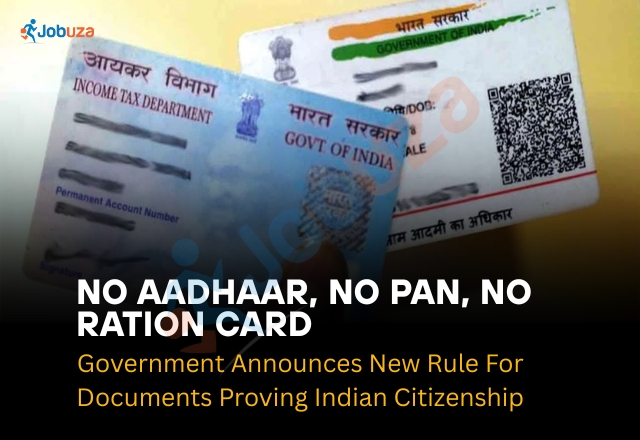
Aadhaar, PAN, Ration Card No Longer Accepted as Proof of Indian Citizenship: Government Announces New Rule
Major Policy Shift After Pahalgam Terror Attack
In a major policy change following the recent Pahalgam terror attack, the Indian government has announced that Aadhaar cards, PAN cards, and ration cards will no longer be accepted as valid proof of Indian citizenship. This decision especially targets individuals suspected of living illegally in the national capital.
Only Voter ID and Passport Accepted as Citizenship Proof
According to a Hindustan Times report, the Delhi Police have confirmed that only voter ID cards and Indian passports will now be accepted to prove Indian citizenship. This directive comes from the central government as part of broader efforts to tighten verification processes and improve national security.
Verification Drive Uncovers False Citizenship Claims
Since October last year, the Delhi Police and other agencies have been conducting an extensive verification drive. During these checks, many foreign nationals—especially from Bangladesh and the Rohingya community—were found using Aadhaar, PAN, and ration cards to falsely claim Indian citizenship.
Why Aadhaar, PAN, and Ration Cards Are Not Proof of Citizenship
It’s important to clarify that while India issues Aadhaar, PAN, and ration cards, none of these documents establish citizenship.
-
Aadhaar card: Confirms identity and address, but not nationality (as clarified by UIDAI).
-
PAN card: Used for tax purposes, not for proving citizenship.
-
Ration card: Helps families access subsidized food and goods, but does not confirm citizenship status.
Valid Documents for Proving Indian Citizenship
The government recognizes birth certificates and domicile certificates as primary documents to prove Indian citizenship. Under the Registration of Births and Deaths Act, 1969, birth certificates issued by authorized authorities serve as valid proof if the individual was born in India.
Government Crackdown on Pakistani Nationals
Following the Pahalgam attack, the government has also taken strict action against Pakistani nationals:
-
Visas issued to Pakistani citizens are being canceled, except for medical, diplomatic, and long-term visas (LTVs).
-
All medical visas will become invalid after April 29.
-
The Delhi Police and intelligence agencies have been ordered to identify Pakistani nationals in Delhi and issue immediate departure notices.
-
Hindu Pakistani citizens with valid long-term visas will not be affected by this rule.
Strengthening National Security and Verification
This major policy shift aims to enhance national security and ensure that all residents undergo proper verification. It reinforces the message that identity documents like Aadhaar, PAN, and ration cards are not sufficient to establish Indian citizenship.
by Jobuza Team | May 2, 2025 | BLOG, Trending News
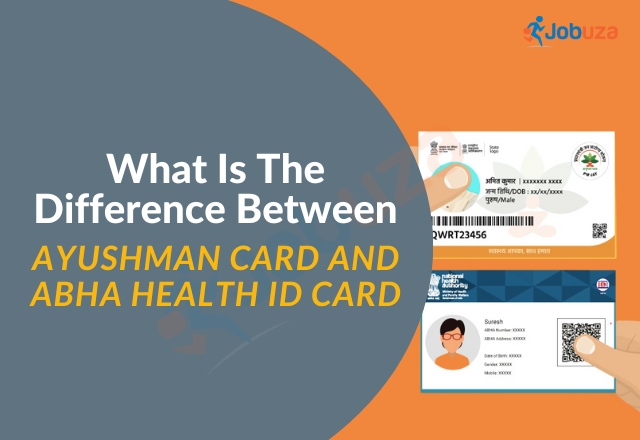
Difference Between Ayushman Card and ABHA Health ID Card Explained
In India’s ongoing mission to improve healthcare access, two government programs have become essential: the Ayushman Card and the ABHA Health ID Card. While they share the goal of improving healthcare delivery, they serve very different purposes.
The Ayushman Card acts as a financial shield against hospital expenses, while the ABHA Card digitizes and organizes your health records. Understanding these tools can help citizens get faster treatment, avoid unnecessary costs, and better manage their healthcare needs.
Why These Cards Matter for Citizens
Healthcare expenses can strain family savings, especially for low-income households.
-
The Ayushman Card provides insurance coverage of up to ₹5 lakh per year for hospitalization, helping families avoid falling into debt.
-
The ABHA Health ID securely stores your health records, such as prescriptions, lab reports, and vaccination details, making them accessible to doctors across India.
Together, they address two major challenges in healthcare: affordability and access to medical data.
Ayushman Card: Your Financial Safety Net
Launched in 2018 under the Pradhan Mantri Jan Arogya Yojana (PM-JAY), the Ayushman Card is aimed at economically vulnerable families.
Key details:
-
What it covers: Hospitalization for over 1,900 procedures, including surgeries, cancer treatments, and emergencies.
-
Benefits: Cashless treatment at empanelled hospitals, coverage for pre- and post-hospitalization costs.
-
Eligibility: Families earning less than ₹5 lakh per year, including manual laborers, homeless individuals, and certain caste groups.
-
Example: A farmer’s family can avoid debt when a ₹3 lakh heart surgery is covered under the scheme.
ABHA Health ID: Your Digital Health Record
Launched in 2021, the Ayushman Bharat Health Account (ABHA) gives every citizen a unique 14-digit digital ID for health records.
What it offers:
-
Stores medical details like prescriptions, lab reports, and vaccination records.
-
Allows doctors to access your medical history instantly, with your consent.
-
Connects with telemedicine services like eSanjeevani.
-
Eligibility: Available to all Indian citizens, regardless of income.
-
How to get it: Register through the ABHA app or website using your Aadhaar number.
-
Example: A Delhi resident can easily share diabetes records with a Mumbai specialist, improving continuity of care.
Key Differences Between Ayushman Card and ABHA Health ID Card
| Feature |
Ayushman Card |
ABHA Health ID Card |
| Purpose |
Pays hospital bills |
Stores health records digitally |
| Coverage |
Up to ₹5 lakh/year per family |
No financial coverage |
| Eligibility |
Low-income families |
All Indian citizens |
| Issued By |
National Health Authority (NHA) |
Ministry of Health and Family Welfare |
| Data Storage |
Does not store health data |
Links full medical history to ID |
Can You Have Both Cards?
Yes. For example, a street vendor can use the Ayushman Card for free cancer treatment and use the ABHA ID to track his wife’s pregnancy records. The two systems work together: one helps pay medical bills, the other organizes health data.
Recent Updates
-
Ayushman Card Expansion: In 2024, the government began discussions on extending coverage to middle-class families, though official changes are still pending.
-
ABHA Upgrades: New features now allow users to link health insurance policies and book lab tests through the ABHA app.
Common Questions Answered
Is ABHA mandatory?
No, but it simplifies healthcare management and reduces paperwork.
Can I get an Ayushman Card online?
You must first check eligibility on pmjay.gov.in and then visit a nearby Common Service Centre (CSC) to apply.
How to Apply
For Ayushman Card:
-
Visit pmjay.gov.in and check eligibility under “Am I Eligible?”
-
Submit income and caste certificates at your nearest CSC.
For ABHA Health ID:
-
Download the ABHA app or visit the official website.
-
Enter your Aadhaar number to generate your 14-digit ABHA ID.
Conclusion
The Ayushman Card and ABHA Health ID are transforming healthcare in India. Since 2018, the Ayushman Card has covered over 6 crore hospitalizations, while ABHA IDs have reached more than 50 crore registrations as of 2024. For individuals, this means fewer loans during medical emergencies and better access to health information.
Think of the Ayushman Card as your health insurance card and the ABHA ID as your personal health diary. Whether you are a daily wage worker or a corporate professional, these tools empower you to take control of your health, minus the paperwork hassle.
by Jobuza Team | Apr 30, 2025 | BLOG, Trending News
Starting May 1, 2025, the Reserve Bank of India (RBI) has introduced new ATM transaction rules that impact all bank customers across India. These changes cover the number of free ATM transactions, updated ATM charges, and new policies regarding Cash Recycler Machines (CRMs).
If you frequently use ATMs, here’s what you need to know to avoid unexpected fees and make informed banking decisions.
Revised Free ATM Transaction Limits
Under the new RBI guidelines, the number of free monthly ATM transactions will now depend on your location:
These limits include both financial and non-financial transactions:
-
Financial: Cash withdrawals
-
Non-financial: Balance enquiries, mini statements, PIN changes, etc.
Updated ATM Charges Beyond Free Limit
Once your monthly quota of free ATM transactions is used up, banks can now charge:
These charges apply to:
-
All transactions beyond the free limit
-
Both financial and non-financial transactions
-
Cash Recycler Machines (CRMs) – except for cash deposits, which remain free
How Major Banks Are Implementing the New Rules
HDFC Bank
-
From May 1, 2025, charges beyond the free limit will be:
-
Only cash withdrawals beyond the free limit are chargeable at HDFC ATMs
-
At other banks’ ATMs, both financial and non-financial transactions count toward the limit
Punjab National Bank (PNB)
IndusInd Bank
-
Effective May 1, 2025, for all Savings, Salary, NRI, and Current Accounts:
Important Tips for Customers
To avoid extra charges and manage your banking efficiently:
-
Monitor your monthly ATM usage, especially if you use ATMs from other banks
-
Be aware of the ₹23 per transaction cap, excluding taxes
-
Note that CRMs now follow the same charge rules as ATMs, except for cash deposits, which are still free
-
Consider switching to digital banking options for balance checks, mini statements, and transfers
Why Has RBI Made These Changes?
The RBI’s new ATM rules aim to:
-
Create a standardized fee structure across banks
-
Encourage digital banking adoption while ensuring fair access to ATM services
-
Improve infrastructure and reduce unnecessary cash handling costs
Despite growing digital adoption, cash remains important—especially in semi-urban and rural regions. According to RBI data:
-
Monthly ATM withdrawals dropped from 57 crore (Jan 2023) to 48.83 crore (Jan 2025)
-
The average monthly ATM withdrawal value in FY24 reached ₹1.43 crore, with a 5.51% YoY increase
Additionally, the National Payments Corporation of India (NPCI) announced a ₹7 interchange fee for balance enquiries in Nepal and Bhutan, excluding GST. These updates do not affect Micro-ATMs, international ATMs, or interoperable cash deposit machines.
Conclusion
With the new RBI ATM rules now in effect, staying informed is essential. Track your usage, avoid unnecessary ATM visits, and leverage digital banking tools to manage your finances efficiently. These changes are part of RBI’s effort to modernize banking while maintaining equitable access to cash across India.
by Jobuza Team | Apr 29, 2025 | BLOG, Trending News
Income Tax: 4 Situations Where the Old Tax Regime Is a Smarter Choice
As the financial year 2024–25 draws to a close, the income tax filing season is now underway. With the deadline to file Income Tax Returns (ITR) set for July 31, taxpayers have nearly three months to assess their finances and file their returns.
One of the most important decisions taxpayers must make is choosing between the old and new tax regimes. While the new regime offers lower tax slabs with simplified compliance, the old regime continues to appeal to many due to its wide range of deductions and exemptions.
Here are four key situations where the old tax regime may be the better option for you:
1. You Have Investments That Qualify for Tax Deductions
The old tax regime allows deductions under various sections such as 80C (for investments in PPF, ELSS, LIC, etc.), 80D (health insurance premiums), 80G (donations), and 80DD (expenses for dependent with disability), among others. If you have made these types of tax-saving investments, the old regime can help you significantly lower your taxable income.
On the other hand, the new tax regime offers limited deductions, mainly under sections like 80CCD(2) (employer contribution to NPS), 80CCH (Agniveer Corpus Fund), and 80JJAA (deduction for new employment). For individuals with substantial deductions, the old regime often results in greater tax savings.
2. You Are Eligible for House Rent Allowance (HRA) Exemption
If you are a salaried employee who pays rent and receives House Rent Allowance (HRA), the old tax regime may be more beneficial. Under Section 10(13A), HRA can be partially or fully exempt from tax, depending on your salary structure and city of residence.
This exemption is not available under the new tax regime. Therefore, those who claim a large HRA component can reduce their taxable income considerably under the old regime.
3. You Fall Into the Highest Tax Bracket
Under the old tax regime, the highest tax rate of 30 percent applies to income above ₹10 lakh. In contrast, the new tax regime applies the highest rate of 30 percent only after your income exceeds ₹15 lakh. While this might sound like an advantage for the new regime, it often doesn’t hold when deductions and exemptions under the old regime are taken into account.
If you are in the highest income bracket and have several eligible deductions, sticking with the old tax regime can result in a lower overall tax liability.
4. The Income Tax Calculator Shows Lower Tax Under the Old Regime
Tax planning should always be backed by a comparative analysis. Using an online income tax calculator is a practical step before finalizing your choice. These tools allow you to input your income, deductions, and exemptions to calculate your tax liability under both regimes.
If the calculator shows that your tax outgo is lower under the old regime, it’s a clear indicator that it’s the right choice for your financial situation.
Conclusion
Choosing between the old and new tax rule requires a careful evaluation of your income, deductions, and financial goals. While the new regime offers simplicity, the old regime continues to provide valuable tax-saving opportunities for many individuals. Before filing your ITR, take the time to compare both regimes and make a data-driven decision that minimizes your tax burden.
by Jobuza Team | Apr 25, 2025 | BLOG, Trending News
RBI’s New Rule: Kids Aged 10+ Can Now Open & Operate Bank Accounts on Their Own — Full Guidelines Inside
New RBI Rule The Reserve Bank of India (RBI) has introduced a new rule that allows children aged 10 years and above to open and manage bank accounts independently. This update simplifies how banks handle accounts for minors, making the process more flexible and transparent.
These changes will come into effect from July 1, 2025, and all banks are required to update their internal policies accordingly.
What’s New in RBI’s Guidelines for Minor Bank Accounts?
✅ 1. Any Minor Can Open an Account Through a Guardian
-
Children of any age can still open a savings or term deposit account through their natural or legal guardian.
-
As per RBI’s older circular, even the mother alone can act as the guardian.
✅ 2. Kids Aged 10 and Above Can Operate Accounts on Their Own
-
Children who are 10 years or older can now independently open and manage their own accounts — without needing a guardian’s help.
-
However, banks will set their own limits and conditions, depending on their risk policies.
-
All terms must be clearly explained to the minor before account activation.
✅ 3. What Happens When a Minor Turns 18?
-
Once the account holder turns 18, they must provide new operating instructions and signature.
-
If the account was earlier managed by a guardian, the account balance must be verified.
-
Banks should initiate this process in advance for a smooth transition to adult ownership.
✅ 4. Extra Services May Be Offered
Banks can also offer minors:
-
ATM/debit cards
-
Internet banking
-
Cheque books
These services will be given only after checking the bank’s risk rules and whether the product is suitable for the child.
✅ 5. No Overdraft – Credit-Only Accounts
-
Whether the account is handled by the child or guardian, no overdraft is allowed.
-
The account must always have a credit balance.
✅ 6. KYC Is Still Mandatory
When Will This Be Implemented?
-
The new rules will apply from July 1, 2025.
-
Until then, banks will continue with the existing policies.
Final Takeaway
This is a major step by the RBI to promote financial awareness among children. Kids can now learn how to save, manage money, and build financial discipline early in life — all while ensuring safety and compliance through proper checks by the banks.

by Jobuza Team | Apr 24, 2025 | BLOG, Trending News
Google’s Monopoly on Android TVs Ends in India: What It Means for Consumers and TV Makers
New Delhi:
In a landmark decision that could reshape the smart TV industry in India, Google will no longer have exclusive control over the operating system and app store on Android TVs. The ruling, passed by the Competition Commission of India (CCI), calls out Google’s dominant position and mandates major changes in how Android TV services are offered in the country.
Why Google Faced Action
India, one of Google’s largest markets globally, has seen widespread use of Android TVs powered by Google’s operating system and bundled with the Google Play Store. According to the CCI, Google’s practice of pre-installing its OS, app store, and other related apps under a strict distribution agreement amounted to abuse of its dominant position.
The case was initiated by two Indian antitrust lawyers, leading to a detailed investigation. Findings revealed that Google’s policies created roadblocks for other companies trying to offer alternative or customized versions of Android for smart TVs in India.
The Settlement and What Changes Now
Following the CCI’s intervention, Google submitted a settlement proposal. As part of the agreement:
-
Google will offer a standalone license for Play Store and Play Services for smart TVs in India.
-
These services, previously bundled for free, will now come with a licensing fee.
-
TV brands and manufacturers are no longer obligated to use Google’s Android OS.
-
Google is required to inform all its Android TV partners in India that they are free to choose any open-source operating system.
In addition, the CCI imposed a penalty of $2.38 million on Google as part of the settlement.
What This Means for Consumers
Consumers will now have more choices when it comes to buying smart TVs. However, they will also need to be more informed. Since brands can now opt for different operating systems and app stores, not all TVs will run Google’s Android OS or include the Play Store by default.
Popular apps may not be available on every app store. As of now, Google Play and Amazon’s App Store offer the widest selection. These platforms are also preferred for their data security and smooth user experience. On the other hand, lesser-known platforms may lack some of these advantages.
If you’re planning to buy a new smart TV, it’s important to check the OS and app store in advance. Features, app availability, and performance can vary depending on the software used.
Impact on TV Manufacturers and Brands
TV brands that previously depended on Google’s software ecosystem now have the flexibility to explore other options. They are no longer bound to pre-install Google apps or services. While this ruling currently applies to smart TVs, the CCI has indicated that similar action could extend to other devices in the future.
Brands such as Sony, Hisense, Panasonic, TCL, Motorola, Nokia, Toshiba, Sharp, and Philips have traditionally used Google’s Android OS. Whether they will continue doing so or explore alternatives remains to be seen.
The Bigger Picture
This development marks a turning point in India’s digital consumer electronics market. With more freedom for manufacturers and more choice for consumers, the smart TV segment is set to become more competitive, open, and diverse.