by Jobuza Team | Jun 30, 2026 | BLOG, Trending News
The rental housing market in India is growing rapidly, and with changing laws and digital processes, tenants need to stay updated before renting a property in 2026.
However, there is no single set of new rent rules that applies uniformly across the entire country. Since tenancy laws come under state jurisdiction, rules can vary from one state to another.
The Model Tenancy Act (MTA), 2021 provides a framework for rental agreements and tenant-landlord relationships, but states have the option to adopt or modify these guidelines according to their requirements.
Before signing a rental agreement in 2026, tenants should understand the important rules and responsibilities applicable in their state.
1. Written Rental Agreement Is Now More Important Than Ever
The practice of renting a house based only on verbal promises is gradually disappearing across India.
Property experts recommend having a detailed written rental agreement that clearly mentions all important terms, including:
- Monthly rent amount
- Security deposit details
- Lock-in period
- Maintenance responsibilities
- Notice period
- Rent increase terms
- Renewal conditions
A properly drafted rental agreement helps avoid misunderstandings and protects the rights of both tenants and landlords.
2. Digital Registration of Rental Agreements Is Increasing
One major change in the rental sector in 2026 is the growing use of digital registration systems.
Several states are moving towards online platforms where rental agreements can be submitted and registered digitally with authorities.
However, tenants should remember that digital registration is not yet a mandatory nationwide rule. Requirements may differ depending on state laws and local regulations.
Before renting a property, tenants should check the registration process applicable in their city or state.
3. Security Deposit Rules for Tenants
Security deposit has always been one of the biggest concerns for tenants.
Under the Model Tenancy Act, a limit of up to two months’ rent for residential properties has been suggested as the security deposit amount.
However, this rule is not automatically applicable across all parts of India. In many cities with high rental demand, landlords may still ask for higher deposits if allowed under local practices or state regulations.
Tenants should check the applicable rules before making any payment.
4. Rent Increase Terms Must Be Clearly Mentioned
Tenants should avoid agreements where landlords say, “We will decide the rent later.”
Every rental agreement should clearly mention:
- When the rent can be increased
- How frequently rent can be revised
- The formula or percentage for rent hikes
Having clear rent revision terms helps prevent future disputes between tenants and landlords.
5. Maintenance Responsibilities Should Be Clearly Defined
Maintenance-related issues are among the most common reasons for landlord-tenant disputes.
Before signing the rental agreement, both parties should clearly decide who will handle different types of repairs.
Generally:
- Major structural repairs are handled by landlords.
- Daily maintenance and minor repairs are usually the tenant’s responsibility.
Clearly defining these responsibilities in advance can help avoid conflicts during the tenancy period.
6. Landlords Cannot Remove Tenants Without Legal Process
Social media often spreads misinformation that landlords can immediately remove tenants after a lease expires or during a dispute.
However, landlords generally need to follow proper legal procedures and notice requirements before asking tenants to vacate.
At the same time, tenants should also follow the agreed lease terms. Staying in a property beyond the agreed rental period may lead to penalties or legal action depending on applicable state rules.
Following proper notice periods protects the interests of both tenants and property owners.
7. Tenant and Landlord Verification Is Important
Identity verification and documentation have become an important part of the rental process.
Depending on state rules, tenants and landlords may need to complete formalities such as:
- Police verification
- Identity proof submission
- Aadhaar or PAN details
- Required rental forms
Completing these verification processes helps maintain transparency and reduces the chances of future legal issues.
Things Tenants Should Check Before Renting a House in 2026
Before finalising a rental property, tenants should:
- Read the rental agreement carefully.
- Understand all charges and responsibilities.
- Check security deposit conditions.
- Confirm maintenance rules.
- Verify landlord details.
- Follow state-specific tenancy regulations.
With changing rental practices and increasing digital processes, staying informed about house rent rules in 2026 can help tenants avoid disputes and ensure a smoother renting experience.
by Jobuza Team | Jun 30, 2026 | BLOG, Trending News
The Employees’ Provident Fund Organisation (EPFO) manages India’s provident fund and pension schemes, helping millions of salaried employees save for their retirement. Under the EPF scheme, both employees and employers contribute a fixed amount every month, and the accumulated amount is provided to employees after retirement or as per applicable withdrawal rules.
Employees can easily check their EPF account balance, contribution details, and claim status through multiple methods, including the EPFO website, UMANG app, and SMS service.
What is EPF and Who Can Open an EPF Account?
The EPF scheme is available for eligible salaried employees. Employees with a basic salary and dearness allowance (DA) of up to ₹15,000 per month are generally covered under the mandatory EPF scheme.
Employees whose basic salary and DA exceed ₹15,000 can also choose the Voluntary Provident Fund (VPF) option to increase their retirement savings.
Currently, EPF and VPF contributions provide an interest rate of 8.25%, helping employees grow their retirement corpus over time.
EPF Tax Benefits for Employees
EPF also provides tax benefits under certain conditions.
Under the old tax regime, employee contributions of up to ₹1.5 lakh per financial year are eligible for deduction under Section 80C of the Income Tax Act.
Employer contributions up to 12% of salary (within the applicable limit) are eligible for tax benefits under both old and new tax regimes.
The interest earned on employee contributions is also tax-free up to the specified limit of ₹2.5 lakh per year. These benefits make EPF one of the most popular retirement savings options among salaried employees.
How to Check EPF Balance Online
EPFO members can check their provident fund balance and other account details through different methods. Users can access their EPF information using the official EPFO portal, UMANG application, or SMS facility.
Check EPF Balance Through SMS
EPFO members can check their PF balance instantly through SMS.
To check your balance, send:
EPFOHO UAN
from your registered mobile number to:
7738299899
After sending the SMS, you will receive your latest PF contribution details and available balance information.
The SMS service is available in multiple languages, including English, Hindi, Bengali, Gujarati, Kannada, Malayalam, Marathi, Punjabi, Tamil, and Telugu.
Check EPF Balance Through UMANG App
The UMANG app allows users to access various government services, including EPFO services.
Follow these steps:
- Download the UMANG app from Google Play Store or Apple App Store.
- Log in using your registered mobile number.
- Search for EPFO services.
- Select the Employee Centric Services option.
- Choose the required service and enter your UAN details.
- Verify your account using OTP.
- After successful login, you can view your EPF account details and claim-related information.
Check EPF Balance Through EPFO Website
Employees can also check their PF details through the official EPFO website.
Steps to check EPF details:
- Visit the official EPFO portal.
- Click on the Services section.
- Select For Employees from the available options.
- Choose the option related to PF account services.
- Enter your UAN, password, and captcha details.
- After login, you can view your PF balance, contribution history, and other account details.
EPFO’s New E-PRAAPTI Portal: What Members Need to Know
EPFO is also planning to introduce a new digital platform called E-PRAAPTI to help members recover details related to old and inactive EPF accounts.
The portal aims to simplify the process of accessing accounts that have become inactive or where members may have difficulty locating their previous EPF details.
E-PRAAPTI stands for Employee Provident Fund Aadhaar-Based Access Portal for Tracking Inoperative Accounts.
The platform is expected to reduce paperwork, improve transparency, and make it easier for EPF members to track and recover funds from old accounts.
In the initial phase, the portal will work through member ID-based access. Later, EPFO plans to expand its features to help members who may not remember their old account details.
How E-PRAAPTI Portal Will Help EPF Members
The new portal can provide several benefits to EPFO members, including:
- Easier access to old and inactive EPF accounts.
- Reduced paperwork and manual processes.
- Faster tracking of account-related information.
- Better transparency in EPF services.
- Improved access to retirement savings.
With these digital initiatives, EPFO aims to make provident fund services more convenient, secure, and accessible for employees across India.
Disclaimer: This article is for informational purposes only. EPF rules, interest rates, and tax benefits may change according to government notifications. Users should verify the latest information from official sources or consult financial experts before making any financial decisions.
by Jobuza Team | Jun 30, 2026 | BLOG, Trending News
RBI’s New Rules: The Reserve Bank of India (RBI) regularly introduces new guidelines to ensure better safety, transparency, and convenience for bank customers. In a recent move, the central bank has directed banks to stop practices that may mislead customers or force unwanted products and services on them.
The RBI has made it clear that banks and their representatives must follow transparent practices while interacting with customers. Any bank found violating these rules may face strict action.
RBI Issues New Guidelines for Banks
The Reserve Bank of India has issued the “Reserve Bank of India (Commercial Banks) Second Amendment Directions, 2026” to improve customer protection and maintain transparency in banking services.
These new guidelines will apply to all commercial banks, including small finance banks, payment banks, regional rural banks, and local area banks.
The RBI guidelines will come into effect from January 1, 2027. Banks will get sufficient time to update their internal systems and ensure compliance with the new rules.
Key Changes Introduced by RBI for Banks
Under the new RBI guidelines, banks will have to follow several important rules to protect customers:
Banks must publish an updated list of all authorised Direct Selling Agents (DSAs) and Direct Marketing Agents (DMAs) on their official websites. Any changes in the list must be updated within seven days.
Bank employees, agents, and third-party representatives must have proper identification so customers can easily understand who they are dealing with.
Banks will need to take a written commitment from DSAs and DMAs confirming that they and their sub-agents will follow the bank’s Code of Conduct.
The Code of Conduct must also be displayed clearly on the bank’s website so customers can access and understand their rights.
Agents or representatives can contact customers only between 9 AM and 7 PM. They cannot approach customers at their home or workplace without permission.
Third-party representatives cannot pretend to be bank employees or make false promises on behalf of the bank.
Why Did RBI Introduce These Rules?
The RBI took this step after observing several cases where customers were offered products or services without proper information or consent.
Many times, customers visit banks for basic queries but are later encouraged to purchase additional products such as insurance policies, investment schemes, or other financial services without fully understanding the terms.
Similar issues have also been reported in digital banking services, where unclear information or misleading options may result in customers signing up for unwanted products.
Through these new guidelines, the RBI aims to increase transparency and ensure that customers have complete control over their financial decisions.
How These RBI Rules Will Benefit Customers
The new RBI guidelines will help customers in several ways. They will be able to identify authorised bank representatives more easily and avoid falling victim to misleading offers.
Banks will also become more accountable for the actions of their agents and third-party representatives. This will reduce unwanted calls, false claims, and pressure-selling practices.
With stricter monitoring and clearer rules, customers can expect a safer and more transparent banking experience in the future.

by Jobuza Team | Jun 16, 2026 | BLOG, Trending News
Every parent wants to build a strong financial foundation for their child’s future. Whether it is higher education, studying abroad, marriage expenses, or other important goals, having a proper investment plan can help manage future financial requirements.
However, with rising inflation, simply saving money may not be enough. The cost of education and other major expenses increases significantly over time. For example, an education expense of ₹10 lakh today could increase to ₹25-30 lakh after 15-20 years.
This is why financial experts suggest starting investments early. Starting at a young age allows parents to benefit from the power of compounding and build a larger corpus over a long period.
Many parents often get confused while choosing the right investment option.
Should you choose PPF for safety?
Can SIP provide better long-term returns?
Is NPS Vatsalya suitable for children?
Is Sukanya Samriddhi Yojana the best option for daughters?
The answer depends on your financial goals, investment period, and risk-taking ability.
Best Investment Options for Your Child’s Future
There is no single investment scheme that suits every family. Some schemes provide guaranteed returns and safety, while others focus on higher growth through market-linked investments.
For parents looking for safe investment options, schemes like Public Provident Fund (PPF) and Sukanya Samriddhi Yojana (SSY) are popular choices.
For higher returns and long-term wealth creation, equity mutual fund SIPs and ELSS can be considered.
Let’s understand the top child investment schemes in detail.
1. Public Provident Fund (PPF): Best Option for Safe Long-Term Savings
The Public Provident Fund (PPF) has been one of the most trusted investment schemes among Indian families for decades.
It is a government-backed savings scheme that provides guaranteed returns with very low risk. PPF is suitable for parents who want a secure investment option for their child’s future.
Key Benefits of PPF
| Feature |
Details |
| Scheme Type |
Government-backed savings scheme |
| Risk Level |
Very Low |
| Lock-in Period |
15 years |
| Maximum Investment |
₹1.5 lakh per year |
| Tax Benefit |
Available under old tax regime |
| Suitable For |
Long-term child goals |
Why Choose PPF?
- Safe and reliable investment option
- Benefit of long-term compounding
- Suitable for education and future financial needs
- Government-supported scheme
PPF is ideal for parents who prefer stability over high returns.
2. Sukanya Samriddhi Yojana (SSY): Best Investment Plan for Daughter’s Future
For parents with a daughter, Sukanya Samriddhi Yojana is one of the most attractive government savings schemes.
The scheme is designed specifically for the financial security of a girl child and can help create a fund for higher education or marriage expenses.
Benefits of Sukanya Samriddhi Yojana
| Feature |
Details |
| Eligibility |
Only for girl child |
| Lock-in Period |
21 years |
| Maximum Investment |
₹1.5 lakh per year |
| Security |
Government-backed |
| Tax Benefit |
Available under old tax regime |
Why Invest in SSY?
- Higher interest rate compared to many traditional schemes
- Safe government-backed investment
- Helps create a dedicated fund for daughters
- Suitable for long-term financial planning
3. National Savings Certificate (NSC): Suitable for Medium-Term Goals
National Savings Certificate (NSC) is another safe investment option offered through post offices.
It is useful for parents who need funds for medium-term goals such as school expenses, coaching fees, or other financial requirements within five years.
Features of NSC
| Feature |
Details |
| Investment Type |
Fixed income scheme |
| Lock-in Period |
5 years |
| Risk |
Very Low |
| Tax Benefit |
Available under old tax regime |
| Returns |
Fixed interest |
When Can NSC Be Useful?
If your child is currently 10-12 years old and you need money after a few years for education-related expenses, NSC can be a practical option.
4. Equity Mutual Fund SIP: For Higher Long-Term Growth
Systematic Investment Plan (SIP) in equity mutual funds is considered one of the best options for long-term wealth creation.
Unlike fixed-return schemes, SIP investments are linked to market performance. They carry higher risk but can provide better returns over long periods.
For example:
If a parent invests ₹10,000 every month through SIP for 18 years and earns an average return of 15% annually, the investment could potentially grow to around ₹1 crore.
However, market-linked returns are not guaranteed.
Benefits of SIP
- Higher growth potential
- Helps beat inflation in the long term
- Flexible investment amount
- Suitable for education and wealth creation goals
5. ELSS Mutual Fund: Investment With Tax Benefits
Equity Linked Savings Scheme (ELSS) is a tax-saving mutual fund option that provides equity market exposure.
It is suitable for parents who want investment growth along with tax benefits under Section 80C in the old tax regime.
Benefits of ELSS
- Short lock-in period of 3 years
- Equity-based growth opportunity
- Tax-saving option
However, returns depend on market performance.
6. NPS Vatsalya: Long-Term Investment for Children
NPS Vatsalya is a government-backed pension-style investment scheme designed specifically for children.
It allows parents or guardians to invest regularly and build a long-term financial corpus.
Benefits of NPS Vatsalya
- Long-term wealth creation
- Disciplined investment habit
- Benefit of compounding
- Suitable for 15-20 year investment periods
It can be considered by parents who want a structured long-term investment approach.
7. Sovereign Gold Bond (SGB): Gold Investment for Diversification
Sovereign Gold Bond is a government-backed way to invest in gold without purchasing physical gold.
It can be used as a diversification option in a child’s investment portfolio.
Advantages of SGB
- No need to store physical gold
- Additional interest benefit
- Protection against inflation
- Maturity benefits
However, gold should generally not be the only investment option for your child’s future.
8. Child ULIP: Investment Along With Insurance Cover
Child ULIP plans combine insurance protection with market-linked investment.
A part of the premium provides life insurance coverage, while the remaining amount is invested in equity or debt funds.
Benefits of Child ULIP
| Feature |
Details |
| Investment Type |
Insurance + Investment |
| Lock-in Period |
5 years |
| Tax Benefit |
Section 80C and 10(10D) subject to conditions |
| Investment Options |
Equity and Debt Funds |
Advantages of Child ULIP
- Provides insurance protection
- Helps create long-term savings
- Offers fund switching options
- Future premiums may continue through waiver benefits in some plans
Disadvantages of Child ULIP
- Different charges may apply
- Returns are not guaranteed
- Lower liquidity due to lock-in period
Comparison of Best Child Investment Plans
| Scheme |
Expected Returns |
Maximum Investment |
Lock-in Period |
Best For |
| PPF |
Around 7% |
₹1.5 lakh/year |
15 years |
Safe long-term savings |
| NSC |
Around 7.7% |
No maximum limit |
5 years |
Medium-term goals |
| Sukanya Samriddhi Yojana |
Around 8% |
₹1.5 lakh/year |
21 years |
Daughter’s future |
| Equity SIP |
12-15% (market-based) |
No limit |
Long term |
Wealth creation |
| ELSS |
12-14% (market-based) |
₹1.5 lakh |
3 years |
Tax saving + growth |
| Sovereign Gold Bond |
Gold return + interest |
As per limits |
8 years |
Portfolio diversification |
| Child ULIP |
8-12% (market-based) |
No limit |
5 years |
Insurance + investment |
| NPS Vatsalya |
10-12% (market-based) |
No limit |
Long term |
Future corpus building |
Which Child Investment Plan Should Parents Choose?
The right investment option depends on your financial goals.
For parents who want complete safety:
PPF, SSY, and NSC are suitable choices.
For parents looking for higher wealth creation:
SIP and ELSS can provide better growth potential over the long term.
For parents wanting a combination of insurance and investment:
Child ULIP can be considered after understanding charges and benefits.
A balanced approach of combining safe investments with growth-oriented options can help build a stronger financial future.
Final Words
Planning for your child’s future requires starting early and investing consistently. The biggest advantage parents have is time, as long-term investments benefit from compounding.
Whether you invest ₹500 per month or ₹5,000 per month, starting early can make a significant difference.
Schemes like PPF, Sukanya Samriddhi Yojana, SIP, ELSS, NPS Vatsalya, and other investment options serve different purposes. The best choice depends on your child’s goals, investment duration, and your risk preference.

by Jobuza Team | Jun 16, 2026 | BLOG, Trending News
The Employees’ Provident Fund Organisation (EPFO) has introduced important changes to its withdrawal process to make accessing provident fund savings easier for members.
Under the updated rules, eligible EPF members can withdraw up to 100% of their PF balance in certain special situations without providing a detailed reason for the withdrawal. The move aims to simplify the claim process, reduce rejection cases, and provide more flexibility to employees during financial difficulties.
The new changes are part of EPFO’s ongoing efforts to improve digital services and make provident fund management more convenient for subscribers.
What Were the Earlier EPF Withdrawal Rules?
Earlier, members were allowed to withdraw their complete EPF balance only under specific circumstances such as unemployment, company closure, lockdown situations, pandemics, or natural disasters.
However, employees were required to mention a valid reason for withdrawal and provide supporting documents along with their claim.
Many claims faced delays or rejection because the reason provided by members did not match the categories approved by EPFO. This created difficulties for subscribers and increased the number of complaints related to withdrawal processing.
Is 100% PF Withdrawal Allowed Under New Rules?
Yes, complete withdrawal of EPF savings is allowed in certain special circumstances. However, it is not available for every situation.
Full PF withdrawal can be permitted in cases such as:
- Closure or lockdown of an establishment for more than 15 days, resulting in employees losing their jobs
- Non-payment of salary for more than two months due to specific reasons
- Employee dismissal, discharge, or retrenchment where the matter has been challenged in court
- Closure of an organisation for more than six months leading to unemployment
- Medical treatment of the member or their family members
In some cases, employers or authorised officials may need to provide required certificates and supporting documents as per EPFO guidelines.
What Has Changed in the New EPFO Withdrawal Rules?
According to the updated guidelines, EPFO has removed the requirement for members to explain the reason while applying for withdrawal under the special circumstances category.
Earlier, members had to provide detailed reasons for partial withdrawals, which often resulted in claim rejection if the reason did not match EPFO-approved categories.
With the new system, eligible members can submit withdrawal requests under the special circumstances category without giving additional explanations.
This change is expected to make the claim process faster and reduce unnecessary delays.
Can Members Withdraw 100% PF Amount Anytime?
No. The new rule does not mean that every EPF member can withdraw their entire PF balance whenever they want.
The facility of 100% withdrawal is limited to specific special circumstances approved by EPFO.
For regular withdrawal requirements, members can withdraw only the permitted amount according to EPFO rules.
Under the revised process, members may be allowed to withdraw up to 75% of the eligible PF amount in normal situations without submitting additional documents, subject to applicable conditions.
EPFO Withdrawal Rules for Medical Treatment
EPFO allows full PF withdrawal for medical treatment of the member or their family members.
For such claims, certain verification requirements may apply, including documents from the employer and treating doctor.
The purpose of this facility is to provide financial support to employees during medical emergencies.
Benefits of the New EPFO Rules
The updated withdrawal rules are expected to provide several benefits to EPF subscribers:
- Faster PF claim processing
- Reduced paperwork requirements
- Fewer claim rejection cases
- Easier access to retirement savings during emergencies
- Improved user experience for EPFO members
These changes will help employees access their provident fund savings more conveniently when they need financial assistance.
Important Points EPF Members Should Know
Although EPFO has simplified the withdrawal process, members should understand that complete PF withdrawal is still subject to eligibility conditions.
The purpose of EPF is to provide financial security after retirement, so withdrawal facilities are regulated to protect long-term savings.
Members should ensure that their UAN, Aadhaar, bank details, and other KYC information are updated to avoid problems while submitting claims.
Final Words
The latest EPFO withdrawal rule changes are aimed at making provident fund services simpler and more user-friendly for employees.
Allowing eligible members to withdraw their PF balance without explaining reasons under special circumstances can reduce delays and make the claim process smoother.
However, 100% PF withdrawal is not available for all situations and can only be used when specific conditions are fulfilled.
EPF subscribers should check the latest EPFO guidelines before applying for withdrawal to understand their eligibility and required documents.
Frequently Asked Questions
Can EPF members withdraw 100% PF money without giving a reason?
Eligible members can withdraw 100% PF money in certain special circumstances without providing a detailed reason, as per updated EPFO rules.
Can everyone withdraw their full PF balance anytime?
No. Full PF withdrawal is allowed only under specific conditions approved by EPFO.
What is the normal PF withdrawal limit under new rules?
Under normal circumstances, members may withdraw up to 75% of the eligible amount according to applicable EPFO guidelines.
Has EPFO removed the reason requirement for withdrawals?
Yes, the reason requirement has been removed for eligible withdrawals under special circumstances.
What situations allow complete PF withdrawal?
Complete withdrawal may be allowed in cases such as prolonged unemployment due to company closure, certain salary-related issues, court-related employment disputes, or medical emergencies.
What should members update before applying for PF withdrawal?
Members should ensure their UAN, Aadhaar, bank account details, and KYC information are updated.
by Jobuza Team | Jun 15, 2026 | BLOG, Trending News
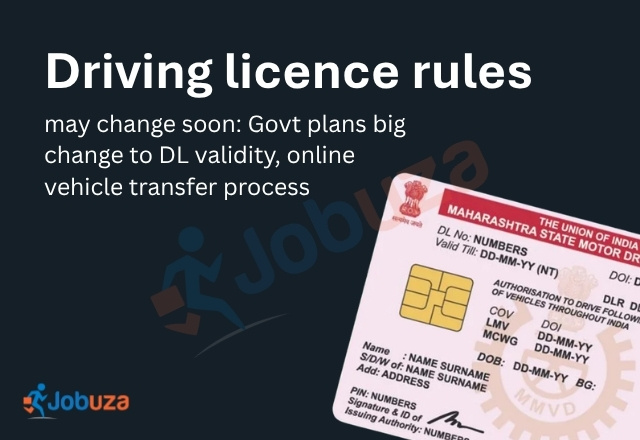
The Central Government is considering major changes in driving licence and vehicle-related services that could benefit millions of vehicle owners across India.
The proposed reforms include extending the validity period of driving licences and making important transport services available completely online. The move aims to reduce dependency on Regional Transport Offices (RTOs) and make vehicle-related processes faster and more convenient for citizens.
According to reports, the Ministry of Road Transport and Highways is reviewing these proposals as part of its efforts to improve digital services and simplify transport-related procedures.
Driving Licence Validity May Be Extended Until Age 50
Currently, a driving licence in India is generally valid for 20 years or until the licence holder reaches the age of 40, depending on applicable rules.
The government is now examining a proposal under which driving licences may remain valid until the holder turns 50 years old.
The proposed change is expected to reduce the frequency of licence renewals and make the process more convenient for vehicle owners.
Officials believe that extending the validity period will help reduce paperwork and save citizens from repeated visits to transport offices.
Vehicle Ownership Transfer May Become Fully Online
Another major proposal under consideration is related to vehicle ownership transfer and permit renewal services.
If approved, vehicle owners may soon be able to complete ownership transfer procedures and other transport-related services entirely through online platforms.
Currently, many vehicle-related processes require multiple visits to RTO offices. The proposed digital system could simplify these procedures and help citizens complete applications from their homes.
Government Focuses on Ease of Living
The proposed changes are part of the government’s broader plan to improve ease of living for citizens through digital transformation.
By shifting more transport services online, authorities aim to reduce delays, improve transparency, and make government services more accessible.
Digital platforms can help citizens complete important tasks faster while also reducing the workload on transport offices.
Online System Will Continue Revenue Collection
Officials have indicated that implementing these changes is unlikely to affect revenue collection for state governments.
Fees related to driving licence issuance, renewal, and other vehicle services can continue to be collected through online payment systems.
This means citizens may get a more convenient service experience without impacting existing revenue mechanisms.
New Digital System May Help Track Traffic Violations
Apart from simplifying services, officials have also highlighted the possibility of introducing better monitoring systems for driving behaviour.
A digital system that tracks traffic violations and assigns negative points to drivers could help identify repeat offenders.
Such a system may allow authorities to take action, including licence suspension or cancellation, against drivers who repeatedly violate traffic rules.
Benefits of Proposed Driving Licence Changes
If implemented, the new rules could provide several benefits to vehicle owners:
- Longer driving licence validity period
- Fewer visits to RTO offices
- Faster online vehicle transfer process
- Reduced paperwork
- Improved transparency in transport services
- Easier access to government facilities
Final Words
The proposed driving licence and vehicle service reforms could bring significant changes to India’s transport system.
Extending licence validity and introducing fully online vehicle transfer services would make daily processes easier for millions of motorists.
However, these changes are still under consideration, and the government is expected to announce further details after completing the review process.
Vehicle owners should wait for official notifications before making any changes based on these proposals.
Frequently Asked Questions
Will driving licence validity increase to 50 years?
The government is considering a proposal to extend driving licence validity until the holder turns 50 years old. The final decision is yet to be announced.
Will vehicle ownership transfer become online?
The government is examining a proposal to make vehicle ownership transfers and permit renewals available through digital platforms.
Will RTO visits be reduced?
If the proposals are approved, many transport-related services may be completed online, reducing the need for physical visits to RTO offices.
Will licence renewal charges be removed?
No. Fees related to licence services are expected to continue through online payment systems.
How will the new system help control traffic violations?
A digital points-based system may help track violations and take action against repeat offenders.