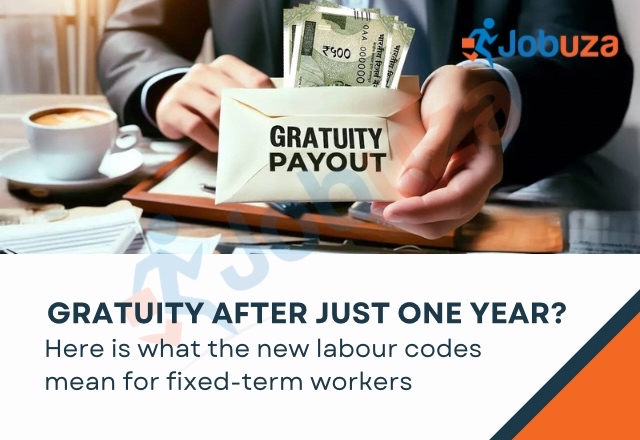
For millions of workers in India’s formal sector, a long-standing concern around gratuity eligibility has finally been addressed. Under the new labour reforms introduced by the Government of India, fixed-term employees can now receive gratuity after completing just one year of continuous service. This marks a major shift from the earlier rule that required at least five years of service.
The new Labour Codes, implemented on 21 November 2025, consolidate 29 existing labour laws into four comprehensive frameworks covering wages, social security, industrial relations, and workplace safety. These changes aim to simplify compliance while improving financial security for workers.
What Has Changed in Gratuity Rules
Earlier, gratuity was governed by the Payment of Gratuity Act, 1972, which mandated a minimum of five years of continuous service to qualify for the benefit. This condition often left out workers on short-term contracts.
Under the new rules, fixed-term employees are now eligible to receive gratuity after just one year of service. The amount will be calculated on a pro rata basis, meaning it will be proportional to the actual duration of employment.
However, the new provision applies only to employees who join on or after 21 November 2025. The rules are not retrospective, so those who were already employed before this date will continue to follow the earlier eligibility criteria.
Who Is Eligible for One-Year Gratuity
The benefit of one-year gratuity is specifically designed for fixed-term employees. These are individuals hired for a defined period under a formal contract, commonly seen in sectors like IT, manufacturing, infrastructure, and retail.
Permanent employees are not covered under this rule and must still complete five years of service to claim gratuity, except in cases of death or disability where different provisions apply.
This targeted approach ensures that workers in contract-based roles, who often switch jobs frequently, are not left without financial protection.
New Wage Definition and Its Impact
Another significant change introduced under the new Labour Codes is the revised definition of wages. According to the new framework, basic wages must account for at least 50 percent of the total salary.
This change prevents companies from reducing statutory payouts by keeping the basic salary low and increasing allowances. As a result, gratuity, provident fund, and bonus calculations will now be based on a higher wage component.
For employees, this means a higher gratuity payout compared to earlier structures where allowances dominated the salary composition.
How Gratuity Is Calculated
The standard formula for calculating gratuity remains unchanged and can be represented as:
Gratuity=15×Last Drawn Wages×Years of Service26\text{Gratuity} = \frac{15 \times \text{Last Drawn Wages} \times \text{Years of Service}}{26}Gratuity=2615×Last Drawn Wages×Years of Service
Here, 26 represents the average number of working days in a month. The maximum gratuity amount is capped at ₹20 lakh for private sector employees.
Why This Change Matters
The introduction of one-year gratuity eligibility for fixed-term workers is a significant step toward improving social security in India’s evolving job market. With more professionals working on contracts or project-based roles, this reform ensures that even short-term employees receive financial benefits.
At the same time, companies may face increased financial liabilities due to higher wage components and broader gratuity coverage. Industry estimates suggest that gratuity obligations could rise substantially for many employers.
Overall, the new labour codes create a more balanced system by extending benefits to a wider section of the workforce while bringing greater transparency to salary structures.