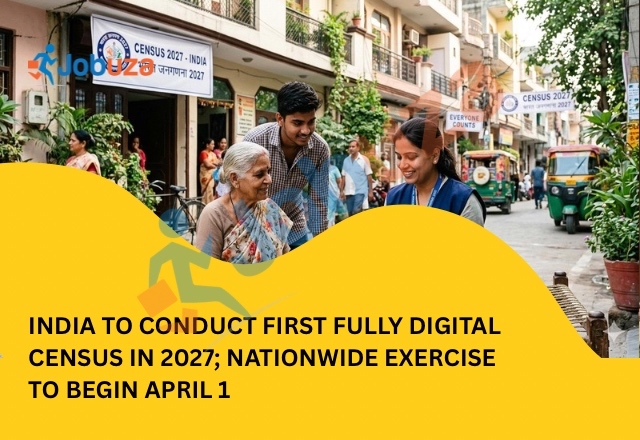
India is set to conduct its first fully digital population census, marking a major shift in how data is collected across the country. According to the Registrar General and Census Commissioner, Mritunjay Kumar Narayan, the first phase of Census 2027 will begin on April 1, 2026.
This will be India’s 16th census since its inception and the eighth after Independence. It is expected to be the largest census exercise in the world, involving more than 3 million enumerators, supervisors, and officials.
First Digital Census with Self-Enumeration Facility
For the first time, the census process will be conducted using digital tools. Enumerators will collect data through mobile applications instead of traditional paper-based methods. In addition, citizens will have the option to complete their details online through a secure self-enumeration portal.
This self-enumeration feature allows households to fill in their information at their convenience before the official visit. Once the data is submitted, a unique Self-Enumeration ID will be generated, which must be shared with the enumerator for verification.
The online portal will be available in multiple languages, making it accessible to a wider population. Authorities have also confirmed that strong security measures have been implemented to protect user data.
How the Self-Enumeration Process Works
The process is simple and designed for ease of use. Citizens can log in to the official portal using their mobile number and basic details. After identifying their location, they can fill in household information and submit it online.
Once completed, the system generates a Self-Enumeration ID. This ID is then provided to the enumerator during their visit, ensuring that the data is verified and included in the final census records.
Two-Phase Census Structure
Census 2027 will be conducted in two major phases.
The first phase, known as the House Listing and Housing Census, will take place between April and September 2026. This phase will collect data related to housing conditions, household assets, and basic amenities.
The second phase, Population Enumeration, is scheduled for February 2027. During this phase, detailed information about individuals will be collected, including demographic, socio-economic, and educational data. Caste-related data will also be gathered in this stage.
Timeline and Coverage Across India
The census will be conducted in a staggered manner across different states and Union Territories. Each region will have a specific schedule, along with a 15-day self-enumeration window before the house-listing phase begins.
Certain regions such as Andaman and Nicobar Islands, Delhi, Goa, Karnataka, Lakshadweep, Mizoram, Odisha, and Sikkim will begin early in April 2026, while other states will follow in subsequent phases.
The reference date for most of the country will be March 1, 2027. However, snow-bound regions like Ladakh and parts of Jammu and Kashmir, Himachal Pradesh, and Uttarakhand will follow an earlier reference date of October 1, 2026.
Scale, Budget and Digital Infrastructure
The government has allocated a budget of over ₹11,700 crore for this massive exercise. The census will cover all 36 states and Union Territories, including thousands of towns and nearly 6.4 lakh villages.
A strong digital ecosystem has been developed to support the process. This includes mobile applications for data collection, online portals for self-enumeration, and real-time monitoring systems to track progress.
Extensive training programs have also been conducted to ensure smooth execution. From national trainers to field-level enumerators, lakhs of personnel are being trained in multiple languages to handle the process efficiently.
Pre-Test and Preparation
Before the official rollout, a nationwide pre-test was conducted in November 2025. This trial covered around 5,000 census blocks and helped validate the digital tools, methodology, and training systems.
The successful pre-test has increased confidence in the system and ensured that the final execution will be more accurate and efficient.
Final Thoughts
Census 2027 represents a major step forward in India’s data collection system. With digital tools, self-enumeration options, and improved infrastructure, the process is expected to be faster, more accurate, and more transparent.
This transformation will not only make participation easier for citizens but also help the government generate reliable data for better policy-making and development planning in the years ahead.