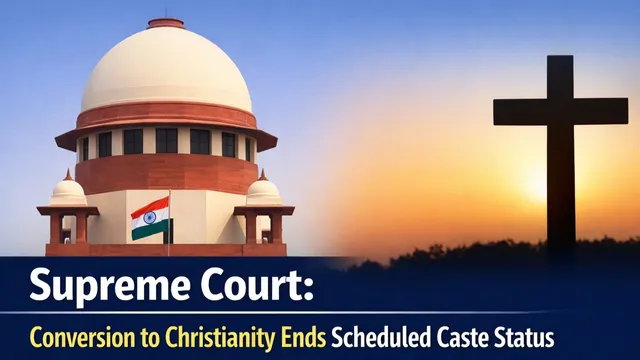
The Supreme Court of India has clarified the legal position on Scheduled Caste status in cases of religious conversion. The ruling reiterates that SC status is governed by the Constitution (Scheduled Castes) Order, 1950, and is linked to specific religions recognized under that order.
SC Status Limited to Certain Religions
According to the 1950 Order, only individuals belonging to Hinduism, Sikhism, and Buddhism are eligible to be notified as members of Scheduled Castes. The court emphasized that this condition flows directly from Clause 3 of the Order. If a person converts to a religion not covered under this framework, their eligibility for SC status does not continue under the law.
Background of the Case
The matter before the court involved an individual from Andhra Pradesh who had converted to Christianity and was working as a pastor. He filed a case under the SC/ST Act alleging assault. The accused challenged the maintainability of the case on the ground that, after conversion, the complainant could not claim protection available to Scheduled Castes under the law.
High Court Findings Upheld
The Andhra Pradesh High Court had earlier set aside the case, noting that once a person converts to Christianity, the original SC status does not remain applicable for the purposes of legal protection under the Act. The High Court also observed that holding an earlier caste certificate is not sufficient if the individual is actively practicing a different religion.
The Supreme Court upheld this view, pointing to the petitioner’s long-standing practice of Christianity as evidence of conversion and confirming that the protections under the SC/ST Act were not applicable in such circumstances.
Legal Implications of the Ruling
The judgment clarifies that eligibility for protections under the Scheduled Castes and Scheduled Tribes (Prevention of Atrocities) Act depends on continued qualification as a member of a Scheduled Caste under the 1950 Order. If that qualification is not met due to conversion, the specific legal safeguards provided by the Act are not available.
What This Means for Reservation Benefits
Reservation in education and government employment tied to Scheduled Caste status is also governed by the same legal framework. As a result, eligibility depends on meeting the criteria laid down in the 1950 Order. Where a person does not fall within that definition, the associated reservation benefits do not apply.
Key Takeaway
The ruling does not introduce a new policy but reinforces the existing constitutional position. SC status and related protections are defined by law and are applicable only within the scope set by the Constitution (Scheduled Castes) Order, 1950.