Let’s be honest, you’ve probably typed some version of “will AI replace jobs in 2026” into Google at least once this year. Maybe after a stressful week, maybe after seeing yet another headline about layoffs and automation. It’s a fair thing to wonder. AI has come a long way from the days of clunky chatbots that could barely answer a simple question. Now it can research a topic, draft an email, schedule your day, handle customer questions, and quietly chew through repetitive workflows in the background. That leap is exactly why the conversation feels so loaded right now.
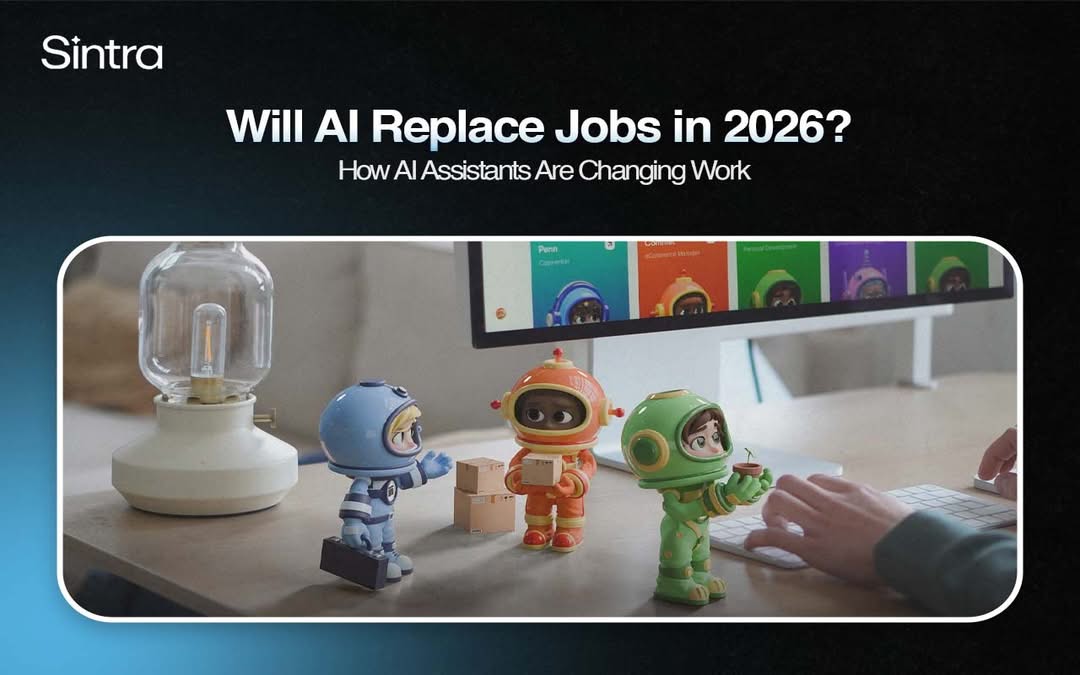
But here’s the thing: spend enough time actually watching how people use these tools, and the story looks less like “robots taking over” and more like job transformation. People aren’t disappearing from the workplace; they’re just handing off the boring stuff. Take Sintra AI as an example: it’s built as an AI assistant meant to help with everyday business tasks, not to sit in someone’s chair and replace them.
What Are AI Employees and AI Assistants?
Strip away the buzzwords, and it’s pretty simple, and honestly, this is where a lot of the will AI replace jobs anxiety actually starts. AI assistants are tools that handle specific tasks with minimal hand-holding: drafting content, summarizing a messy report, answering a routine customer email. AI employees take it a notch further, often running an entire workflow start to finish, like managing a whole support inbox or keeping a content calendar moving on its own.
The real difference comes down to scope: one tool helps a person do their job, and the other can basically run a slice of the business by itself. Sintra fits into that second bucket; it’s positioned as an AI-powered assistant that can juggle research, content creation, data processing, and admin work all at the same time, which is honestly more than most humans want to juggle in one afternoon.
Which Jobs Are Most Likely to Change Because of AI?
Some jobs lean heavily on repetitive, predictable digital work, and those are the ones feeling the most pressure right now:
- Data entry
- Customer support
- Administrative work
- Basic content creation
- Bookkeeping
- Marketing assistance
- Research and reporting
Here’s the nuance nobody puts in the headline, though: these are jobs AI will replace in pieces, not all at once. If you’re wondering whether AI will replace jobs like these completely, the honest answer is rarely. AI replacing jobs, in practice, usually looks more like AI replacing a handful of tasks inside a job. The person is still there; they’re just spending less time copy-pasting data and more time doing the parts of the work that actually need a brain behind them.
How AI Assistants Are Changing Everyday Work
Instead of drowning in the same repetitive tasks every single day, people can now offload a good chunk of that to AI, which is arguably a more useful answer to will AI replace jobs than any prediction: it’s already reshaping how the workday looks. It can organize information, knock out a first draft, summarize a long document nobody wants to read in full, and keep routine workflows moving in the background. That frees people up for the stuff that actually needs a human touch, creativity, strategy, real conversations with real customers.
This is where AI productivity tools are quietly making the biggest dent, and it’s also where an assistant like Sintra AI tends to come in, supporting several workplace tasks at once: inbox triage in the morning, social content planning in the afternoon.
Will AI Replace Human Employees Completely?
This is the question underneath the question: will AI replace human jobs entirely? For most roles, honestly, no. Not completely. Skills like empathy, leadership, judgment, negotiation, and just plain accountability are stubbornly hard to automate. AI can hand you information fast, options, numbers, drafts, but someone still has to decide what to actually do with all of it. That “so what now” part is still very much a human job, and it’s a big reason why AI replacing jobs remains more of an open question than a settled fact.
AI vs Human Employees: Who Does What Better?
AI is better at:
- Repetitive, rules-based tasks
- Processing large amounts of information quickly
- Speed and consistency
- Working continuously, without breaks or downtime
- Automating predictable workflows
- Spotting patterns across large datasets
Humans are better at:
- Creativity and original thinking
- Emotional intelligence and empathy
- Leadership and motivating a team
- Complex judgment and weighing trade-offs
- Building relationships and trust
- Navigating ambiguity and unwritten context
Put those two lists side by side, and you get a much clearer answer to whether AI will replace jobs than any headline gives you; it’s pretty clear why human-AI collaboration, not competition, is shaping up to be the actual workplace model going forward.
What Jobs Are Less Likely to Be Replaced by AI?
Jobs that lean on real human interaction or physical presence tend to hold up better against automation, which is part of why whether AI will replace jobs isn’t a yes-or-no question; it depends heavily on the role. Think healthcare professionals, teachers, skilled trades, managers, therapists and care workers, creative leadership roles, the kind of work where showing up in person, reading a room, or making a judgment call actually matters. These are largely jobs AI cannot replace on its own, even though the people in them are increasingly using AI tools to work more efficiently without being replaced by them.
How Workers Can Prepare for AI in 2026
A few habits go a long way here:
- Get genuinely comfortable using AI tools instead of just poking at them occasionally
- Sharpen your critical-thinking and problem-solving skills
- Keep working on communication and creativity, the things AI still can’t fake convincingly
- Build the habit of checking and verifying AI-generated work instead of taking it at face value
- Focus on skills that complement AI rather than compete head-on with automation
- Learn to actually manage an assistant like Sintra; it’s quickly turning into a real career advantage as more workplaces adopt tools like it.
The Future of Work Will Be Human + AI.
Realistically, the workplace ahead is going to blend AI capability with human expertise, not pick one over the other, which is really the fullest answer to whether AI will replace jobs that anyone can do right now. AI handles the execution and the repetitive grind; humans provide the direction, the judgment, the accountability when something goes wrong. Tools like Sintra are a good early glimpse of what that blend looks like in practice: AI doing the heavy lifting on tasks, humans steering the outcome. That’s the real shape of AI workplace automation, not people getting eliminated, but people spending their time differently.
Bottom line
So, will AI replace jobs? Some tasks and some roles, yes, they’ll get automated. But far more will simply evolve into something a little different. The workers who take the time to actually learn how to collaborate with AI, using tools like Sintra AI alongside their own judgment, not instead of it, are the ones who’ll be best prepared for what’s coming. The future of work isn’t humans versus AI. It’s humans working with AI.