UP Shadi Anudan Yojana 2026: The Uttar Pradesh government runs the Shadi Anudan Yojana to provide financial assistance to eligible low-income families for the marriage of their daughters. The scheme is intended to reduce the financial burden of marriage expenses on economically weaker families.
Eligible families can apply through the official Shadi Anudan portal by providing the required personal, income, caste and bank account details. The scheme covers eligible applicants from categories including SC, ST, OBC, Minority and General BPL families, subject to the applicable eligibility conditions.
Here is everything you need to know about the UP Shadi Anudan Yojana 2026, including its objective, benefits, eligibility criteria, required documents and application process.
UP Shadi Anudan Yojana 2026: Key Details
Particulars
Details
Scheme Name
UP Shadi Anudan Yojana 2026
State
Uttar Pradesh
Launched By
Government of Uttar Pradesh
Launch Year
2017
Benefit
Marriage assistance of ₹20,000 for an eligible daughter
Maximum Assistance
Up to two daughters per family
Beneficiary Categories
SC, ST, OBC, Minority and eligible General/BPL families
Category
Women Welfare
Last Verified
July 30, 2026
Official Website
shadianudan.upsdc.gov.in
What is UP Shadi Anudan Yojana 2026?
The UP Shadi Anudan Yojana is a government welfare scheme designed to provide financial support to economically weaker families for the marriage of their daughters.
Under the scheme, eligible families can receive ₹20,000 as marriage assistance per eligible daughter, subject to the applicable scheme rules. Assistance can be provided for a maximum of two daughters from one family.
The scheme is implemented through different government departments depending on the applicant’s category. The OBC Welfare Department handles eligible OBC applicants, while the Social Welfare Department covers eligible SC and General category applicants. The Scheduled Tribes Development Department deals with applicants belonging to the ST category.
Objective of UP Shadi Anudan Yojana
The main purpose of the scheme is to provide financial assistance to families that may find it difficult to manage marriage-related expenses.
The major objectives include:
Providing financial support to economically weaker families.
Reducing the financial burden associated with a daughter’s marriage.
Supporting eligible families from SC, ST, OBC, Minority and General BPL categories.
Encouraging a positive attitude towards the education and welfare of girls.
Helping prevent social problems such as child marriage.
UP Shadi Anudan Yojana Benefits
The primary benefit available under the scheme is financial assistance for the marriage of an eligible daughter.
An eligible family can receive ₹20,000 per daughter, with assistance available for a maximum of two daughters per family, subject to the applicable eligibility conditions.
The financial assistance is intended to help families meet some of the expenses associated with marriage. Applicants should check the latest official guidelines before applying, as scheme benefits and conditions may be revised by the government.
UP Shadi Anudan Yojana Eligibility Criteria
The eligibility requirements vary depending on the applicant’s category. Candidates should carefully check the applicable conditions before submitting their application.
OBC Category Eligibility
Applicants belonging to the Other Backward Classes must meet the following conditions:
The applicant should be a permanent resident of Uttar Pradesh.
The applicant should belong to the eligible OBC category.
The annual family income should be less than ₹1 lakh.
Financial assistance can be provided for a maximum of two daughters in a family.
SC and General Category Eligibility
Applicants from the Scheduled Caste and eligible General categories must meet these conditions:
The applicant should be a permanent resident of Uttar Pradesh.
The applicant should belong to the eligible SC or General category.
The annual family income should not exceed ₹46,080 in rural areas.
For urban areas, the annual family income should not exceed ₹56,460.
Assistance is available for a maximum of two daughters per family.
ST Category Eligibility
Applicants belonging to the Scheduled Tribes category must fulfil the following requirements:
The applicant should be a permanent resident of Uttar Pradesh.
The applicant should belong to the Scheduled Tribes category.
The annual family income should not exceed ₹46,080 in rural areas.
The annual family income should not exceed ₹56,460 in urban areas.
Assistance can be provided for a maximum of two daughters per family.
Applicants should verify their category-specific eligibility and the latest income limits on the official portal before submitting the form.
Documents Required for UP Shadi Anudan Yojana
Applicants need to keep the required documents ready before starting the online application. These documents are used to verify the applicant’s identity, residence, income, category and other details.
The commonly required documents include:
Aadhaar Card of the bride and family member/applicant
Caste certificate, wherever applicable
Bank passbook
Uttar Pradesh domicile certificate
Income certificate
Marriage certificate
Age proof of the bride and groom
Passport-size photograph
Applicants should ensure that the information provided in the application matches the details mentioned in their documents. Any mismatch or incorrect information may affect the verification process.
How to Apply for UP Shadi Anudan Yojana 2026?
Eligible applicants can submit their application online through the official Shadi Anudan portal. The process involves registration, entering personal and family details, uploading documents and submitting the application.
Follow these steps to apply:
Visit the official UP Shadi Anudan portal.
Select the relevant option for applicant registration or application.
If you are a new applicant, complete registration using your mobile number and verify the OTP.
Log in using the required registration details.
Enter your personal, family, residential and other required information.
Provide the bride’s details and marriage-related information as requested.
Upload the required documents, including Aadhaar, domicile, income and caste certificates, wherever applicable.
Check all the information carefully on the preview page.
Submit the application form after verifying the details.
Save or download the acknowledgement/registration details for future reference.
Existing applicants can also use the portal to access their application and check the status of the verification process.
UP Shadi Anudan Application Status
After submitting the application, applicants should regularly check the status through the official portal. The application goes through the required verification process before the eligible benefit is released.
Applicants should keep their registration or acknowledgement details safely because these may be required to check the application status or resolve any issue related to the application.
UP Shadi Anudan Yojana 2026: Important Points
Before applying, applicants should keep the following points in mind:
Check your eligibility according to your category and residential area.
Make sure your income certificate is valid and contains the correct information.
Ensure that the bride and groom meet the applicable age requirements.
Upload clear and valid documents in the prescribed format.
Check the bank account details carefully before submitting the application.
Keep the acknowledgement or registration number for future reference.
Always verify the latest scheme rules on the official portal before applying.
UP Shadi Anudan Yojana 2026: Conclusion
The UP Shadi Anudan Yojana 2026 provides financial assistance to eligible low-income families for the marriage of their daughters. The scheme is aimed at reducing the financial pressure on families and supporting the welfare of girls.
Eligible applicants should carefully check the category-wise eligibility criteria, income limits and document requirements before applying. Since government schemes can be updated from time to time, applicants should rely on the official Uttar Pradesh government portal for the latest information and application guidelines.
Official Website: shadianudan.upsdc.gov.in
Disclaimer: This article is intended for informational and educational purposes only. Applicants should verify the latest eligibility conditions, benefits and application rules from the official government portal before applying.
Let’s be honest, you’ve probably typed some version of “will AI replace jobs in 2026” into Google at least once this year. Maybe after a stressful week, maybe after seeing yet another headline about layoffs and automation. It’s a fair thing to wonder. AI has come a long way from the days of clunky chatbots that could barely answer a simple question. Now it can research a topic, draft an email, schedule your day, handle customer questions, and quietly chew through repetitive workflows in the background. That leap is exactly why the conversation feels so loaded right now.
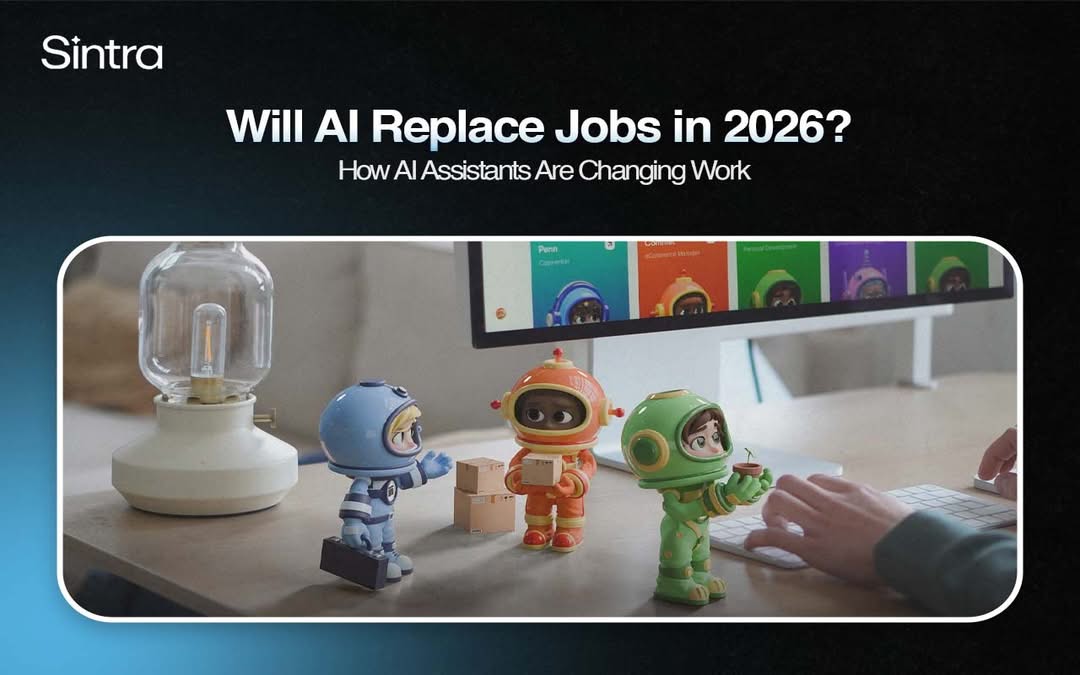
But here’s the thing: spend enough time actually watching how people use these tools, and the story looks less like “robots taking over” and more like job transformation. People aren’t disappearing from the workplace; they’re just handing off the boring stuff. TakeSintra AI as an example: it’s built as an AI assistant meant to help with everyday business tasks, not to sit in someone’s chair and replace them.
What Are AI Employees and AI Assistants?
Strip away the buzzwords, and it’s pretty simple, and honestly, this is where a lot of the will AI replace jobs anxiety actually starts. AI assistants are tools that handle specific tasks with minimal hand-holding: drafting content, summarizing a messy report, answering a routine customer email. AI employees take it a notch further, often running an entire workflow start to finish, like managing a whole support inbox or keeping a content calendar moving on its own.
The real difference comes down to scope: one tool helps a person do their job, and the other can basically run a slice of the business by itself.Sintra fits into that second bucket; it’s positioned as an AI-powered assistant that can juggle research, content creation, data processing, and admin work all at the same time, which is honestly more than most humans want to juggle in one afternoon.
Which Jobs Are Most Likely to Change Because of AI?
Some jobs lean heavily on repetitive, predictable digital work, and those are the ones feeling the most pressure right now:
Data entry
Customer support
Administrative work
Basic content creation
Bookkeeping
Marketing assistance
Research and reporting
Here’s the nuance nobody puts in the headline, though: these are jobs AI will replace in pieces, not all at once. If you’re wondering whether AI will replace jobs like these completely, the honest answer is rarely. AI replacing jobs, in practice, usually looks more like AI replacing a handful of tasks inside a job. The person is still there; they’re just spending less time copy-pasting data and more time doing the parts of the work that actually need a brain behind them.
How AI Assistants Are Changing Everyday Work
Instead of drowning in the same repetitive tasks every single day, people can now offload a good chunk of that to AI, which is arguably a more useful answer to will AI replace jobs than any prediction: it’s already reshaping how the workday looks. It can organize information, knock out a first draft, summarize a long document nobody wants to read in full, and keep routine workflows moving in the background. That frees people up for the stuff that actually needs a human touch, creativity, strategy, real conversations with real customers.
This is where AI productivity tools are quietly making the biggest dent, and it’s also where an assistant likeSintra AI tends to come in, supporting several workplace tasks at once: inbox triage in the morning, social content planning in the afternoon.
Will AI Replace Human Employees Completely?
This is the question underneath the question: will AI replace human jobs entirely? For most roles, honestly, no. Not completely. Skills like empathy, leadership, judgment, negotiation, and just plain accountability are stubbornly hard to automate. AI can hand you information fast, options, numbers, drafts, but someone still has to decide what to actually do with all of it. That “so what now” part is still very much a human job, and it’s a big reason why AI replacing jobs remains more of an open question than a settled fact.
AI vs Human Employees: Who Does What Better?
AI is better at:
Repetitive, rules-based tasks
Processing large amounts of information quickly
Speed and consistency
Working continuously, without breaks or downtime
Automating predictable workflows
Spotting patterns across large datasets
Humans are better at:
Creativity and original thinking
Emotional intelligence and empathy
Leadership and motivating a team
Complex judgment and weighing trade-offs
Building relationships and trust
Navigating ambiguity and unwritten context
Put those two lists side by side, and you get a much clearer answer to whether AI will replace jobs than any headline gives you; it’s pretty clear why human-AI collaboration, not competition, is shaping up to be the actual workplace model going forward.
What Jobs Are Less Likely to Be Replaced by AI?
Jobs that lean on real human interaction or physical presence tend to hold up better against automation, which is part of why whether AI will replace jobs isn’t a yes-or-no question; it depends heavily on the role. Think healthcare professionals, teachers, skilled trades, managers, therapists and care workers, creative leadership roles, the kind of work where showing up in person, reading a room, or making a judgment call actually matters. These are largely jobs AI cannot replace on its own, even though the people in them are increasingly using AI tools to work more efficiently without being replaced by them.
How Workers Can Prepare for AI in 2026
A few habits go a long way here:
Get genuinely comfortable using AI tools instead of just poking at them occasionally
Sharpen your critical-thinking and problem-solving skills
Keep working on communication and creativity, the things AI still can’t fake convincingly
Build the habit of checking and verifying AI-generated work instead of taking it at face value
Focus on skills that complement AI rather than compete head-on with automation
Learn to actually manage an assistant likeSintra; it’s quickly turning into a real career advantage as more workplaces adopt tools like it.
The Future of Work Will Be Human + AI.
Realistically, the workplace ahead is going to blend AI capability with human expertise, not pick one over the other, which is really the fullest answer to whether AI will replace jobs that anyone can do right now. AI handles the execution and the repetitive grind; humans provide the direction, the judgment, the accountability when something goes wrong. Tools likeSintra are a good early glimpse of what that blend looks like in practice: AI doing the heavy lifting on tasks, humans steering the outcome. That’s the real shape of AI workplace automation, not people getting eliminated, but people spending their time differently.
Bottom line
So, will AI replace jobs? Some tasks and some roles, yes, they’ll get automated. But far more will simply evolve into something a little different. The workers who take the time to actually learn how to collaborate with AI, using tools likeSintra AI alongside their own judgment, not instead of it, are the ones who’ll be best prepared for what’s coming. The future of work isn’t humans versus AI. It’s humans working with AI.
The 8th Pay Commission has become a major point of interest for central government employees and pensioners across India. Discussions around the proposed salary revision, pension increase, fitment factor and new pay matrix are continuing as the commission moves ahead with its consultation process.
Although the final recommendations are yet to be submitted, employee organisations and other stakeholders have already presented their demands. The key questions include the expected fitment factor, revised minimum salary, pension increase and the possible implementation timeline.
Here are the five major updates employees and pensioners should know about the 8th Pay Commission.
1. 8th Pay Commission Work Progresses Through Consultations
The government has provided the 8th Pay Commission with an 18-month timeframe to complete its work and submit its recommendations.
The commission has already completed its initial groundwork, including gathering relevant information and receiving representations from ministries, departments and employee organisations. It is now conducting consultations with various stakeholders.
Inputs from government departments, state representatives, employees and other groups will help the commission assess factors such as inflation, cost of living, working conditions and existing pay structures before preparing its recommendations.
2. Salary Revision Could Be Effective From January 1, 2026
The effective date of January 1, 2026 is one of the most important aspects of the 8th Pay Commission.
If the revised pay structure is implemented at a later date, employees and pensioners could become eligible for arrears from the effective date, subject to the government’s final decision and implementation rules.
This could result in arrears for the period between January 2026 and the actual date on which the revised salary and pension structure is implemented.
3. Fitment Factor Could Determine the Salary Increase
The fitment factor is a key component of the proposed salary revision. It is used to calculate revised basic pay based on the existing basic salary.
Under the 7th Pay Commission, the fitment factor was fixed at 2.57. For the 8th Pay Commission, employee organisations have demanded higher fitment factors, with some demands ranging from 2.86 to 3.68.
However, these figures are demands and should not be considered confirmed recommendations. Various estimates have suggested a possible fitment factor in the range of 2.25 to 2.57, but the final figure will depend on the commission’s recommendations and the government’s decision.
4. How Much Could Minimum Salary and Pension Increase?
The current minimum basic salary under the 7th Pay Commission is ₹18,000 per month. Depending on the fitment factor eventually approved, the revised minimum basic salary could increase substantially.
For example, an indicative calculation would look like this:
Fitment Factor
Estimated Minimum Basic Pay
Current
₹18,000
2.25
₹40,500
2.40
₹43,200
2.57
₹46,260
2.86*
₹51,480
3.68*
₹66,240
Similarly, the current minimum pension of ₹9,000 per month could potentially increase depending on the final fitment factor and pension revision formula.
These calculations are only estimates and do not represent an officially approved salary or pension structure.
5. 8th Pay Commission Consultations Continue Across India
The commission is consulting various employee groups and other stakeholders to understand their expectations and concerns.
Representations have been received from groups associated with:
Defence services
Railways
Postal departments
Civil services
Pensioners
Employee organisations
The consultation process is expected to provide the commission with information about inflation, living expenses, working conditions and other factors affecting government employees and pensioners.
8th Pay Commission Salary Hike: What Different Fitment Factors Mean
The possible impact of different fitment factors can be understood by applying them to the current minimum basic pay of ₹18,000.
Scenario
Fitment Factor
Indicative Basic Salary
Existing Basic Pay
—
₹18,000
Estimated Scenario
2.25
₹40,500
Estimated Scenario
2.40
₹43,200
7th CPC Fitment Factor
2.57
₹46,260
Employee Demand*
2.86
₹51,480
Employee Demand*
3.68
₹66,240
Note: The figures for 2.86 and 3.68 are based on employee demands and are not confirmed government proposals.
When Will the 8th Pay Commission Salary Increase Be Implemented?
The exact implementation date of the revised pay structure has not been finalised. The commission must first complete its consultations and submit its recommendations.
After the report is submitted, the government will examine the recommendations before taking a final decision on the revised pay matrix, salary structure, pension and allowances.
Therefore, employees should not consider any projected salary figure as final until an official decision is announced.
What Should Central Government Employees Expect Next?
The next major developments are expected to include the completion of stakeholder consultations, preparation of the commission’s recommendations and submission of its final report.
The major points employees and pensioners will be watching include:
Final fitment factor
Revised pay matrix
Minimum basic salary
Minimum pension
Allowance revisions
Implementation date
Arrears from January 1, 2026
Until the government officially approves the recommendations, all salary and pension projections should be treated as indicative estimates.
8th Pay Commission: Key Takeaway
The 8th Pay Commission is currently progressing through its consultation and review process. The proposed fitment factor, revised pay matrix and pension formula will ultimately determine the actual increase in salary and pension.
While employees are expecting a significant revision and possible arrears from January 1, 2026, the final benefits can only be confirmed after the commission submits its recommendations and the government takes a decision.
RVUNL Recruitment 2026: The Rajasthan Rajya Vidyut Utpadan Nigam Limited (RVUNL) has announced recruitment for 2,005 posts including Junior Engineer-I, Junior Accountant and Junior Assistant/Commercial Assistant-II. Candidates who meet the prescribed eligibility criteria can submit their applications online through the official website.
The application process started on August 5, 2026, and the last date to apply is August 25, 2026. Candidates who are yet to apply should complete the registration and application process before the deadline. No extension of the application deadline has been announced so far.
RVUNL Recruitment 2026: Key Details
Candidates can check the important details of the recruitment drive below:
Computer-Based Test (CBT) and Document Verification
Mode of Application
Online
Official Website
energy.rajasthan.gov.in
RVUNL Vacancy 2026: Post-Wise Details
A total of 2,005 vacancies have been announced under the recruitment drive. The vacancies are distributed among the posts as follows:
Post Name
Vacancies
Junior Engineer-I (JEN)
869
Junior Accountant
371
Junior Assistant/Commercial Assistant-II
765
Total
2,005
RVUNL Recruitment 2026 Apply Online
The online application process for RVUNL Recruitment 2026 commenced on August 5, 2026. Eligible candidates can submit their applications online through the designated application portal.
Candidates should ensure that all the information entered in the application form is correct and that the required documents are uploaded in the prescribed format. The application must be submitted before the deadline.
Candidates can complete the RVUNL application process by following the steps below:
Visit the official RVUNL website at energy.rajasthan.gov.in.
Click on the link for “Apply Online for State Power Companies Recruitment 2026.”
Register as a new candidate using a valid mobile number and email ID.
Log in using the registration credentials.
Select the post for which you wish to apply.
Enter your personal, educational and communication details.
Upload the required photograph, signature and category certificates, wherever applicable.
Pay the prescribed application fee through the available online payment method.
Carefully verify all the details entered in the application form.
Submit the application form and download a copy for future reference.
RVUNL Recruitment 2026 Application Fee
Candidates are required to pay the prescribed application fee while submitting the online application. The category-wise fee is given below:
Category
Application Fee
General/UR
Rs 1,000
OBC/SC/ST/PwD
Rs 500
Candidates should check the official notification for complete details regarding the application fee and any applicable additional charges.
RVUNL Recruitment 2026 Eligibility Criteria
Before applying, candidates must ensure that they fulfil the required age and educational qualifications for their respective posts.
RVUNL Recruitment 2026 Age Limit
The prescribed age limit for the advertised posts is as follows:
The minimum age of candidates should be 18 years.
The maximum age limit is 28 years for Junior Engineer, Junior Accountant and Junior Assistant/Commercial Assistant-II posts.
Relaxation in the upper age limit will be available to eligible candidates belonging to reserved categories as per applicable government rules.
RVUNL Recruitment 2026 Educational Qualification
The educational qualification varies according to the post:
Junior Engineer-I: Candidates should possess the required engineering qualification/diploma in the relevant discipline, such as Electrical, Mechanical or Civil, from a recognised institution/university.
Junior Accountant: Candidates should have a graduation qualification with the required Commerce background or equivalent qualification, along with basic computer knowledge.
Junior Assistant/Commercial Assistant-II: Candidates should be graduates from a recognised university and possess the required computer typing knowledge in Hindi and English.
Candidates should carefully read the official recruitment notification to verify the exact discipline-wise qualification and other eligibility requirements before applying.
RVUNL Recruitment 2026 Selection Process
The selection process for the advertised posts will include a Computer-Based Test (CBT) followed by Document Verification. Candidates who qualify at the required stages will be considered for appointment as per the recruitment rules.
RVUNL Recruitment 2026: Important Points
Candidates should keep the following points in mind before submitting the application:
The recruitment drive is being conducted for 2,005 vacancies.
The online application process started on August 5, 2026.
The last date to submit the application is August 25, 2026.
Candidates must fulfil the post-wise educational and age requirements.
The selection process includes CBT and Document Verification.
Applicants should retain a copy of the submitted application form and fee payment receipt for future reference.
Candidates who are eligible and have not yet submitted their application should complete the process before the deadline to avoid missing the recruitment opportunity.
UP Cooperative Bank Exam Date 2026: The Uttar Pradesh Cooperative Institutional Service Board (UPCISB) has announced the exam dates for various technical and non-technical posts under the Combined Co-operative Banking & Technical Services Exam 2026. As per the official notice, the online examination will be conducted on September 7 and 8, 2026, in multiple shifts.
The recruitment drive is being conducted for 116 vacancies for posts including Manager, Junior Manager, Assistant/Cashier (Banking Assistant/Clerical Staff), Assistant/Typist and Assistant Engineer (Civil). Candidates appearing for the examination should check the complete exam schedule and shift timings given below.
UPCISB UP Cooperative Bank Exam Date 2026
The UP Cooperative Institutional Service Board has released a public notice regarding the examination schedule for the 2026 recruitment. According to the notice, the online examination will be held on September 7 and September 8, 2026.
The examination will be conducted in online mode, with different posts scheduled across different shifts. Candidates should carefully check their respective exam date and shift before appearing for the examination.
UP Cooperative Bank Exam Schedule 2026
The Combined Co-operative Banking & Technical Services Exam 2026 will be conducted over two days. The examination will have three shifts on September 7 and two shifts on September 8.
Uttar Pradesh State Construction Cooperative Union Limited
September 8, 2026
2nd Shift: 12:35 PM to 02:35 PM
Assistant Engineer (Civil)
District Cooperative Bank Limited
UP Cooperative Bank Exam 2026: Is There a Prelims Exam?
Candidates should note that the recruitment process for these posts will consist of only one stage. As mentioned in the examination notice, there will be no Preliminary examination for these posts.
The Mains examination will be conducted as the single-stage online examination, and the final merit list will be prepared on the basis of candidates’ performance in the recruitment examination.
UP Cooperative Bank Vacancy 2026
Through this recruitment drive, UPCISB will fill a total of 116 vacancies across different technical and non-technical posts. The post-wise vacancy distribution is given below:
What After the UP Cooperative Bank Exam Date Announcement?
Candidates should start preparing according to their respective exam dates and shift timings. Since the recruitment involves a single-stage examination, performance in the online exam will be important for determining the final merit.
Candidates should also keep their admit card, valid photo ID and other required documents ready before the examination. The exam centre details and reporting time should be checked carefully once the admit card is released.
UP Cooperative Bank Exam Date 2026: Key Details
Conducting Body: Uttar Pradesh Cooperative Institutional Service Board (UPCISB)
If you’ve been scrolling through job boards lately, you’ve probably noticed something odd. Titles that barely existed a couple of years ago are suddenly everywhere. That’s exactly why so many people are searching for AI jobs in 2026 right now, and the market genuinely doesn’t look like it’s slowing down.
AI isn’t just quietly handling boring background tasks anymore. It’s spinning up brand-new roles that didn’t exist before, while reshaping careers we already thought we understood. And here’s the part that tends to surprise people: companies aren’t only hunting for coders. They want people who get artificial intelligence jobs from a bunch of angles , building it, managing it, questioning it, applying it responsibly. Tools likeEmergent are even making it possible for total beginners to build AI-powered products without years of technical training.
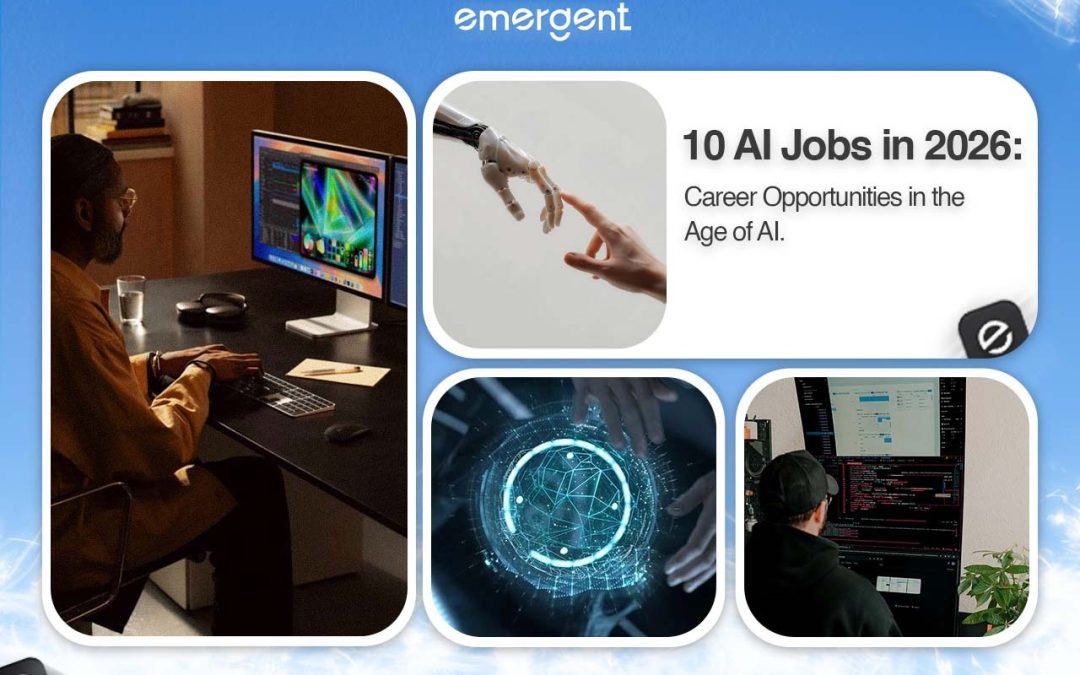
So let’s get into it — here are 10 AI jobs in 2026 worth knowing about, whether you’re a student, a career-switcher, or just curious where all this is headed.
Why AI Jobs Are Growing in 2026
Businesses in pretty much every industry- retail, healthcare, finance, education — are adopting AI faster than most people predicted. That’s really the whole story behind why AI jobs in 2026 keep multiplying instead of fading out. Companies need people who can build these systems, keep them running day to day, and work alongside them without losing the human judgment AI still hasn’t managed to replicate.
And it’s not like AI skills are staying locked inside tech departments either. Marketing teams, HR, even legal departments are starting to look for people with some level of AI fluency. That’s a big part of why AI careers are opening up to folks who never once pictured themselves working in “tech.”
10 AI Jobs in 2026
AI is creating new career opportunities across industries, from engineering and automation to governance and beyond.
AI Engineer: Builds and maintains the infrastructure that supports AI applications. Strong programmer; good understanding of machine learning frameworks; able to implement research into a working tool. One of the most in-demand AI jobs in 2026 as companies race to roll out AI features before their competitors.
Machine Learning Engineer: Solid experience in math, coding, and data pipelines with a focus on building, training, and improving models over time. It is one of the more stable AI positions to have, given the need for smarter models isn’t going anywhere.
Product Manager: AI The translator between the engineers and the business side, understanding what is technically possible but also what customers really want. Technical know-how is just as important as communication and product strategy.”
Generative AI Specialist: As generative tools improve, companies need people who know how to put them to good use — content, design, product work. One of the newer AI job opportunities, growing fast as generative AI works its way into nearly every department.
Prompt Engineer: Designs and fine-tunes prompts to get more reliable results out of AI models. Sounds simple, but doing it well is a genuine skill, used across customer service, content creation, and coding help.
Data Scientist: Takes messy data, builds models around it, and turns raw numbers into insights people can act on. Strong statistics, programming, and machine learning knowledge keep this one of the most reliable AI jobs in 2026 for data lovers.
AI Research Scientist: The deep, research-heavy end of the field. Usually needs an advanced degree and serious technical expertise; a smaller but genuinely respected corner of AI careers, pushing the boundaries of what AI can do.
AI Automation Specialist: Helps businesses automate repetitive workflows at scale. Platforms likeEmergent can support these projects, helping teams build and deploy AI-powered automation without reinventing the wheel every time.
AI Ethics and Governance Specialist: Keeps a close eye on privacy, fairness, and transparency as AI systems get more powerful. This role has quietly become essential as companies work to manage the risks that come with deploying AI at scale.
AI-Powered Software Developer: AI coding tools are changing how software gets built, and developers who pair solid programming fundamentals with these tools have a real edge. Platforms likeEmergent even let people build working applications using plain, natural-language instructions, lowering the barrier to entry.
Skills You Need for an AI Career in 2026
Honestly, no matter which of these AI jobs in 2026 catches your eye, a few skills keep coming up over and over again once you start digging into what these roles actually want:
Solid AI and machine learning fundamentals
Programming and data skills
Comfort with generative AI tools and prompt writing
Genuine problem-solving and analytical thinking
Good communication and collaboration
A willingness to keep learning, because let’s be real, the AI skills that matter today might look nothing like what matters next year
How to Start an AI Career in 2026
Honestly, it’s a lot less complicated than people make it sound:
Pick one path that actually fits where you’re coming from — trying to learn everything at once is a fast way to burn out.
Build the core skills through courses, tutorials, whatever works for you, but hands-on practice is really where it clicks.
Put together a small portfolio of real projects; even a couple of scrappy ones beat a resume full of buzzwords.
Mess around with platforms likeEmergent and actually build something that works.
Go ahead and apply for internships, entry-level roles, freelance gigs, junior positions — anything, really. You just need to start somewhere.
Keep your resume and LinkedIn honest and up to date with what you’re actually doing, not a wishlist of skills you’d like to have someday.
Are AI Jobs Good for Beginners?
Yes, genuinely, and this tends to catch people off guard. Not every one of these AI jobs in 2026 requires an advanced degree or years of coding under your belt. There are real entry points in AI support, automation, data work, prompt writing, and AI-powered development. Out of all the AI job opportunities floating around, what actually matters most is having real, demonstrable projects rather than a folder of certificates nobody’s going to ask to see.
Future of AI Jobs
The future of AI jobs probably won’t be all pure technical roles. A lot of upcoming positions will blend AI expertise with a completely different field: healthcare, finance, marketing, education, design- take your pick. Instead of mastering one tool forever, the real advantage is staying adaptable, because the ground under this field keeps shifting.
Final thoughts
From engineering and research to ethics and product management, AI jobs in 2026 cover a lot more ground than most people realize. Whether you’re technical or not, there’s real opportunity here, and the sooner you start building practical AI skills, the better positioned you’ll be down the line. If you’re looking for a low-pressure way to start experimenting as you begin building your first AI-powered projects, it’s worth checking out platforms like Emergent.