by Jobuza Team | Aug 26, 2026 | BLOG, Trending News
When it comes to saving money for long-term financial goals, many people prefer investment options that offer stability along with reasonable returns. Post Office savings schemes are among the options that continue to attract conservative investors because they are backed by the government and provide relatively predictable returns.
These schemes can be useful for different financial needs, whether you are planning for your child’s education, creating a retirement income source or simply looking for a fixed-return investment. Some schemes also provide tax benefits, which can make them useful as part of a long-term financial plan.
Here are four popular government-backed savings schemes that investors can consider based on their financial goals.
Sukanya Samriddhi Yojana: Build a Corpus for Your Daughter’s Future
The Sukanya Samriddhi Yojana (SSY) is designed specifically to help parents and guardians save for the future financial needs of a girl child. It can be used to build a long-term corpus for expenses such as higher education and other eligible needs.
The scheme encourages regular savings over a long period. Because the investment is intended for a specific long-term goal, it can help parents develop a disciplined approach towards saving for their daughter’s future.
The interest rate on small savings schemes is notified by the government from time to time, so investors should check the latest applicable rate before opening an account or making a new deposit.
Senior Citizen Savings Scheme: Regular Income After Retirement
The Senior Citizen Savings Scheme (SCSS) is intended primarily for eligible senior citizens who want a government-backed investment option with periodic interest payments.
The scheme can provide a regular income because interest is paid at specified intervals. This can be useful for retirees who want to supplement their pension or meet routine household expenses.
Eligible investors should check the current age criteria, deposit limits, interest rate and tax rules before investing. The interest rate is revised by the government periodically, so the applicable rate can change over time.
National Savings Certificate: Fixed-Term Investment With Tax Benefits
The National Savings Certificate (NSC) is another popular Post Office investment option for people who prefer fixed returns and a defined investment period.
NSC has a five-year maturity period, making it suitable for investors with a medium- to long-term savings goal. Since the returns are not directly linked to stock market movements, investors do not have to deal with the day-to-day volatility associated with market-linked investments.
Investment in NSC can also qualify for tax benefits under the applicable provisions of the Income Tax Act, subject to the prevailing rules and limits. Investors should check their individual tax situation before relying on these benefits.
Kisan Vikas Patra: Let Your Investment Grow Over Time
Kisan Vikas Patra (KVP) is designed for investors who want a simple fixed-income savings option. It allows investors to make a lump-sum investment and hold it for the prescribed maturity period.
At the applicable rate, the investment grows over the specified period and reaches the maturity value determined under the scheme rules. The interest rate and maturity period can be revised by the government, so the latest terms should always be checked before investing.
One of the attractions of KVP is its straightforward structure. Investors do not need to actively manage the investment based on market movements.
Why Are Post Office Savings Schemes Popular?
Post Office savings schemes are popular among investors who give greater importance to capital safety and predictable returns than high-risk, market-linked gains.
Another advantage is accessibility. These schemes are available through the Post Office network, making them accessible to people in different parts of the country.
However, investors should not choose a scheme only because it offers a particular interest rate. The investment period, withdrawal rules, taxation, deposit limits and financial goal should also be considered before making a decision.
Which Government Savings Scheme Should You Choose?
The right scheme depends on your financial objective and investment horizon.
If you are saving specifically for the future needs of a girl child, Sukanya Samriddhi Yojana may be relevant if you meet its eligibility conditions. Senior citizens looking for periodic income can consider the Senior Citizen Savings Scheme.
For investors looking for a five-year fixed-term option with applicable tax benefits, NSC can be considered. Those looking for a simple lump-sum savings product may find Kisan Vikas Patra worth evaluating.
Interest rates, tax rules and scheme conditions can change, so always verify the latest details before investing.
Things to Check Before Investing in Post Office Schemes
Before putting your money into any government-backed savings scheme, check the current interest rate and maturity period. You should also understand whether interest is paid periodically or added to the investment until maturity.
Tax treatment is another important factor. A scheme offering a tax benefit does not necessarily mean that all returns will be completely tax-free.
Investors should also consider liquidity. Some schemes have restrictions or conditions on premature withdrawal, which can matter if you may need access to your money before maturity.
FAQs About Government-Backed Savings Schemes
Which government savings schemes are available through the Post Office?
Several small savings schemes are available through Post Offices, including Sukanya Samriddhi Yojana, Senior Citizen Savings Scheme, National Savings Certificate and Kisan Vikas Patra.
Are Post Office savings schemes safe?
These schemes are government-backed small savings products, but investors should still understand the individual scheme’s rules, interest rates, maturity period and withdrawal conditions.
Can interest rates change?
Yes. The government reviews and notifies interest rates for small savings schemes periodically. Therefore, investors should check the latest rate before investing.
Which scheme is suitable for a girl child’s future?
Sukanya Samriddhi Yojana is specifically designed for eligible girl children and is intended to support long-term financial planning for their future.
Is NSC a tax-saving investment?
Investment in NSC can qualify for deductions under applicable tax provisions, subject to the prevailing rules and limits. Investors should check the latest Income Tax rules for their financial year.
Can senior citizens get regular income from Post Office schemes?
The Senior Citizen Savings Scheme provides interest payments at specified intervals, making it a potential option for eligible senior citizens seeking periodic income.

by Jobuza Team | Aug 26, 2026 | BLOG, Latest Jobs
The Punjab Subordinate Services Selection Board (PSSSB) is conducting the Craft Instructor Recruitment 2026 for candidates looking for a government job in Punjab. The recruitment drive aims to fill 681 Craft Instructor vacancies under the Department of Technical Education & Industrial Training, Punjab.
The online application process is scheduled to close on August 25, 2026. Candidates who meet the required educational and technical qualifications can submit their applications through the official PSSSB recruitment portal.
The recruitment notification was released on July 8, 2026, while the online application process started on July 10. The original application deadline was July 30, but it was later extended to August 25, giving eligible candidates additional time to complete their applications.
PSSSB Craft Instructor Recruitment 2026 Apply Online
Eligible candidates can apply online for the PSSSB Craft Instructor Recruitment 2026 through the official recruitment portal. Applicants need to complete the registration process, enter their personal and educational information, upload the required documents and pay the applicable application fee.
Candidates should carefully check all the information entered in the application form before submitting it. Once submitted, applicants should also keep a copy of the completed application form and payment receipt for future reference.
The PSSSB Craft Instructor Recruitment 2026 application link and official notification PDF are available on the official PSSSB website.
| Particular |
Details |
| Recruitment Authority |
Punjab Subordinate Services Selection Board (PSSSB) |
| Advertisement Number |
Advt. No. 03/2026 |
| Post Name |
Craft Instructor |
| Total Vacancies |
681 |
| Department |
Technical Education & Industrial Training, Punjab |
| Application Mode |
Online |
| Notification Date |
July 8, 2026 |
| Application Start Date |
July 10, 2026 |
| Extended Last Date |
August 25, 2026 |
| Selection Process |
Written Examination and Document Verification |
| Official Website |
sssb.punjab.gov.in |
PSSSB Craft Instructor Vacancy 2026
A total of 681 Craft Instructor posts will be filled through this recruitment drive. The vacancies are available across different trades under the Department of Technical Education & Industrial Training, Punjab.
Since the educational and technical requirements can differ according to the particular trade, candidates should check the official notification carefully before selecting a post.
The recruitment provides an opportunity for candidates with relevant technical and vocational qualifications to join the Punjab government department as Craft Instructors.
PSSSB Craft Instructor Recruitment 2026 Eligibility Criteria
Candidates must fulfil the prescribed eligibility requirements before submitting their applications. The educational and technical qualification requirements depend on the particular Craft Instructor trade.
Applicants are generally required to possess the relevant technical or vocational qualification in the concerned trade from a recognized institute or board.
The minimum age to apply is 18 years. The maximum age limit may vary depending on the post or trade. Candidates belonging to eligible reserved categories will receive relaxation in the upper age limit according to the applicable Punjab government rules.
Because the qualification requirements can vary from one trade to another, candidates should refer to the official notification for the exact educational qualification, technical qualification and age criteria applicable to their chosen post.
PSSSB Craft Instructor Selection Process 2026
Candidates applying for the Craft Instructor posts will be selected through the recruitment process prescribed by PSSSB.
The selection process includes a written examination followed by document verification. Candidates who qualify in the examination will be required to produce their original documents and certificates during the verification stage.
Applicants should keep their educational certificates, technical qualification documents, identity proof and other relevant documents ready for the later stages of the recruitment process.
How to Apply for PSSSB Craft Instructor Recruitment 2026
Candidates can complete the PSSSB Craft Instructor application process online by following these steps:
- Visit the official PSSSB recruitment website.
- Open the Recruitment or Advertisements section.
- Find the notification for Craft Instructor Recruitment 2026, Advt. No. 03/2026.
- Complete the registration process using the required details.
- Log in using the credentials generated during registration.
- Fill in the application form with personal, educational and other required information.
- Upload the photograph, signature and other documents in the prescribed format.
- Pay the applicable application fee through the available online payment method.
- Carefully check all the information entered in the form.
- Submit the application before the deadline.
- Download and save a copy of the completed application form and payment receipt.
PSSSB Craft Instructor Application 2026: Important Documents
Candidates should keep the required documents ready while filling out the online application form. These may include educational certificates, technical qualification certificates, photograph, signature, identity proof and category certificates, wherever applicable.
Applicants should upload each document according to the size and format specified by PSSSB. Providing incorrect or incomplete information can lead to problems during the recruitment process.
PSSSB Craft Instructor Recruitment 2026: Important Dates
The official notification for PSSSB Craft Instructor Recruitment 2026 was released on July 8, 2026. The online application process started on July 10, 2026.
The initial deadline for submitting applications was July 30, 2026. PSSSB later extended the deadline, and eligible candidates can now apply until August 25, 2026.
Candidates should complete their applications before the extended deadline rather than waiting until the last day.
PSSSB Craft Instructor Recruitment 2026: Key Points
The PSSSB recruitment drive is being conducted for 681 Craft Instructor vacancies in Punjab. Candidates with the required trade-specific technical or vocational qualifications can apply, subject to fulfilling the other eligibility conditions.
The selection process will include a written examination and document verification. Since the application deadline is August 25, 2026, eligible candidates should complete the online application process as soon as possible.
For the latest information regarding eligibility, trade-wise qualifications, vacancies, examination details and other recruitment conditions, candidates should refer to the official PSSSB notification.
FAQs About PSSSB Craft Instructor Recruitment 2026
How many vacancies are available in PSSSB Craft Instructor Recruitment 2026?
A total of 681 Craft Instructor vacancies have been announced.
What is the last date to apply for PSSSB Craft Instructor Recruitment 2026?
The extended last date to submit the online application is August 25, 2026.
What is the minimum age for PSSSB Craft Instructor Recruitment?
The minimum age required to apply is 18 years. The maximum age limit depends on the applicable post or trade and category.
What is the selection process for PSSSB Craft Instructor posts?
Candidates will be selected through a written examination and document verification.
What qualification is required for the Craft Instructor post?
The required educational and technical qualification varies according to the trade. Candidates should check the official notification for the exact qualification applicable to their selected post.
Where can I apply for PSSSB Craft Instructor Recruitment 2026?
Candidates can submit their applications through the official PSSSB recruitment portal at sssb.punjab.gov.in.
by Jobuza Team | Aug 25, 2026 | BLOG, Latest Jobs
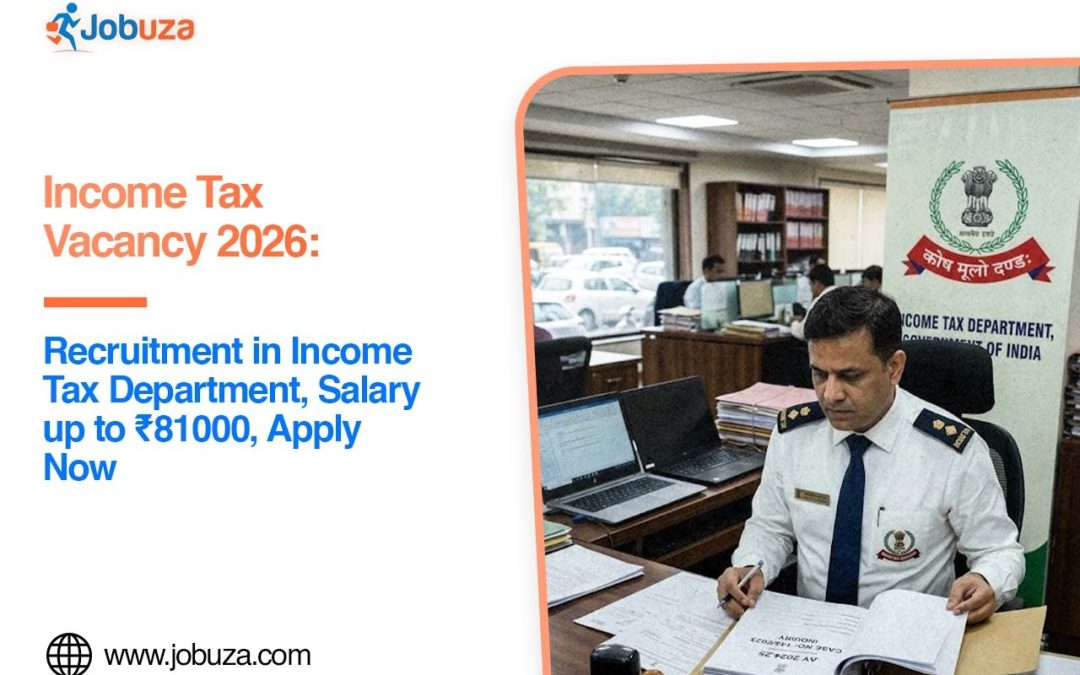
Pune Income Tax Department Recruitment 2026 has brought a good opportunity for sportspersons who want to build a career in government service. The Office of the Principal Chief Commissioner of Income Tax, Pune, has invited applications from meritorious sportspersons for Stenographer Grade-II, Tax Assistant and Multi-Tasking Staff (MTS) posts.
A total of 85 vacancies have been announced under the sports quota. Eligible candidates who have represented their state, university, country or participated in recognized national-level competitions can apply for the recruitment. The application process is currently underway, and the last date to submit the application form is 15 September 2026.
The recruitment covers 17 sports disciplines, including athletics, badminton, basketball, cricket, hockey, kabaddi, swimming, volleyball, tennis, yoga and para-sports. Among the available positions, athletics has the highest number of vacancies.
Pune Income Tax Department Recruitment 2026: Overview
The recruitment is being conducted specifically for meritorious sportspersons. Candidates will be considered based on their sports achievements along with the eligibility requirements prescribed for the respective post.
| Particular |
Details |
| Recruiting Department |
Income Tax Department, Pune |
| Recruitment Type |
Sports Quota Recruitment |
| Total Vacancies |
85 |
| Posts |
Stenographer Grade-II, Tax Assistant, MTS |
| Sports Covered |
17 Sports |
| Application Mode |
Online |
| Last Date |
15 September 2026 |
| Application Fee |
₹200 |
Income Tax Department Vacancy 2026
The Income Tax Department has announced a total of 85 vacancies for different posts under the sports quota. The post-wise vacancy details are given below.
| Post |
Vacancies |
Pay Level |
| Stenographer Grade-II |
6 |
Level-4, ₹25,500–₹81,100 |
| Tax Assistant |
40 |
Level-4, ₹25,500–₹81,100 |
| Multi-Tasking Staff (MTS) |
39 |
Level-1, ₹18,800–₹56,900 |
| Total |
85 |
|
The highest number of vacancies are available for the Tax Assistant post, with 40 positions, followed by 39 vacancies for MTS and 6 vacancies for Stenographer Grade-II.
Income Tax Recruitment 2026 Salary
Selected candidates will receive a salary according to the pay level assigned to their post. The salary for Stenographer Grade-II and Tax Assistant is in Level-4, with a pay range of ₹25,500 to ₹81,100.
For the Multi-Tasking Staff (MTS) post, the pay scale is Level-1, ranging from ₹18,800 to ₹56,900.
Apart from the basic pay, eligible government employees may also receive allowances and other benefits as applicable under the rules.
Eligibility Criteria for Income Tax Recruitment 2026
Candidates must meet the required educational qualification, age limit and sports eligibility criteria to apply for the recruitment.
Stenographer Grade-II Eligibility
Candidates applying for the Stenographer Grade-II post should have passed Class 12th or an equivalent examination from a recognized board.
The prescribed age limit is 18 to 27 years.
Candidates must also fulfill the required sports eligibility criteria and possess valid sports achievement certificates issued by the competent authority.
Tax Assistant Eligibility
For the Tax Assistant post, candidates should have a degree or equivalent qualification from a recognized university.
The age limit for this post is 18 to 27 years.
Along with the educational qualification, candidates must meet the prescribed sports eligibility requirements.
Multi-Tasking Staff Eligibility
Candidates applying for the MTS post should have passed Class 10th or an equivalent examination from a recognized board.
The prescribed age limit is 18 to 25 years.
Candidates must also have the required sports achievements and supporting certificates as mentioned in the official notification.
Sports Eligibility for Income Tax Recruitment 2026
This recruitment is specifically for meritorious sportspersons. Candidates must have participated or achieved the required position in recognized competitions.
The recruitment includes sports such as athletics, badminton, basketball, cricket, hockey, kabaddi, swimming, volleyball, tennis, yoga and para-sports, among others.
Candidates who have represented India in international competitions are given the highest preference. Other eligible achievements include strong performances in recognized national championships, All India University competitions, Khelo India events and other competitions mentioned in the recruitment notification.
Applicants should carefully check whether their sports achievement meets the prescribed criteria before submitting the application form.
Sports Certificates Required
Candidates need to provide valid sports certificates as proof of their achievements. The recruitment notification specifies different forms depending on the level and type of competition.
For example, certificates related to international and national-level participation may need to be authenticated by the concerned national or state sports federation. Certificates for university-level competitions may require certification from the authorized sports authority of the university.
Similarly, certificates related to school or other recognized competitions must be issued or authenticated by the authority prescribed in the official notification.
Candidates should make sure that their sports certificates are in the required format because these documents play an important role in the selection process.
Income Tax Recruitment 2026 Selection Process
The selection process will primarily consider the candidate’s sports achievements and eligibility for the post. Preference will be given according to the level of sports performance specified in the recruitment rules.
Candidates who have represented India in international competitions receive the highest preference. Candidates who have secured a position among the top three in recognized senior or junior national championships and national games are considered under the next preference category.
Performance in All India University competitions and Khelo India University Games is also considered under the prescribed preference system.
After the initial assessment, eligible candidates may have to appear for a skill test, depending on the post. This will be followed by document verification and other required verification procedures, including police verification wherever applicable.
Income Tax Recruitment 2026 Application Fee
Candidates applying for the Pune Income Tax Department sports quota recruitment are required to pay an application fee of ₹200.
The fee is to be paid through the prescribed online payment method. Once submitted, the application fee is generally non-refundable, so candidates should verify all details before completing the payment.
How to Apply for Pune Income Tax Department Recruitment 2026
Eligible candidates should visit the official Income Tax Department website and carefully read the recruitment notification before applying.
Candidates should keep their educational certificates, sports achievement certificates, photograph, signature and other required documents ready before starting the application process.
After entering all the required details, candidates should upload the documents in the prescribed format and pay the application fee of ₹200. Before submitting the application, check the form carefully and make sure all information is correct.
The completed application should be submitted before 15 September 2026.
Important Date for Income Tax Recruitment 2026
The application process for Pune Income Tax Department Recruitment 2026 is currently open. The last date to submit the application form is 15 September 2026.
Candidates should avoid waiting until the final day and complete the application process well in advance to prevent problems related to payment, document uploads or technical issues.
Pune Income Tax Recruitment 2026: FAQs
How many vacancies are available in Pune Income Tax Recruitment 2026?
A total of 85 vacancies have been announced for Stenographer Grade-II, Tax Assistant and MTS posts.
What is the last date to apply for Income Tax Recruitment 2026?
Eligible candidates can apply until 15 September 2026.
What is the salary of Tax Assistant in Income Tax Department?
The Tax Assistant post carries Level-4 pay of ₹25,500 to ₹81,100, as mentioned in the recruitment details.
Who can apply for this Income Tax sports quota recruitment?
Eligible meritorious sportspersons who meet the required educational qualification, age limit and sports achievement criteria can apply.
What is the application fee?
The application fee is ₹200, payable through the prescribed online payment method.
Where can candidates check the official notification?
Candidates can visit the official Income Tax Department website at incometaxindia.gov.in and check the recruitment section for the official notification and application details.
by Jobuza Team | Aug 25, 2026 | BLOG, Trending News
NPS Vatsalya Scheme: Parents who want to start saving for their child’s long-term future can consider the NPS Vatsalya scheme. The scheme is designed specifically for minor children and allows parents or legal guardians to open an account in the child’s name and make contributions on their behalf.
One of the key features of NPS Vatsalya is that parents can start investing with a minimum annual contribution of ₹250. Since the account is intended for long-term investment, starting early can give the investment more time to grow through the power of compounding.
Here is everything you need to know about NPS Vatsalya, including eligibility, minimum investment, documents required, account opening process and other important details.
What Is NPS Vatsalya?
NPS Vatsalya is a scheme under the National Pension System (NPS) designed for minor children. The account is opened in the name of the child and is managed by the parent or legal guardian until the child reaches the age of 18.
A Permanent Retirement Account Number (PRAN) is issued in the child’s name. Parents or guardians can make regular contributions to the account with the aim of building a long-term financial corpus for the child.
The scheme encourages parents to begin financial planning for their children at an early age rather than waiting until the child becomes an adult.
Who Is Eligible for NPS Vatsalya?
NPS Vatsalya is available for minor children who meet the prescribed eligibility conditions. The important points are:
- Indian citizens below the age of 18 can have an NPS Vatsalya account.
- NRI and OCI minor children can also open an account, subject to applicable rules.
- The account is opened in the name of the minor.
- The account is operated by the parent or legal guardian until the child turns 18.
- Parents or legal guardians can contribute to the account on behalf of the child.
- Other relatives or individuals can also contribute to the child’s account, subject to the applicable provisions.
What Is the Minimum Investment in NPS Vatsalya?
Parents do not need to make a large investment to start an NPS Vatsalya account. The minimum annual contribution is ₹250.
This allows parents to begin saving even with a relatively small amount. They can contribute more over time depending on their financial capacity and investment goals.
However, the final corpus will depend on factors such as the amount invested, investment duration and returns generated by the chosen investment options. Returns are market-linked and are not guaranteed.
What Documents Are Required for NPS Vatsalya?
Parents or guardians need to provide the required documents while opening an NPS Vatsalya account.
Documents Required for the Child
The documents may include:
- Birth certificate
- School leaving certificate or matriculation certificate
- PAN card, if available
- Passport, if applicable
Documents Required for the Parent or Guardian
The parent or legal guardian may need to submit:
- Aadhaar Card
- PAN Card or Form 60
- Proof of identity
- Proof of address
- Voter ID
- Driving licence
- Passport-size photograph
The exact documents required may vary depending on the method and point of registration. Applicants should check the applicable requirements before submitting the application.
How to Open an NPS Vatsalya Account?
Parents or legal guardians can open an NPS Vatsalya account through online or offline channels.
The account can generally be opened through a Point of Presence (PoP) registered with the Pension Fund Regulatory and Development Authority (PFRDA). Eligible applicants can also use the online facility provided by the respective PoP.
Another option is to use the eNPS platform for online registration. Other electronic methods approved by PFRDA may also be available.
Before starting the application, parents should keep the child’s and guardian’s required documents ready.
What Happens to the NPS Vatsalya Account After the Child Turns 18?
NPS Vatsalya is designed for minors, so the account undergoes a transition when the child reaches adulthood. The account is required to be converted into an NPS account under the applicable rules.
The child becomes responsible for the account after attaining the prescribed age and completing the required formalities. Parents should therefore understand the rules applicable at the time of transition before making long-term investment decisions.
Why Should Parents Start Investing Early?
Starting an investment at a young age gives the money a longer period to remain invested. Even a small contribution made regularly over several years can potentially build a substantial corpus because of the effect of compounding.
For example, parents may use the investment as part of a broader financial plan for future expenses such as higher education or other long-term goals.
However, NPS Vatsalya should not be viewed as a guaranteed-return investment. The actual returns depend on the investment choices and market performance.
Is NPS Vatsalya a Good Option for Your Child?
NPS Vatsalya can be considered by parents looking for a long-term investment option for their minor child. Its low minimum contribution makes it possible to start investing with a small amount, while the long investment horizon can provide an opportunity for the corpus to grow over time.
Parents should compare NPS Vatsalya with other investment options based on their financial goals, risk tolerance, investment horizon and liquidity requirements before making a decision.
NPS Vatsalya: Key Points at a Glance
| Particular |
Details |
| Scheme |
NPS Vatsalya |
| Designed for |
Minor children |
| Account holder |
Child |
| Operated by |
Parent or legal guardian |
| Minimum annual contribution |
₹250 |
| PRAN |
Issued in the child’s name |
| Investment horizon |
Long term |
| Account opening |
Online and offline options |
| Regulator |
PFRDA |
Frequently Asked Questions About NPS Vatsalya
Can I open an NPS Vatsalya account for my child?
Yes. A parent or legal guardian can open an NPS Vatsalya account in the name of an eligible minor child.
What is the minimum amount required for NPS Vatsalya?
The minimum annual contribution is ₹250, according to the scheme rules.
Can relatives contribute to NPS Vatsalya?
Yes, contributions can also be made by relatives or other eligible individuals, subject to the applicable rules.
Is NPS Vatsalya a guaranteed-return scheme?
No. NPS investments are market-linked, so returns are not guaranteed. The eventual value of the investment depends on factors including the investment option and market performance.
What happens when the child turns 18?
The NPS Vatsalya account transitions according to the applicable NPS rules and the required formalities have to be completed by the account holder.

by Jobuza Team | Aug 25, 2026 | BLOG, Latest Jobs
Coal India MT Recruitment 2026: Coal India Limited (CIL) has announced recruitment for Management Trainee (MT) posts based on GATE 2027 scores. The recruitment is aimed at eligible Mining Engineering graduates who wish to build a career with one of India’s major public sector companies.
CIL has released an indicative recruitment advertisement containing the initial details of the upcoming Management Trainee recruitment. According to the information provided in the advertisement, eligible candidates will be required to appear for the GATE 2027 Mining Engineering (MN) paper to be considered for recruitment.
Candidates interested in the Coal India MT Recruitment 2026 should check the notification, eligibility requirements, important dates and selection process before applying.
Coal India MT Recruitment 2026: Key Highlights
Candidates can check the important details of the recruitment below:
| Particulars |
Details |
| Recruiting Organisation |
Coal India Limited (CIL) |
| Post Name |
Management Trainee |
| Discipline |
Mining Engineering |
| Recruitment Basis |
GATE 2027 Score |
| GATE Paper |
Mining Engineering (MN) |
| Application Mode |
Online |
| Last Date Mentioned in Indicative Advertisement |
September 21, 2026 |
| Official Website |
coalindia.in |
The detailed recruitment advertisement containing the complete vacancy and application information is expected to provide further details under the Career with CIL section of the official website.
Coal India MT Recruitment 2026 Notification
Coal India Limited has released an indicative advertisement for the Management Trainee recruitment based on the GATE 2027 score.
The recruitment is intended for eligible graduates in Mining Engineering. Candidates should carefully read the official advertisement to understand the requirements and keep checking the CIL website for the detailed advertisement.
The indicative notification can be accessed through the official CIL recruitment information.
Coal India Official Recruitment Portal
Coal India MT Recruitment 2026 Important Date
The indicative advertisement mentions September 21, 2026 as the last date for submitting the online application.
| Event |
Date |
| Recruitment Advertisement |
2026 |
| Last Date to Submit Application |
September 21, 2026 |
| GATE Examination |
GATE 2027 |
| Recruitment Basis |
GATE 2027 Score |
Candidates should note that the complete schedule and other recruitment details should be verified from the detailed CIL advertisement when it is released.
What Is the Basis of Coal India MT Recruitment 2026?
The Management Trainee recruitment will be based on the GATE 2027 score.
Candidates interested in the Mining Engineering Management Trainee posts will need to appear for the GATE 2027 Mining Engineering paper. The GATE score will be an important component of the recruitment process.
Therefore, candidates planning to apply should not only focus on the CIL application but also prepare thoroughly for the GATE 2027 examination.
Coal India MT Recruitment 2026 Eligibility Criteria
The recruitment is intended for candidates from the Mining Engineering discipline.
Candidates should have the prescribed educational qualification mentioned in the detailed CIL advertisement. Since the current advertisement is indicative, applicants should check the final notification for the exact requirements relating to:
- Educational qualification
- Minimum percentage of marks
- Age limit
- GATE 2027 eligibility
- Category-wise age relaxation
- Final-year candidate eligibility
- Other applicable conditions
Candidates should not rely on previous Coal India recruitment notifications for these conditions because the eligibility requirements can vary between recruitment cycles.
GATE 2027 Requirement for Coal India MT Recruitment
GATE 2027 is particularly important for candidates targeting these Management Trainee positions.
Candidates aspiring to join CIL through this recruitment should appear for the Mining Engineering (MN) paper in GATE 2027.
The GATE score will be used as the basis for shortlisting candidates for the subsequent stages of the CIL recruitment process, as prescribed in the detailed advertisement.
Coal India MT Recruitment 2026 Selection Process
The recruitment will be linked to the candidate’s GATE 2027 score.
The detailed CIL notification will specify the complete selection procedure, including the method used for shortlisting candidates and any subsequent stages.
Candidates should therefore wait for the detailed advertisement for confirmation of:
- GATE score requirements
- Shortlisting criteria
- Interview or other selection stages, if applicable
- Final merit preparation
- Document verification requirements
How to Apply for Coal India MT Recruitment 2026
Candidates should follow the official CIL recruitment instructions once the online application link becomes active.
The general application process is expected to involve the following steps:
- Visit the official Coal India website.
- Go to the Career with CIL section.
- Find the Management Trainee recruitment notification.
- Read the detailed advertisement carefully.
- Register using the required details.
- Enter personal and educational information.
- Provide the required GATE 2027 details as prescribed.
- Upload the required documents.
- Pay the application fee, if applicable.
- Submit the application form.
- Download and save the final application for future reference.
Candidates should ensure that all information entered in the application form matches their official documents.
Coal India MT Recruitment 2026 Application Fee
The application fee, if applicable, will be mentioned in the detailed recruitment advertisement.
Candidates should check the final CIL notification for the exact fee amount, category-wise exemptions and available payment methods before submitting the application.
Coal India Management Trainee Salary
The Management Trainee position offers an opportunity to build a long-term career with Coal India Limited.
The exact pay scale, allowances and other benefits for the 2026 Management Trainee recruitment should be checked in the detailed advertisement issued by CIL.
Candidates should refer to the official notification rather than relying on salary information from previous recruitment cycles.
Why Should Candidates Consider Coal India MT Recruitment?
Coal India Limited is one of India’s major public sector companies and plays an important role in the country’s coal industry.
For Mining Engineering graduates, a Management Trainee position can provide exposure to large-scale mining operations, technical work and managerial responsibilities.
The recruitment can therefore be an important opportunity for candidates who are preparing for GATE 2027 and looking for PSU career options.
Coal India MT Recruitment 2026: Important Points
Candidates should keep the following points in mind:
- Coal India Limited has announced Management Trainee recruitment based on GATE 2027 scores.
- The recruitment is focused on Mining Engineering graduates.
- Candidates will need to appear for the GATE 2027 Mining Engineering paper.
- The indicative advertisement mentions September 21, 2026 as the application deadline.
- Candidates should check the detailed CIL notification for the final eligibility criteria.
- The complete selection process will be governed by the detailed recruitment advertisement.
- Candidates should regularly check the official CIL website for updates.
Coal India MT Recruitment 2026: Final Words
Coal India MT Recruitment 2026 can be a valuable opportunity for Mining Engineering graduates looking to pursue a career in the public sector. Since the recruitment is linked to GATE 2027, candidates planning to apply should start preparing for the GATE Mining Engineering paper well in advance.
At present, candidates should treat the available information as indicative and check the detailed CIL recruitment notification for the final vacancy, eligibility, age limit, application fee, selection process and other conditions before submitting the application.
Note: The current CIL recruitment information available online may be updated as the detailed advertisement is released. Candidates should rely on the final official notification for all recruitment-related decisions.
by Jobuza Team | Aug 24, 2026 | BLOG, JOB SEARCH, Trending News
A degree from an IIT or IIM has traditionally been considered one of the strongest routes to a high-paying career in India. However, the job market has changed significantly in recent years. Companies are increasingly focusing on specialised skills, practical experience and the ability to solve real-world problems.
Emerging fields such as artificial intelligence, software development, cybersecurity, product management and data science are creating new opportunities for graduates from different educational backgrounds.
This does not mean that every graduate can earn Rs 20 lakh per annum immediately after college. Salary depends on several factors, including skills, experience, job role, location and the company. However, graduates who build expertise in high-demand areas and develop a strong portfolio can create a realistic path towards the Rs 20 LPA salary range.
Here are five career options worth considering.
1. AI Engineer: One of the Fastest-Growing Tech Careers
Artificial intelligence has become an important part of businesses across industries. Companies are using AI for customer service, fraud detection, marketing, software development, automation and product development.
This has increased demand for professionals who can build, deploy and maintain AI-powered applications. AI engineers can work with technologies such as machine learning, generative AI, large language models, Python and cloud platforms.
Depending on experience and specialisation, professionals working in AI and machine learning can progress into high-paying roles.
Why Choose a Career in AI Engineering?
An IIT degree is not the only way to demonstrate AI expertise. Graduates from other colleges can also build relevant skills through courses, practical projects and self-learning.
A strong portfolio containing machine learning projects, AI applications and generative AI solutions can help candidates demonstrate their technical abilities to employers.
Skills Required for AI Engineering
- Python
- Machine Learning
- Generative AI
- Large Language Models
- Deep Learning
- API integration
- Data Modelling
- MLOps
- Cloud Computing
- Prompt Engineering
2. Software Engineer: A Career With Long-Term Demand
Software engineering remains one of the most popular technology careers because almost every modern business depends on software.
Banks need digital platforms, e-commerce companies need online applications, startups build technology products and large organisations rely on internal software systems. This creates opportunities for software engineers across multiple industries.
One major advantage of software engineering is that candidates can demonstrate their skills through coding tests, internships, open-source contributions and personal projects.
Can a Non-IIT Graduate Earn Rs 20 LPA in Software Engineering?
Yes, but reaching Rs 20 LPA generally takes time and depends on the candidate’s skills and experience.
Freshers may start with considerably lower salaries, while experienced software engineers working with product companies or specialised technologies can move into significantly higher salary ranges.
Strong programming fundamentals, problem-solving ability and practical development experience can play a major role in career growth.
Skills to Build for Software Engineering
- Java
- JavaScript
- Python
- C++
- SQL
- Data Structures and Algorithms
- Backend Development
- Database Management
- System Design
- Software Architecture
3. Product Manager: Build a Career Without an IIM MBA
Product management is another career option that is often associated with an MBA from a leading business school. However, an IIM degree is not necessarily a requirement for entering the field.
Product managers work at the intersection of business, technology and customer needs. Their responsibilities can include understanding user problems, analysing market trends, defining product requirements and working with engineering and design teams.
Graduates who have a combination of business understanding, analytical ability and technology knowledge can explore this career path.
Product Manager Salary in India
Product management salaries can vary significantly depending on the company, experience and responsibilities.
Junior product managers may earn competitive salaries, while experienced professionals working with established technology companies and high-growth startups can move into the Rs 20 LPA and above range.
However, product management is generally not a career where a graduate should expect a Rs 20 LPA salary immediately after completing college.
Skills Required for Product Management
- Product Strategy
- Market Research
- User Research
- Product Analytics
- Data Analysis
- Strategic Thinking
- Business Fundamentals
- Cross-Functional Collaboration
- Communication
- Problem Solving
4. Cybersecurity: A Growing Career in the Digital Economy
As businesses move more of their operations online, protecting digital systems and customer information has become increasingly important.
Companies need cybersecurity professionals to secure applications, networks, cloud infrastructure and sensitive data. The field includes several specialised career paths, including security analysts, penetration testers, application security engineers, cloud security specialists and incident response professionals.
This makes cybersecurity an attractive option for graduates who enjoy technology and problem-solving.
Can Cybersecurity Professionals Earn Rs 20 LPA?
Cybersecurity salaries depend heavily on the candidate’s specialisation, certifications, experience and organisation.
Entry-level professionals may start at a comparatively lower salary, while specialists with strong technical expertise and several years of experience can reach Rs 20 LPA or higher in certain roles and companies.
Building hands-on experience is particularly important because cybersecurity employers often value practical knowledge alongside academic qualifications.
Important Cybersecurity Skills
- Networking
- Scripting
- Cloud Security
- Application Security
- Vulnerability Assessment
- Security Tools
- DevOps
- Incident Response
- Security Frameworks
- Cybersecurity Certifications
5. Data Scientist: Turn Data Into Business Decisions
Businesses generate enormous amounts of data every day. Data scientists use statistics, programming and machine learning to analyse this information and identify useful patterns.
They can work on areas such as customer behaviour, recommendation systems, fraud detection, forecasting and business analytics.
Data science can be a strong career option for graduates who enjoy mathematics, statistics, programming and analytical problem-solving.
Data Scientist Salary in India
The salary of a data scientist varies depending on experience, technical skills, industry and company.
Entry-level professionals may start with moderate salaries, while experienced data scientists with strong machine learning and analytical skills can progress towards the Rs 20 LPA range and beyond in certain organisations.
Building practical projects and developing expertise in modern data tools can improve career opportunities.
Skills Required for Data Science
- Python
- SQL
- Statistics
- Machine Learning
- Data Wrangling
- Excel
- Git
- Database Management
- Data Visualisation
- Generative AI
How Can Graduates Reach a Rs 20 LPA Salary Without IIT or IIM?
A high salary is not guaranteed by a particular degree alone. For graduates from non-IIT or non-IIM backgrounds, developing specialised expertise can help compensate for the absence of a prestigious college tag.
A practical approach is to:
- Choose one high-demand career field.
- Build strong foundational skills.
- Work on real-world projects.
- Create a professional portfolio.
- Gain internship or work experience.
- Improve communication and problem-solving skills.
- Apply to companies where the required skills are in demand.
- Keep learning as technology and industry requirements change.
Final Takeaway
An IIT or IIM degree can provide valuable opportunities, but it is not the only route to a high-paying career in India. Fields such as AI engineering, software engineering, product management, cybersecurity and data science offer promising opportunities for graduates who develop specialised skills and gain practical experience.
The goal should not simply be to target a Rs 20 LPA package. Instead, graduates should focus on becoming highly skilled in a specific area, building a strong portfolio and gaining relevant experience. Over time, these factors can significantly improve the chances of reaching higher salary levels, including the Rs 20 LPA range.5 High-Paying Careers That Can Help Graduates Reach Rs 20 LPA Without IIT or IIM