by Jobuza Team | Jun 15, 2026 | BLOG, Latest Jobs
The National Commission for Scheduled Tribes (NCST) has started the registration process for its Internship Programme 2026. Eligible students who are interested in gaining practical experience in the field of research, administration, and policy-related work can submit their applications through the official NCST Grievance Redressal and Management System (NCSTGRAMS) portal.
The application process is currently open, and candidates can apply online at ncstgrams.gov.in. The last date to submit the application form is June 18, 2026, up to 5 PM.
Under this internship programme, around 10 students will be selected in each intake. Selected interns will be assigned to the NCST Headquarters or Regional Offices depending on administrative requirements and availability of seats.
Each selected intern will receive a stipend of ₹15,000 after successfully completing the one-month internship period. To become eligible for the stipend, interns must maintain at least 90 percent attendance throughout the internship duration.
NCST Internship 2026 Overview
The NCST Internship Programme provides students with an opportunity to understand the functioning of a government organization and gain practical exposure in areas related to Scheduled Tribes’ welfare, governance, and policy implementation.
Key Details
- Organization: National Commission for Scheduled Tribes (NCST)
- Internship Name: NCST Internship Programme 2026
- Application Mode: Online
- Application Portal: NCSTGRAMS
- Internship Duration: One Month
- Number of Interns Selected: Around 10 per intake
- Stipend: ₹15,000
- Last Date to Apply: June 18, 2026
- Attendance Requirement: Minimum 90%
Eligibility Criteria for NCST Internship 2026
Candidates interested in applying for the NCST Internship Programme must fulfill the required eligibility conditions.
Applicants should have secured at least 60 percent marks or an equivalent grade in their previous qualifying examination.
Students who are currently studying in the second year of graduation or have already completed their graduation are eligible to apply.
In special cases, NCST may provide relaxation in eligibility conditions depending on the circumstances and requirements of the programme.
Candidates are advised to check all eligibility requirements carefully before submitting their applications.
Selection Process for NCST Internship 2026
The selection of candidates will be carried out through a screening and evaluation process.
Applications will be reviewed based on several factors, including:
- Academic performance
- Relevance of the candidate’s academic background
- Quality and originality of the Statement of Purpose (SOP)
After the initial screening, shortlisted candidates may be invited for a personal interview or online interaction session.
The final selection will be made based on the recommendations of the Selection Committee.
Documents Required for NCST Internship Application
Candidates need to submit important documents while completing the application process.
The required documents include:
- Statement of Purpose (SOP) on the prescribed topic
- No Objection Certificate (NOC), if the candidate is currently associated with an educational institution
- Academic records and supporting documents
Applicants should ensure that all submitted information and documents are accurate to avoid rejection during the selection process.
How to Apply for NCST Internship 2026
Candidates can follow the steps below to submit their online application:
Visit the official NCSTGRAMS portal.
Open the NCST Internship 2026 application link available on the homepage.
Complete the registration process by entering the required details.
Fill out the application form with accurate personal and academic information.
Upload the required documents, including SOP and NOC if applicable.
Review the application form carefully before final submission.
Submit the application and download a copy for future reference.
Benefits of NCST Internship Programme
The NCST Internship Programme offers students a valuable opportunity to gain practical knowledge and understand the working process of a government institution.
Through this internship, participants can improve their research skills, learn about policy frameworks, and gain professional experience that can support their future academic and career goals.
The stipend support also provides financial assistance to selected interns during the internship period.
Important Instructions for Applicants
Candidates should complete the application process before the deadline of June 18, 2026, to avoid last-minute technical issues.
Applicants should carefully prepare their Statement of Purpose as it plays an important role in the selection process.
Students currently enrolled in educational institutions should arrange their No Objection Certificate in advance if required.
For further updates and detailed information, candidates should regularly visit the official NCSTGRAMS portal.
Final Words
The NCST Internship 2026 is a valuable opportunity for students looking to gain experience in government administration, research, and policy-related activities. With a stipend of ₹15,000 and exposure to the working environment of the National Commission for Scheduled Tribes, this internship can help students develop professional skills and practical knowledge.
Eligible candidates should complete their applications before June 18, 2026, and ensure that all required documents are submitted correctly.
Frequently Asked Questions
What is the last date to apply for NCST Internship 2026?
The last date to submit the application form is June 18, 2026, at 5 PM.
How much stipend will NCST interns receive?
Selected interns will receive a stipend of ₹15,000 after completing the one-month internship.
Who can apply for the NCST Internship Programme?
Students studying in the second year of graduation or those who have completed graduation can apply.
What is the minimum eligibility percentage required?
Candidates must have secured at least 60 percent marks or an equivalent grade in their previous qualifying examination.
How many students will be selected?
Around 10 students will be selected in each internship intake.
What documents are required for the application?
Candidates need to submit an SOP and an NOC if they are currently associated with an educational institution.
How will candidates be selected?
Selection will be based on academic records, SOP quality, and performance in the interview or online interaction session.
by Jobuza Team | Jun 12, 2026 | BLOG, Trending News
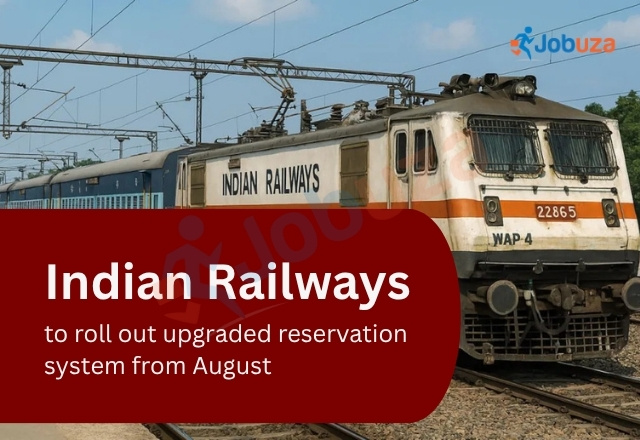
Indian Railways is set to introduce a major upgrade to its Passenger Reservation System (PRS) from August. This will be one of the biggest technological changes in the railway ticket booking system in several decades.
The upgraded reservation platform will gradually replace the existing system that has been operating since 1986. The new system has been designed to improve ticket booking speed, increase handling capacity, and provide a smoother experience for millions of railway passengers.
Railway Minister Ashwini Vaishnaw recently reviewed the progress of the project at Rail Bhawan and directed officials to ensure that passengers do not face any inconvenience during the transition process.
The review meeting was also attended by Ministers of State for Railways V. Somanna and Ravneet Singh Bittu.
Indian Railways to Upgrade 40-Year-Old Reservation System
The current Passenger Reservation System was introduced in 1986 and has undergone several limited improvements over the years. However, with the increasing number of passengers and rising demand for online ticket booking, Indian Railways decided to develop a completely modern reservation platform.
The new PRS has been built using advanced technology and will offer improved performance, faster processing, and greater capacity compared to the existing system.
Indian Railways started internet-based ticket booking services in 2002. Since then, online reservations have become the preferred choice for passengers.
Currently, around 88 percent of railway ticket bookings are completed through digital platforms, highlighting the growing importance of a modern reservation system.
New System Aims to Improve Passenger Experience
The upgraded Passenger Reservation System is expected to make several aspects of railway ticket booking more efficient.
Passengers can expect:
- Faster ticket booking process
- Better system performance during peak demand
- Improved digital services
- Higher capacity for handling bookings
- More reliable reservation experience
The upgrade will help Indian Railways manage the increasing number of passengers who depend on online services for train reservations.
RailOne App Becomes Popular Among Passengers
The new reservation system upgrade is part of Indian Railways’ larger digital transformation initiative.
The RailOne app, launched in July 2025, has gained significant popularity among passengers and has crossed 3.5 crore downloads within a year.
The app provides multiple railway services through a single platform. Passengers can use it for:
- Train ticket booking and cancellation
- Checking train running status
- Viewing platform and coach details
- Raising complaints
- Accessing other railway-related services
According to Indian Railways, around 9.29 lakh tickets are booked daily through the RailOne app. This includes approximately 7.2 lakh unreserved tickets and 2.09 lakh reserved tickets.
AI-Based Feature Helps Predict Waiting List Confirmation
Another major digital improvement introduced by Indian Railways is the use of Artificial Intelligence (AI) for waitlist prediction.
The AI-based tool helps passengers estimate the possibility of their waitlisted ticket getting confirmed before travelling.
According to railway officials, the accuracy of waitlist prediction has improved significantly from 53 percent to 94 percent.
This feature allows passengers to make better travel decisions and plan their journeys with more confidence.
Indian Railways Moving Towards Smarter Digital Services
The upcoming Passenger Reservation System upgrade reflects Indian Railways’ focus on adopting modern technology to improve passenger services.
With faster booking, improved digital platforms, and AI-based features, the new system is expected to make train travel planning more convenient and efficient.
As the upgraded reservation system begins its rollout from August, Indian Railways aims to provide a faster, smarter, and more reliable ticket booking experience for passengers across India.
Frequently Asked Questions
When will the new Indian Railways reservation system start?
The upgraded Passenger Reservation System will begin its rollout from August.
What is the current railway reservation system?
The existing Passenger Reservation System was introduced in 1986 and is now being replaced with a modern upgraded platform.
Why is Indian Railways upgrading the reservation system?
The upgrade aims to improve ticket booking speed, increase system capacity, and provide a better passenger experience.
How many railway tickets are booked online?
Around 88 percent of railway ticket bookings are currently completed through digital platforms.
What is the RailOne app used for?
The RailOne app allows passengers to book tickets, cancel reservations, check train status, access coach information, and use other railway services.
How does AI help railway passengers?
AI-based waitlist prediction helps passengers estimate the chances of confirmation for their waitlisted tickets.
How accurate is the AI waitlist prediction system?
The prediction accuracy has improved from 53 percent to 94 percent, according to Indian Railways.

by Jobuza Team | Jun 12, 2026 | BLOG, Trending News
The Employees’ Provident Fund Organisation (EPFO) is preparing to introduce a major digital upgrade through EPFO 3.0. The new initiative aims to make provident fund services faster, more convenient, and accessible through modern digital platforms.
One of the most talked-about features under EPFO 3.0 is the ability to withdraw PF money using UPI and UPI-enabled ATM services. The move is expected to simplify fund access for millions of EPF subscribers across the country and reduce the time required for processing withdrawals.
Here is everything you need to know about the upcoming EPFO 3.0 features, withdrawal limits, eligibility conditions, and additional digital services.
What Is EPFO 3.0?
EPFO 3.0 is the next phase of digital transformation being introduced by the Employees’ Provident Fund Organisation. The initiative focuses on improving user experience, reducing paperwork, speeding up claim processing, and enabling easier access to EPF services through digital channels.
The upgraded system is expected to provide members with greater control over their provident fund accounts while making transactions more seamless and transparent.
When Will EPFO 3.0 Be Launched?
Union Labour Minister Mansukh Mandaviya announced that testing of the EPFO 3.0 platform had been completed and that implementation would begin soon.
Although an official rollout date has not yet been announced, the government has indicated that the new features are expected to be introduced in phases after final approvals and system integration.
EPF subscribers are advised to keep checking official EPFO announcements for the latest updates.
How Much PF Money Can Be Withdrawn Through UPI?
Under the proposed EPFO 3.0 framework, subscribers may be allowed to withdraw between 50 percent and 75 percent of their available EPF balance using UPI or UPI-enabled ATM services.
The exact withdrawal amount will depend on applicable EPF rules, eligibility conditions, and account status at the time of withdrawal.
Members should note that withdrawal limits may vary depending on the purpose of withdrawal and regulatory guidelines issued by EPFO.
How Will UPI-Based PF Withdrawal Work?
The new system is expected to allow subscribers to access their EPF balance directly through a linked UPI platform.
Members will be able to check their available PF balance and initiate a transfer from their EPF account to their registered bank account.
To complete the transaction, users will need to authenticate the transfer using their linked UPI PIN. Once the money is successfully credited to the bank account, it can be used for digital payments, transfers, purchases, or cash withdrawals through regular bank ATMs.
The objective is to reduce dependency on lengthy claim procedures and make fund access faster for eligible members.
Will UPI Withdrawals Affect EPF Pension Benefits?
No. The proposed UPI withdrawal facility will apply only to the Provident Fund component of the EPF account.
The pension contribution accumulated under the Employees’ Pension Scheme (EPS) will remain unaffected. This means members will continue to retain their pension benefits according to existing EPFO regulations.
Therefore, using the UPI withdrawal facility will not impact retirement pension entitlements.
Face Authentication for Faster Services
Another important feature being introduced under EPFO 3.0 is Face Authentication Technology (FAT).
Using facial authentication through the UMANG application, members will be able to activate both new and existing Universal Account Numbers (UAN) without visiting physical offices.
This feature is expected to simplify identity verification and make EPF services more accessible for users across the country.
Easier Access to Passbooks and Online Claims
EPFO 3.0 aims to improve self-service options for subscribers.
Members will be able to access their EPF passbooks more easily, update incomplete information, and submit claims online through a simplified digital process.
These improvements are expected to reduce processing delays and minimize the need for manual intervention.
EPFO Services Coming to WhatsApp
EPFO is also working on introducing WhatsApp-based services for subscribers.
Under the proposed system, members will be able to access important account information such as:
- PF account balance
- Recent transactions
- Claim status updates
- Account-related services
EPFO is expected to issue a dedicated WhatsApp number for this service. Members may simply send a message from their registered mobile number to receive account-related information quickly and conveniently.
The service is expected to provide round-the-clock access to basic EPF information.
Benefits of EPFO 3.0 for Subscribers
The new EPFO platform is expected to offer several advantages to members.
Faster access to provident fund money, simplified claim procedures, improved digital verification, enhanced transparency, and easier account management are among the key benefits.
The integration of UPI, facial authentication, UMANG services, and WhatsApp support reflects EPFO’s effort to modernize retirement savings management for millions of employees.
Final Thoughts
EPFO 3.0 represents a significant step toward digitizing provident fund services in India. Features such as UPI-based withdrawals, ATM access, facial authentication, online claim management, and WhatsApp support are expected to make EPF services faster and more user-friendly.
While the official rollout date is still awaited, subscribers can expect a more convenient and digitally connected experience once the new system becomes operational.
Keeping UAN, Aadhaar, bank account details, and mobile numbers updated will help members take full advantage of these upcoming services when they are launched.
Frequently Asked Questions
What is EPFO 3.0?
EPFO 3.0 is the next-generation digital upgrade being introduced by the Employees’ Provident Fund Organisation to improve EPF services and user experience.
Can PF money be withdrawn through UPI?
Yes, EPFO plans to introduce a facility that will allow eligible subscribers to transfer PF funds through UPI-based services.
How much PF balance can be withdrawn?
Subscribers may be able to withdraw between 50 percent and 75 percent of their available EPF balance, subject to applicable conditions.
Will UPI-based withdrawals affect pension benefits?
No. The facility will apply only to the provident fund portion of the account and will not impact pension contributions under EPS.
What is Face Authentication Technology in EPFO 3.0?
Face Authentication Technology allows members to verify their identity and activate UAN services using facial recognition through the UMANG app.
Will EPFO provide services through WhatsApp?
Yes. EPFO is planning to introduce WhatsApp-based account services, including balance checks, transaction history, and claim status updates.
Has the rollout date been announced?
No official launch date has been announced yet, although testing has reportedly been completed.
What should members do before EPFO 3.0 launches?
Members should ensure that their UAN, Aadhaar, bank account details, and registered mobile number are updated to avoid any issues when the new services become available.

by Jobuza Team | Jun 12, 2026 | BLOG, Latest Jobs
Through this recruitment campaign, the organization aims to fill 4,318 vacancies across various depots in Gujarat. The notification has been released under Advertisement Number GSRTC/202627/32 and offers an excellent opportunity for candidates seeking government jobs in the transport sector.
Interested and eligible candidates can submit their applications through the Gujarat Government’s official OJAS portal. The online application process is currently active, and candidates must complete their registration before the last date, July 5, 2026.
Candidates are advised to review the eligibility criteria, selection process, and application instructions carefully before applying.
GSRTC Conductor Recruitment 2026 Overview
The recruitment drive is being conducted by the Gujarat State Road Transport Corporation to fill thousands of conductor vacancies across the state. Selected candidates will be appointed according to the rules and regulations specified in the official notification.
Recruitment Highlights
- Organization: Gujarat State Road Transport Corporation (GSRTC)
- Post Name: Conductor
- Total Vacancies: 4,318
- Advertisement Number: GSRTC/202627/32
- Application Mode: Online
- Job Type: Government Job
- Last Date to Apply: July 5, 2026
- Official Website: ojas.gujarat.gov.in
GSRTC Conductor Vacancy 2026
The recruitment offers 4,318 vacancies for the Conductor post, making it one of the largest recruitment drives announced by GSRTC in recent years.
Candidates interested in working in Gujarat’s public transport sector can take advantage of this opportunity by submitting their applications before the deadline.
Eligibility Criteria for GSRTC Conductor Recruitment 2026
Applicants must satisfy the eligibility conditions prescribed by the Gujarat State Road Transport Corporation.
Candidates should have passed Class 12 or an equivalent examination from a recognized board. In addition, applicants must possess basic computer knowledge as required by the Gujarat Government.
Candidates will need to produce the necessary educational and computer proficiency certificates during the document verification process.
Another important requirement is a valid Conductor Licence. Applicants must hold a valid conductor licence at the time of submitting their online application form.
Candidates who fail to meet any of these requirements may not be considered for further stages of recruitment.
Selection Process
The GSRTC Conductor Recruitment 2026 selection process consists of multiple stages designed to ensure a fair and transparent recruitment procedure.
The first stage is an Optical Mark Recognition (OMR)-based written examination. The examination will carry a total of 100 marks and will consist of objective-type questions.
Candidates who perform well in the written examination will be shortlisted according to the criteria mentioned in the official notification.
Shortlisted candidates will then be called for document verification, where their educational qualifications, conductor licence, computer knowledge certificates, and other required documents will be examined.
Final appointment will be granted only after successful verification of documents and fulfillment of all eligibility requirements.
How to Apply for GSRTC Conductor Recruitment 2026
Candidates can follow these simple steps to complete their online application:
Visit the official OJAS website.
Open the recruitment section and click on the “Current Advertisement” option.
Find the GSRTC Conductor Recruitment 2026 advertisement.
Click on the application link and complete the registration process.
Enter your personal, educational, and other required details carefully.
Upload the necessary documents as instructed.
Accept the declaration and proceed with the application.
Pay the applicable application fee, if required.
Review all details and submit the application form.
Download and save a copy of the submitted application for future reference.
Applicants should ensure that all information provided in the application form is accurate to avoid rejection during verification.
Important Points for Applicants
Candidates should apply well before the closing date to avoid technical issues or last-minute delays.
A valid conductor licence is mandatory for application. Without the required licence, candidates will not be eligible for recruitment.
Applicants should also keep copies of all submitted documents and application details for future use during the recruitment process.
Regularly checking the official website is recommended for updates regarding examination dates, admit cards, results, and further recruitment announcements.
Why This Recruitment Is Important
With more than 4,300 vacancies, the GSRTC Conductor Recruitment 2026 presents a significant opportunity for job seekers in Gujarat. Government jobs in the transport sector offer stable employment, career growth opportunities, and various benefits provided by state government organizations.
Candidates who meet the eligibility requirements should not miss this chance to secure a position with one of Gujarat’s largest public transport organizations.
Final Thoughts
The GSRTC Conductor Recruitment 2026 is an excellent opportunity for candidates looking for a government job in Gujarat. With 4,318 vacancies available, eligible applicants should complete their online applications before July 5, 2026.
Candidates are encouraged to carefully review the official notification, verify their eligibility, and submit their applications as early as possible. Staying updated through the official OJAS portal will help ensure a smooth application and recruitment experience.
Frequently Asked Questions
How many vacancies are available under GSRTC Conductor Recruitment 2026?
A total of 4,318 vacancies have been announced for the Conductor post.
What is the last date to apply?
The last date to submit the online application form is July 5, 2026.
What is the minimum educational qualification required?
Candidates must have passed Class 12 or an equivalent examination from a recognized board.
Is a conductor licence mandatory?
Yes, applicants must possess a valid conductor licence while submitting their application.
What is the selection process?
The selection process includes an OMR-based written examination followed by document verification and final merit-based selection.
How many marks will the written examination carry?
The written examination will carry a total of 100 marks.
Where can candidates apply online?
Candidates can apply through the official OJAS portal.
Is computer knowledge required for this recruitment?
Yes, candidates must possess basic computer knowledge and provide supporting certificates during document verification.
by Jobuza Team | Jun 11, 2026 | BLOG, Latest Jobs
The Defence Research and Development Organisation (DRDO) has announced the DRDO SAG Internship 2026 for students pursuing engineering and science courses. Through its prestigious Scientific Analysis Group (SAG), DRDO is offering a paid internship program for final-year undergraduate and postgraduate students in selected disciplines.
The internship provides students with an opportunity to gain practical research experience while working with one of India’s leading defence research organizations. Selected candidates will receive a stipend of ₹30,000 for a six-month internship program scheduled to begin on July 1, 2026.
Interested and eligible candidates can submit their applications via email until June 15, 2026.
About DRDO SAG Internship 2026
The Scientific Analysis Group (SAG) is a premier DRDO laboratory operating under the Ministry of Defence, Government of India. The laboratory specializes in advanced research and development projects and offers valuable exposure to students interested in technology, engineering, and scientific research.
The internship program is designed for students currently pursuing the final semester of their undergraduate or postgraduate courses. During the six-month internship period, participants will work on projects related to their academic disciplines under the guidance of experienced researchers and scientists.
The internship will be conducted at the SAG facility located in Delhi from July 1, 2026, to December 31, 2026.
DRDO SAG Internship 2026 Overview
The internship offers opportunities across multiple engineering and science disciplines. A total of 40 internship positions have been announced for eligible candidates.
Key Details
- Organization: Scientific Analysis Group (SAG), DRDO
- Ministry: Ministry of Defence, Government of India
- Internship Type: Paid Internship
- Internship Duration: Six Months
- Internship Location: SAG, DRDO, Civil Lines, Delhi
- Total Internship Positions: 40
- Eligible Candidates: Final-Year B.E., B.Tech., M.E., M.Tech., and M.Sc. Students
- Minimum Academic Requirement: 75% Marks or 7.5 CGPA
- Stipend: ₹30,000
- Application Mode: Email
- Application Deadline: June 15, 2026
- Internship Start Date: July 1, 2026
Stipend and Internship Benefits
Students selected for the DRDO SAG Internship 2026 will receive a total stipend of ₹30,000 during the internship period.
The amount will be paid in two equal installments of ₹15,000 each. Apart from financial support, interns will gain valuable hands-on experience, exposure to advanced research projects, and the opportunity to work alongside experts in the defence research sector.
Such experience can significantly strengthen a student’s academic profile and future career prospects.
Eligibility Criteria for DRDO SAG Internship 2026
Candidates must carefully review the eligibility requirements before submitting their applications.
Nationality Requirement
Applicants must be citizens of India.
Educational Qualification
For undergraduate courses, candidates should be pursuing B.E. or B.Tech. and must be in their fourth year, specifically the seventh or eighth semester.
For postgraduate courses, candidates should be pursuing M.E., M.Tech., or M.Sc. and must be in the second year of their program.
The course must be full-time and offered by an institution recognized by AICTE or UGC.
Minimum Academic Performance
Applicants must have secured at least 75 percent marks or a minimum CGPA of 7.5 in their current academic program.
Students with any backlog or failed semester are not eligible to apply.
Eligible Disciplines
The internship is open to students from the following disciplines:
Computer Science
Artificial Intelligence
Information Technology
Information Science and Engineering
Cyber Security
Electronics
Electronics and Communication Engineering
Electronics and Instrumentation Engineering
Physics
Mathematics
Statistics
Academic Session Requirement
Candidates should be studying in the final year of their respective courses during the academic session 2026-27.
No Objection Certificate Requirement
Applicants must obtain a No Objection Certificate (NOC) from their college or university. The NOC should be issued by the Principal, Head of Department, Dean, or Training and Placement Officer and must confirm that the student will be relieved for the internship period.
DRDO SAG Internship 2026 Selection Process
The selection process is primarily based on academic merit.
Candidates meeting the minimum eligibility requirements will be shortlisted based on their CGPA and academic performance. Only students who have secured at least 75 percent marks or a CGPA of 7.5 and above from recognized institutions will be considered.
Shortlisted candidates may also be invited for an interview or interaction session if required by DRDO SAG.
Final selection will be subject to verification of all submitted documents, including the original No Objection Certificate.
Selected candidates will receive joining instructions through their registered email address. Candidates who are not selected will not receive separate communication regarding their application status.
DRDO reserves the right to modify the number of internship positions or alter the selection criteria at any stage without prior notice.
How to Apply for DRDO SAG Internship 2026
Eligible candidates must submit their applications through email before the deadline.
Applicants should carefully prepare all required documents, including academic records, identification documents, and the No Objection Certificate issued by their institution.
The completed application should be sent to the official email address specified in the notification before June 15, 2026.
Candidates are advised to verify all information before submission to avoid rejection due to incomplete or incorrect details.
Why Students Should Apply
The DRDO SAG Internship 2026 provides a unique opportunity to work with one of India’s most respected research organizations. Students gain exposure to real-world research projects, advanced technologies, and professional work environments that can significantly enhance their technical skills and career prospects.
For students interested in research, defence technology, cybersecurity, electronics, artificial intelligence, mathematics, or scientific innovation, this internship can serve as an excellent stepping stone toward future opportunities.
Final Thoughts
The DRDO SAG Internship 2026 is an excellent opportunity for talented engineering and science students to gain valuable research experience while receiving a paid stipend. With only 40 internship positions available, interested candidates should ensure they meet all eligibility requirements and submit their applications before June 15, 2026.
Students with strong academic records and a passion for research should take advantage of this opportunity to work with one of India’s leading defence research institutions.
Frequently Asked Questions
What is the duration of the DRDO SAG Internship 2026?
The internship will run for six months, from July 1, 2026, to December 31, 2026.
How many internship positions are available?
A total of 40 internship positions have been announced.
What stipend will selected interns receive?
Selected candidates will receive a total stipend of ₹30,000, paid in two installments of ₹15,000 each.
Who can apply for the internship?
Final-year B.E., B.Tech., M.E., M.Tech., and M.Sc. students from eligible disciplines can apply.
What is the minimum academic requirement?
Candidates must have secured at least 75 percent marks or a CGPA of 7.5 and above.
Is there any application fee?
No. There is no application fee for the DRDO SAG Internship 2026.
How can candidates apply?
Applications must be submitted through email as specified in the official notification.
What is the last date to apply?
The last date for submitting applications is June 15, 2026.

by Jobuza Team | Jun 11, 2026 | BLOG, Latest Jobs
The Central Industrial Security Force (CISF) has officially announced the CISF ASI Paramedical Recruitment 2026 for various medical support positions. The recruitment drive aims to fill 24 vacancies for Assistant Sub-Inspector (ASI) posts in different paramedical trades, including Pharmacist, X-Ray Technician, and Lab Technician.
Eligible male and female candidates can submit their applications online through the official CISF recruitment portal. The online application process began on June 8, 2026, and will remain open until July 7, 2026.
This recruitment presents an excellent opportunity for candidates with paramedical qualifications who are looking for a government job in the healthcare sector.
CISF ASI Paramedical Recruitment 2026 Overview
The recruitment is being conducted by the Central Industrial Security Force to fill vacancies in its medical support staff category. Selected candidates will be appointed under Pay Level 5 and may be posted anywhere in India based on organizational requirements.
Recruitment Highlights
- Recruiting Authority: Central Industrial Security Force (CISF)
- Post Name: Assistant Sub-Inspector (ASI) Paramedical Staff
- Total Vacancies: 24
- Application Mode: Online
- Application Start Date: June 8, 2026
- Last Date to Apply: July 7, 2026
- Selection Process: Written Examination, Physical Standard Test (PST), Basic Vocational Aptitude Test (BVAT), Document Verification, and Medical Examination
- Official Website: cisfrectt.cisf.gov.in
CISF ASI Paramedical Vacancy 2026
The recruitment notification includes vacancies for several paramedical positions. Candidates should carefully review the eligibility requirements before submitting their applications.
The available posts include:
- ASI Pharmacist
- ASI X-Ray Technician
- ASI Lab Technician
A total of 24 vacancies have been announced across these trades.
Eligibility Criteria for CISF ASI Paramedical Recruitment 2026
Candidates must possess the required educational qualifications for the specific post they wish to apply for.
ASI Pharmacist
Applicants must have completed Class 12 from a recognized board. They should also possess a Diploma or Degree in Pharmacy from a recognized institution approved by the Central or State Government. Additionally, candidates must be registered as a pharmacist under the Pharmacy Act, 1948.
ASI X-Ray Technician
Candidates should have passed Class 12 from a recognized board and possess a two-year Diploma in Radiography from a government-recognized institution.
ASI Lab Technician
Applicants must have completed Class 12 with Science subjects from a recognized board. They should also hold a two-year Diploma in Medical Laboratory Technology from a recognized institution.
Application Fee
Candidates belonging to the General, OBC, and EWS categories are required to pay an application fee of ₹100 while submitting the online application form.
Candidates from SC, ST, Female, and Ex-Servicemen categories are exempted from paying the application fee.
Selection Process
The selection process for CISF ASI Paramedical Recruitment 2026 consists of multiple stages.
Candidates will first appear for a written examination. Those who qualify will be called for the Physical Standard Test (PST). After successfully clearing the PST, candidates will undergo document verification and the Basic Vocational Aptitude Test (BVAT). The final stage of recruitment will be the medical examination.
Only candidates who successfully clear all stages will be considered for final selection.
How to Apply for CISF ASI Paramedical Recruitment 2026
Candidates can complete their online application by following these steps:
Visit the official CISF recruitment website.
Complete the registration process using the required personal details.
Log in to the recruitment portal and select the desired ASI Paramedical post.
Fill out the online application form carefully with accurate information.
Upload the required documents, including your photograph and signature.
Pay the application fee according to your category, if applicable.
Review all entered information and submit the application form.
Download and save a copy of the submitted application for future reference.
Important Instructions for Candidates
Before applying, candidates should carefully read the official notification to understand the eligibility conditions, educational qualifications, age criteria, and recruitment process.
Providing incorrect information or submitting incomplete documents may result in the rejection of the application.
Candidates are also advised to keep copies of all uploaded documents and application details for future recruitment stages.
Helpline for Recruitment Queries
Candidates facing difficulties during the application process or any stage of recruitment can contact the CISF recruitment helpline for assistance.
The helpline numbers are:
011-24366431
011-24307933
Support is available on working days between 10:00 AM and 6:00 PM.
Final Words
The CISF ASI Paramedical Recruitment 2026 offers a valuable opportunity for qualified healthcare and paramedical professionals seeking a stable government career. With vacancies available for Pharmacists, X-Ray Technicians, and Lab Technicians, eligible candidates should complete their applications before the July 7, 2026 deadline.
Interested applicants are encouraged to review the official notification thoroughly and submit their applications well before the closing date to avoid last-minute issues.
Frequently Asked Questions
What is the last date to apply for CISF ASI Paramedical Recruitment 2026?
The last date to submit the online application form is July 7, 2026.
How many vacancies have been announced?
A total of 24 vacancies have been announced for various ASI Paramedical posts.
Which posts are available under this recruitment?
The recruitment includes vacancies for Pharmacist, X-Ray Technician, and Lab Technician positions.
What is the application fee for General category candidates?
General, OBC, and EWS category candidates must pay an application fee of ₹100.
Are female candidates required to pay the application fee?
No, female candidates are exempted from paying the application fee.
What is the selection process for CISF ASI Paramedical Recruitment?
The selection process includes a written examination, PST, document verification, BVAT, and medical examination.
Where can candidates apply online?
Candidates can apply through the official CISF recruitment portal at cisfrectt.cisf.gov.in.
Can candidates from any state apply?
Yes, eligible Indian citizens from any state can apply, and selected candidates may be posted anywhere in India based on organizational requirements.