by Jobuza Team | Feb 26, 2026 | BLOG, Latest Jobs
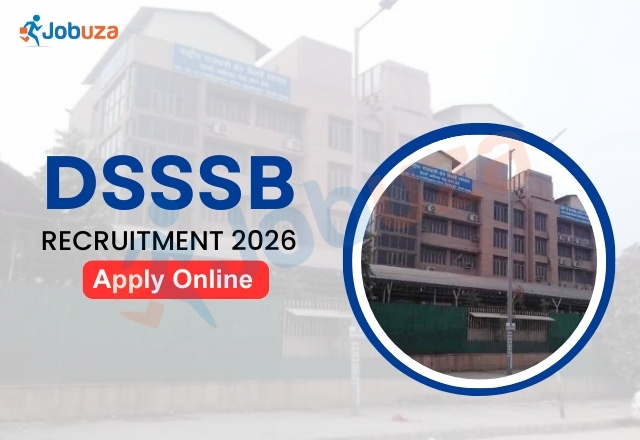
The DSSSB Recruitment 2026 Notification has been officially released by Delhi Subordinate Services Selection Board under Advertisement No. 01/2026. The recruitment drive aims to fill 911 vacancies through Combined Examinations for key technical and administrative roles including Assistant Section Officer (ASO), Assistant Engineer (Civil), Junior Engineer (Civil), and Legal Assistant.
The online application process will begin on 24 February 2026 and candidates can apply until 25 March 2026 through the official Online Application Registration System.
In addition to this notification, the board is also continuing large-scale recruitment for teaching and non-teaching positions, including 5,346 TGT vacancies and 1,180 Assistant Teacher (Primary) posts.
DSSSB Recruitment 2026 Notification Details
Candidates planning to apply must carefully read the official notification, which provides complete information regarding eligibility conditions, age limit, selection procedure, and application guidelines. Applications will be accepted only through the online mode. Any other method of submission will not be considered.
DSSSB Recruitment 2026 Overview
Organisation: Delhi Subordinate Services Selection Board
Advertisement Number: 01/2026
Posts: Assistant Section Officer, Assistant Engineer, Junior Engineer, Legal Assistant
Total Vacancies: 911
Application Mode: Online
Registration Period: 24 February 2026 to 25 March 2026
Selection Process: Tier I Examination, Tier II Examination, Skill Test (as applicable)
Official Website: dsssb.delhi.gov.in
DSSSB Vacancy 2026 Post-wise Details
The recruitment drive includes vacancies across administrative and engineering roles. The post-wise distribution is as follows:
Assistant Section Officer / Grade-II (GNCTDSS): 587 posts
Junior Engineer (Civil): 281 posts
Assistant Engineer (Civil): 33 posts
Legal Assistant: 10 posts
DSSSB Recruitment 2026 Eligibility Criteria
Candidates must meet the required educational qualifications and age criteria for the post they wish to apply for. Eligibility varies depending on the role.
Educational Qualification
Assistant Section Officer: Bachelor’s degree from a recognised university. Basic knowledge of computer applications is desirable.
Junior Engineer (Civil): Degree in Civil Engineering or Diploma in Civil Engineering with two years of relevant work experience.
Assistant Engineer (Civil): Degree in Civil Engineering from a recognised university or institute.
Legal Assistant: Law degree (LLB) from a recognised university with relevant legal work experience.
Age Limit
The general age limit for most posts is 18 to 30 years as on 25 March 2026. Age relaxation is applicable as per government rules.
SC and ST candidates: 5 years relaxation
OBC candidates (Delhi): 3 years relaxation
Persons with Disabilities: 10 years relaxation
DSSSB Selection Process
The selection procedure will vary depending on the post but generally includes:
Tier I Examination
Tier II Examination
Skill Test or Practical Test (where applicable)
Document Verification
Final selection will be based on merit and fulfillment of eligibility requirements.
How to Apply for DSSSB Recruitment 2026
Candidates must submit their application through the official online portal by following these steps:
Visit the official DSSSB website and access the Online Application Registration System.
Register using a valid email ID and mobile number.
Log in and fill out the application form with accurate personal and academic details.
Upload required documents in the prescribed format.
Submit the application form and keep a copy for future reference.

by Jobuza Team | Feb 26, 2026 | BLOG, Latest Jobs
The HPCL Recruitment 2026 Notification has been released by Hindustan Petroleum Corporation Limited on its official website. The recruitment drive invites applications from both fresh graduates and experienced professionals for multiple technical and non-technical positions. This is a strong career opportunity in a Maharatna Central Public Sector Enterprise for candidates seeking stable and growth-oriented government-sector roles.
Eligible candidates can submit their applications online from 25 February 2026 to 25 March 2026.
HPCL Recruitment 2026 Notification Details
HPCL has announced vacancies across engineering, management, and specialist domains. The recruitment includes positions such as Graduate Engineers, Safety Officers, Diploma Engineers, Quality Control Officers, Information Systems professionals, Hindi Officers, and other technical roles.
The organization has also opened applications for experienced professionals in specialized departments including Sales, Human Resources, Legal, Biofuel Operations, Cyber Security, Finance, Projects, and City Gas Distribution.
Candidates are advised to review the detailed notification carefully before applying to ensure they meet the required eligibility criteria.
HPCL Recruitment 2026 Notification PDF
The official notification provides complete details regarding eligibility conditions, selection stages, job roles, and application guidelines. Candidates should refer to the official website for the complete advertisement and instructions.
HPCL Recruitment 2026 Overview
Organization: Hindustan Petroleum Corporation Limited
Posts Offered: Graduate Engineers, Safety, Diploma Engineers, IT, Human Resources, Quality Control, Information Systems, Hindi Officer and others
Advertisement Number: HPCL/OPEN/HR/3/2025-26
Application Mode: Online
Official Website: hindustanpetroleum.com
HPCL Recruitment 2026 Important Dates
Online Application Start Date: 25 February 2026
Last Date to Apply Online: 25 March 2026
Candidates are encouraged to complete the application process well before the closing date to avoid last-minute technical issues.
Eligibility Criteria
Applicants must possess the required educational qualifications relevant to the post they are applying for. Both freshers and experienced professionals are eligible depending on the role. Specific qualification requirements, experience conditions, and age limits vary post-wise and are detailed in the official notification.
Selection Process
The selection procedure may include one or more of the following stages depending on the position:
• Computer-Based Test or Written Examination
• Group Discussion
• Personal Interview
• Document Verification
• Medical Examination
Final selection will be based on performance in the applicable stages and fulfillment of eligibility requirements.
How to Apply for HPCL Recruitment 2026
Candidates must apply through the official website by following these steps:
-
Visit the official HPCL website and open the careers section.
-
Select the relevant recruitment advertisement.
-
Register using a valid email ID and mobile number.
-
Log in using the generated credentials.
-
Fill in the application form with accurate personal and academic details.
-
Upload required documents including certificates and photographs.
-
Submit the application form and keep a copy for future reference.
by Jobuza Team | Feb 24, 2026 | BLOG, Latest Jobs, Railway Jobs
The Western Railway has released the RRC WR Apprentice Recruitment 2026 notification for 5349 ITI Apprentice vacancies under Advertisement No. RRC/WR/04/2025. This recruitment offers one-year apprenticeship training to eligible candidates under the Apprentices Act.
Candidates who have passed Class 10 with at least 50 percent marks and hold an ITI certificate in a relevant trade can apply online. The application window is open from 21 February to 23 March 2026. Selection will be based purely on merit, and no written exam or interview will be conducted.
Applicants should carefully review the eligibility criteria and complete the application process well before the deadline to avoid last-minute issues.
RRC WR Apprentice Notification 2026
The official notification contains detailed information about eligibility requirements, trade-wise vacancies, application guidelines, and the selection process. Candidates are advised to read the notification thoroughly before applying to ensure they meet all conditions.
The notification PDF can be downloaded from the official recruitment portal.
RRC WR Apprentice Recruitment 2026 Overview
Organisation: Railway Recruitment Cell, Western Railway
Post Name: Apprentice
Advertisement Number: RRC/WR/04/2025
Total Vacancies: 5349
Qualification: Class 10 with minimum 50 percent marks plus ITI certificate
Age Limit: 15 to 24 years
Notification Release Date: 18 February 2026
Application Start Date: 21 February 2026
Last Date to Apply: 23 March 2026
Application Mode: Online
Selection Process: Merit-Based
Official Website: rrc-wr.com
RRC WR Apprentice Vacancy 2026
Western Railway has announced 5349 apprentice positions across multiple technical trades. The highest number of vacancies are available in Fitter, Electrician, and Welder trades. Candidates must possess an ITI certificate in the relevant trade for which they are applying.
This recruitment aims to provide practical training and technical experience within the Indian Railways system, helping candidates build skills for future employment opportunities.
Eligibility Criteria for RRC WR Apprentice 2026
Candidates must satisfy all eligibility conditions specified in the notification before submitting their application.
Educational Qualification
Applicants must have passed Class 10 under the 10+2 system with a minimum of 50 percent aggregate marks. In addition, candidates must hold an ITI certificate in the relevant trade issued by a recognised institute.
Trade-specific ITI certification is mandatory. For example, candidates applying for Fitter must have ITI in Fitter, and those applying for Electrician must hold ITI in Electrician.
Age Limit
Candidates must be between 15 and 24 years of age.
Age Relaxation
SC and ST candidates: 5 years
OBC candidates: 3 years
PwBD candidates: 10 years
Ex-servicemen: As per Railway rules
Selection Process
Selection will be based on a merit list prepared using the average percentage of marks obtained in Class 10 and ITI. Equal weightage will be given to both qualifications.
There will be no written examination or interview. Final selection will be subject to document verification and fulfillment of eligibility conditions.
How to Apply for RRC WR Apprentice Recruitment 2026
Candidates must submit their applications online through the official website. Applications submitted through any other mode will not be accepted.
Visit the official website rrc-wr.com
Open the Apprentice Recruitment 2026 section
Complete registration using a valid mobile number and email ID
Fill in personal, academic, and trade details accurately
Upload required documents including photograph and signature
Pay the application fee if applicable
Review all details and submit the form
Download the confirmation page for future reference
Application Fee
General and OBC candidates: ₹100
SC, ST, PwBD, and women candidates: No fee
The application fee must be paid online through the available payment methods.

by Jobuza Team | Feb 24, 2026 | BLOG, Latest Jobs, PSU Jobs
The Central Selection Board of Constable (CSBC) has released the official notification for Bihar Police Constable Operator Recruitment 2026. A total of 993 vacancies will be filled through this recruitment drive. Candidates who have passed Class 12 are eligible to apply online.
The online application process will be open from March 1 to March 31, 2026. Interested applicants can submit their forms through the official website at CSBC Bihar Official Website.
Candidates will be selected through a written examination followed by Physical Efficiency Test (PET), Physical Standard Test (PST), and document verification.
Bihar Police Constable Operator 2026 Notification PDF
Candidates planning to apply must carefully read the official notification before submitting the application form. The notification includes detailed information about eligibility conditions, category-wise vacancies, selection process, exam pattern, and application guidelines.
The direct link to download the notification PDF is provided on the official website.
Bihar Police Constable Operator Vacancy 2026 — Overview
A total of 993 posts have been announced for Constable Operator recruitment in Bihar Police. Below are the key details of the recruitment process.
Organisation: Central Selection Board of Constable (CSBC), Bihar
Post Name: Constable (Operator / Special Branch / GD)
Total Vacancies: 993 (Tentative)
Application Mode: Online
Educational Qualification: 10+2 (Intermediate) Pass
Selection Process: Written Examination, PST/PET, Document Verification
Job Location: Bihar
Official Website: csbc.bihar.gov.in
Bihar Police Constable Operator 2026 Eligibility Criteria
Candidates must meet the eligibility requirements set by CSBC before applying. Applications that do not meet the prescribed criteria will be rejected at any stage of the recruitment process.
Educational Qualification
Applicants must have passed 10+2 (Intermediate) from a recognised board in India.
Age Limit (As on 01 August 2026)
General (Male/Female): 18 to 25 years
BC/EBC (Male): 18 to 27 years
BC/EBC (Female): 18 to 28 years
SC/ST (Male/Female): 18 to 30 years
Age relaxation is provided as per government recruitment rules.
Selection Process for Bihar Police Constable Operator 2026
The recruitment process consists of multiple stages designed to assess both knowledge and physical fitness.
Written Examination
Physical Standard Test (PST)
Physical Efficiency Test (PET)
Document Verification
Candidates must qualify in each stage to proceed to the next round.
How to Apply Online
Candidates can apply online by following the official application process.
Visit the official website csbc.bihar.gov.in
Navigate to the Bihar Police or Special Branch recruitment section
Click on “Advt. No. 01/2026 — Apply Online for Constable Operator”
Complete registration using a valid mobile number and email ID
Fill out the application form carefully
Upload photograph and signature in the required format
Pay the application fee online
Submit the form and download the confirmation page for reference

by Jobuza Team | Feb 23, 2026 | BLOG, Trending News
Managing vehicle documents in India is now much easier with the official mParivahan app developed by the Ministry of Road Transport and Highways. The app was launched under the Digital India initiative to help drivers store and access transport documents digitally, reducing the need for physical paperwork and repeated visits to RTO offices.
Available free on the Google Play Store and Apple App Store, the app allows users to manage vehicle and licence information directly from their smartphones. The digital documents provided through the app are officially recognised and can be shown to traffic authorities when required.
Digital RC and Driving Licence
One of the most important features of the app is the ability to store a digital Registration Certificate and Driving Licence. These documents include secure QR codes that can be verified instantly by traffic police. This means drivers do not need to carry physical copies while travelling.
Instant Vehicle Information
The app allows users to check vehicle details by entering a registration number. Information such as owner name, registration date, vehicle type, insurance status, fitness validity and pollution certificate expiry can be viewed instantly. This feature is especially useful for people planning to buy a used vehicle.
Check and Pay e-Challan Online
Users can check pending traffic fines directly in the app. Violation details are displayed clearly, and payments can be completed online. This helps drivers avoid additional penalties caused by delayed payments.
Insurance and PUC Status Tracking
The app provides real-time updates on vehicle insurance and Pollution Under Control certificate validity. This helps vehicle owners stay compliant with legal requirements without manual tracking.
Additional Useful Services
The platform also helps users locate nearby RTO offices, receive transport updates, book appointments and access learner’s licence practice tests. Support for multiple Indian languages makes the app accessible to users across different regions.
Why Vehicle Owners Should Use mParivahan
The app reduces dependence on physical documents and simplifies compliance with transport rules. By bringing multiple services into one platform, it saves time, reduces paperwork and improves transparency in vehicle management.
How to Download the App
The NextGen mParivahan app can be downloaded from official Android and iOS app stores. Registration requires a mobile number linked to your vehicle or driving licence records. Once registered, users can access digital documents and transport services anytime.
The mParivahan app provides a practical and secure way for Indian vehicle owners to manage essential transport information in one place, making everyday travel more convenient and compliant with regulations.
by Jobuza Team | Feb 23, 2026 | BLOG, Trending News
IRCTC and Indian Railways have introduced updated Tatkal booking rules for 2026 to make last-minute ticket reservations more transparent, secure, and accessible to genuine passengers. The revised framework focuses on stronger identity verification, tighter booking controls, and the prevention of misuse by automated systems and unauthorized agents. With some measures already active and others being implemented progressively, travellers should understand the new requirements to improve their chances of securing confirmed Tatkal tickets.
Stronger Verification for Genuine Passengers
Under the revised system, only fully verified user accounts are allowed to participate in Tatkal booking. Passenger profiles must now be authenticated using Aadhaar-linked details or other approved identity verification methods. Accounts that remain incomplete or partially verified will not be permitted to access Tatkal reservations during the booking window.
This stricter verification process aims to reduce duplicate accounts and eliminate automated bots that previously secured tickets within seconds of release. By prioritising verified individuals, the updated system is designed to create a fairer booking environment, particularly during peak travel periods when demand is highest.
Updated Booking Process and Practical Tips
The Tatkal booking schedule remains unchanged. Reservations open one day before the train’s scheduled departure, typically at 10:00 AM for AC classes and 11:00 AM for sleeper classes. However, monitoring mechanisms have been strengthened to detect unusual or automated booking activity.
Passengers are advised to prepare in advance by logging in a few minutes before the booking window opens. Saving traveller details beforehand and keeping payment methods such as UPI or net banking ready can significantly improve booking speed. In a high-demand system where seats fill rapidly, preparation plays a crucial role in increasing the likelihood of confirmation.
Key Points Passengers Should Know
Full account verification is now mandatory for Tatkal booking access.
Automated booking tools and scripts are actively restricted.
Accurate passenger information and valid identification are essential for successful reservation processing.
A More Transparent Tatkal System
The 2026 Tatkal reforms are intended to restore fairness and reliability in last-minute train reservations. By strengthening verification standards and limiting misuse, the updated framework offers genuine travellers a more balanced opportunity to obtain confirmed tickets. Passengers who follow the new requirements and prepare in advance can expect a smoother booking experience under the revised system.