by Jobuza Team | Feb 9, 2026 | BLOG, Latest Jobs, State Govt Job
The Haryana Public Service Commission (HPSC) has released Advertisement No. 23/2026 for the recruitment of Post Graduate Teachers (PGTs) in Computer Science. This recruitment drive is being conducted for both the Rest of Haryana Cadre and the Mewat Cadre under the School Education Department.
Candidates will be appointed according to the Haryana State Education School Cadre (Group B) Service Rules, 2012 and the Mewat District School Education (Group B) Service Rules, 2012, along with their latest amendments. Applications will be accepted only through online mode on the official HPSC website. No offline forms will be entertained.
This is a major opportunity for qualified Computer Science postgraduates and engineering graduates who are looking for a government teaching job in Haryana.
Important Dates for HPSC PGT Computer Science Recruitment 2026
Candidates must keep track of the application schedule to avoid missing deadlines.
-
Notification Release Date: February 5, 2026
-
Online Application Start Date: February 16, 2026
-
Last Date to Apply Online: March 9, 2026
-
Last Date to Pay Application Fee: March 9, 2026
The application process includes registration, filling out the application form, payment of fees, and final submission of the form online.
HPSC PGT Computer Science Recruitment Vacancy 2026 Details
A total of 1672 vacancies have been announced for the post of PGT Computer Science.
Reservation benefits are available for categories such as SC, BC-A, BC-B, EWS, ESM, and PwBD as per Haryana Government rules. Additionally, 33 percent horizontal reservation for women will be applicable across all categories.
The detailed category-wise vacancy distribution, including the SC sub-categories, will be published separately on the official HPSC website.
Eligibility Criteria for HPSC PGT Computer Science
Candidates must carefully check educational qualifications and other eligibility conditions before applying.
Educational Qualification
Applicants must have one of the following with at least 55 percent marks from a recognized university:
-
M.Sc. in Computer Science
-
Master of Computer Applications (MCA)
-
BE or B.Tech in Computer Science, Computer Engineering, or Information Technology
In addition, candidates must have studied Hindi or Sanskrit up to Matric level or higher. They must also qualify HTET or STET for the PGT level.
Age Limit
The age of the candidate should be between 18 and 42 years as of the last date of application submission. Age relaxation is available for reserved categories as per Haryana Government norms.
Application Fee for HPSC PGT Recruitment 2026
The application fee varies by category:
-
PwBD candidates of Haryana: No fee
-
SC, BC, EWS, ESM, and Women candidates of Haryana: Rs 250
-
DESM candidates of Haryana (Unreserved): Rs 1000
-
All other candidates: Rs 1000
The application fee once paid will not be refunded under any circumstances.
Age Relaxation Rules
The upper age limit is relaxable for certain categories:
-
Scheduled Castes and Backward Classes of Haryana: 5 years
-
Persons with Benchmark Disabilities: 5 years, with additional category relaxation, subject to a maximum age of 52 years
-
Widowed, divorced, judicially separated, and unmarried women: 5 years
-
Wife of military personnel disabled during service: 5 years
-
Ex-servicemen: Length of military service plus 3 years
-
Haryana Government adhoc, contract, or work-charged employees: Relaxation equal to completed years of service, up to a maximum age of 52 years
The Matriculation certificate will be considered as valid proof of age.
Selection Process for HPSC PGT Computer Science
The selection process will be completed in multiple stages.
First, candidates will appear for a screening test consisting of 100 multiple-choice questions carrying 100 marks. Those who qualify will move to the subject knowledge test, which will carry 150 marks.
Candidates who clear the written examinations will be called for an interview. The interview will carry 12.5 percent weightage in the final merit. The final selection will be based on combined performance in the written tests and interview.
Pay Scale and Admit Card Information
Selected candidates will be appointed in the pay scale of Rs 47,600 to Rs 1,51,100 along with other admissible allowances as per Haryana Government rules.
Admit cards for the examination will be issued online only. No admit card will be sent by post, so candidates must regularly check the official HPSC website for updates.
by Jobuza Team | Feb 6, 2026 | BLOG, Trending News
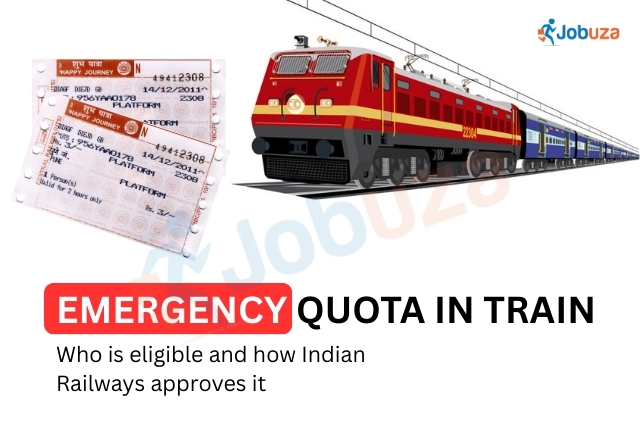
Indian Railways offers multiple ticket booking quotas to help passengers travel in different situations. One of the most important but least understood among them is the Emergency Quota (EQ). This quota is designed to handle urgent and unavoidable travel needs, but it is not available to the general public.
Here is a simple guide to understand who can use the Emergency Quota and how Indian Railways approves these requests.
What Is the Emergency Quota in Indian Railways?
The Emergency Quota is a special reservation quota maintained by Indian Railways to accommodate passengers who must travel urgently due to official or unavoidable personal reasons.
A limited number of seats or berths are kept aside in various trains and travel classes. These seats are released only after reviewing genuine requests from eligible categories of passengers.
Who Is Eligible for the Emergency Quota?
According to the Ministry of Railways, the Emergency Quota is mainly meant for High Official Requisition (HOR) holders and other priority categories.
Primary Eligible Categories
The quota is first meant for:
-
Central Government Ministers
-
Judges of the Supreme Court and High Courts
-
Members of Parliament (MPs)
-
Other high-ranking government officials covered under High Official Requisition
These passengers are considered on priority, especially if they are on the waiting list and need to travel urgently.
Other Cases Considered Under Emergency Quota
After priority categories are handled, Indian Railways may consider other genuine emergency requests based on the seriousness of the situation. These include:
-
Travel on urgent government duty
-
Family bereavement (death of a close family member)
-
Serious illness or medical emergencies
-
Important job interviews
-
Other unavoidable and urgent personal situations
Approval in such cases depends on seat availability and the urgency of the request.
How Indian Railways Approves Emergency Quota Requests
Indian Railways receives a large number of Emergency Quota requests every day from different sources. Because of limited seats, requests are approved based on a strict priority system.
Priority System Used by Railways
The Railways follow the Warrant of Precedence, which is an official ranking order of government positions in India.
-
Emergency Quota is first allotted for self-travel of HOR holders and Members of Parliament.
-
These requests are processed strictly according to their rank and seniority under the Warrant of Precedence.
-
Only after these are cleared are other requests considered.
How Remaining Emergency Quota Seats Are Allotted
Once priority officials are accommodated, the Railways examine other pending requests. The decision to approve these is based on several factors:
-
Official status of the passenger
-
Nature and seriousness of the emergency
-
Purpose of travel
-
Availability of seats in the requested train and class
This ensures that the limited Emergency Quota is used only for genuine and urgent needs.
Where Emergency Quota Requests Are Processed
Emergency Quota requests are handled by special railway offices known as Emergency Quota Cells. These are located at:
-
Zonal Railway Headquarters
-
Divisional Railway Headquarters
-
Some important non-headquarter railway stations
These offices review and process the requests before releasing seats.
Written Requests Are Mandatory
To prevent misuse of the Emergency Quota, Indian Railways has made it compulsory that requests must be submitted in writing.
Verbal requests or informal recommendations are not considered. The Railway Board has instructed all zones to release Emergency Quota seats only after receiving proper written requisitions from authorized sources.
Important Things to Remember About Emergency Quota
-
Emergency Quota is not meant for regular passengers.
-
It cannot be booked directly online like Tatkal tickets.
-
Approval is not guaranteed and depends on priority and availability.
-
Strong and genuine reasons increase the chance of approval, but final discretion rests with railway authorities.
Conclusion
The Emergency Quota in Indian Railways is a special facility created to manage urgent and unavoidable travel situations, mainly for high-ranking officials and serious emergency cases. Since the number of seats is limited, approvals follow a strict priority system and require proper written requests.
by Jobuza Team | Feb 5, 2026 | BLOG, Latest Jobs, Technical/IT Jobs
Bharat Sanchar Nigam Limited (BSNL), the government-owned telecommunications company, has announced a major recruitment drive for 2026. The organization is inviting online applications for 120 Senior Executive Trainee (SET) positions. This opportunity is ideal for young professionals with engineering and finance backgrounds who want to build a stable career in the public sector.
Important Dates for BSNL SET Recruitment 2026
BSNL has officially opened the online application process on February 5, 2026. Interested candidates must complete and submit their applications before the last date, which is March 7, 2026.
Applications will be accepted only through BSNL’s official websites:
-
bsnl.co.in
-
externalexam.bsnl.co.in
Candidates are advised to apply well before the deadline to avoid last-minute technical issues.
Vacancy Details
The 120 vacancies are divided into two streams:
-
Telecom Stream: 95 posts
-
Finance Stream: 25 posts
This distribution provides opportunities for both engineering graduates and finance professionals.
Eligibility Criteria
Educational Qualification
Telecom Stream:
Applicants must have a BE or B.Tech degree in relevant disciplines such as Electronics, Telecommunications, Computer Science, Information Technology, Electrical, or Instrumentation. A minimum of 60 percent marks is required.
Finance Stream:
Candidates must hold a professional qualification such as Chartered Accountant (CA) or Cost and Management Accountant (CMA).
Age Limit
-
Minimum Age: 21 years
-
Maximum Age: 30 years
Age relaxation is applicable as per government norms:
-
OBC (Non-Creamy Layer): 3 years relaxation
-
SC/ST: 5 years relaxation
-
PwBD candidates: Additional relaxation as per rules
Salary and Pay Scale
Selected candidates will be placed in the E-3 IDA pay scale, with a starting salary ranging from Rs. 24,900 to Rs. 50,500 (pre-revised). After successful completion of the probation period, candidates will be confirmed as Senior Executives. They will also receive additional allowances and benefits as per BSNL and government policies.
Application Fee
The application fee must be paid online and is non-refundable.
Selection Process
The selection process is expected to be conducted through a Computer-Based Test (CBT). The tentative date for the written examination is March 29, 2026.
BSNL will also provide an application correction window from March 8 to March 15, 2026, allowing candidates to edit and correct any mistakes in their submitted forms.
Why This Recruitment Matters
BSNL’s Senior Executive Trainee recruitment offers a strong career path in India’s public telecom sector. With attractive pay, government benefits, and long-term stability, this opportunity is highly suitable for qualified engineering and finance professionals aiming for a respected government job.
Candidates should carefully review the eligibility criteria and apply within the given dates to secure their chance in this prestigious recruitment drive.

by Jobuza Team | Feb 4, 2026 | BLOG, Latest Jobs, Teaching Jobs
The National Council of Educational Research and Training (NCERT) has announced a major recruitment drive for the academic session 2026–27. A total of 117 vacancies are available for teaching and non-teaching positions. This is a strong opportunity for candidates who want to build a career with one of India’s most respected educational institutions.
Interested applicants can submit their forms online through the official NCERT website.
Important Dates
The application process is already open. Candidates must complete the online application on or before February 20, 2026. Applications submitted after the deadline will not be accepted.
Official website for applying: ncert.nic.in
NCERT Vacancy 2026 Post Details
NCERT is hiring for both academic and library positions. The available roles include:
-
Professor
-
Associate Professor
-
Assistant Professor
-
Deputy Librarian
-
Assistant Librarian
These positions will be filled across different NCERT campuses in India.
Total Number of Vacancies
As per Advertisement No. 177/2026, the vacancies are divided as follows:
-
114 teaching posts (Professor, Associate Professor, Assistant Professor)
-
3 librarian posts (Deputy Librarian and Assistant Librarian)
This recruitment aims to strengthen NCERT’s academic and research environment by bringing in experienced professionals.
Job Location
Selected candidates may be posted at any of the following NCERT campuses:
-
New Delhi
-
Ajmer
-
Bhopal
-
Bhubaneswar
-
Mysuru
-
Shillong
Candidates should be prepared to work at any campus based on organizational requirements.
Eligibility Criteria
Eligibility conditions vary depending on the post applied for. However, some general requirements include:
-
Educational qualifications as per UGC norms
-
Relevant teaching or professional experience for higher positions
-
Age limits and retirement age as per Government of India and NCERT rules
-
Age relaxation and reservation benefits for eligible categories according to government guidelines
Candidates should carefully read the official notification to ensure they meet all eligibility conditions before applying.
Application Fee
The application fee structure is as follows:
-
General, OBC, and EWS candidates: ₹1,000
-
SC, ST, PwD, and Women candidates: No application fee
The fee must be paid online through the available payment options on the application portal.
Selection Process
The selection process will be based entirely on interviews. There will be no written examination for this recruitment.
The process will include:
Final selection will be made based on interview performance, following UGC and NCERT guidelines.
How to Apply for NCERT Recruitment 2026
Candidates can apply online by following these steps:
-
Visit the official NCERT website at ncert.nic.in
-
Go to the Vacancies or Announcements section
-
Register using basic personal details
-
Fill out the online application form carefully
-
Upload required documents, including educational certificates, photograph, and signature
-
Pay the application fee, if applicable
-
Submit the form and download a copy for future reference
Make sure all information is correct to avoid rejection.
Why Work at NCERT
NCERT plays a key role in shaping school education in India. Working here offers several benefits:
-
A respected career in the academic field
-
Government pay scale and job stability
-
Opportunities for research, curriculum development, and teaching
-
National-level exposure and professional growth
This makes NCERT one of the most desirable institutions for educators and academic professionals.
Final Advice for Applicants
Before applying, candidates should carefully read the official notification, confirm their eligibility, and prepare all necessary documents. Applying early can help avoid last-minute technical issues.
The NCERT Recruitment 2026 drive is an excellent chance for qualified teachers and librarians to join a prestigious national institution and contribute to India’s education system.
by Jobuza Team | Feb 3, 2026 | Bank Jobs, BLOG, Latest Jobs
Bank of Baroda (BOB) has released an official notification for the recruitment of IT professionals for 2026. This hiring drive aims to fill a total of 441 positions across various technology roles. Out of these, 418 posts are on a regular basis and 23 posts are on a contractual basis.
The online application process began on January 30, 2026, and the last date to submit the application form and pay the fee is February 19, 2026. Candidates interested in building a career in the banking technology sector should review the eligibility details carefully before applying.
Who Is Eligible to Apply for BOB IT Recruitment 2026?
To apply for Bank of Baroda’s IT professional vacancies, candidates must hold a full-time degree in one of the following fields:
-
BE or B.Tech
-
ME or M.Tech
-
MCA
The degree must be in Computer Science, Information Technology, or Electronics and Communication from a recognized college or university. Eligibility requirements may differ slightly depending on the specific post.
Age Limit
The age limit is calculated as of January 1, 2026.
For Regular Positions:
For Contractual Positions:
-
Minimum age: 25 years
-
Maximum age: 40 years
Work Experience
Bank of Baroda IT Recruitment 2026 Selection Process
The selection process may include multiple stages, depending on the post applied for.
Online Examination
Candidates applying for regular positions may have to appear for an online test. This exam is designed to evaluate technical knowledge, reasoning ability, and overall aptitude.
Shortlisting and Psychometric Test
For certain roles, candidates may be shortlisted based on their academic background and work experience. A psychometric test may also be conducted to assess behavioral traits and mental aptitude.
Personal Interview
Shortlisted candidates will be invited for a personal interview. This stage helps assess communication skills, technical understanding, and overall suitability for the role.
Credit History Requirement
At the time of joining, selected candidates must have a CIBIL score of 680 or above. This is an important eligibility condition set by the bank.
How to Apply for Bank of Baroda IT Jobs 2026
Candidates can apply online by following these steps:
-
Visit the official Bank of Baroda website.
-
Go to the Careers or Current Opportunities section.
-
Select the relevant link for IT recruitment, either regular or contractual.
-
Register using valid personal details and an active email ID.
-
Log in and fill in your educational qualifications and work experience.
-
Upload the required documents, including identity proof, date of birth certificate, educational certificates, and experience certificates.
-
Pay the application fee online according to your category.
-
Review all details carefully and submit the application form.
Important Dates
-
Application Start Date: January 30, 2026
-
Last Date to Apply and Pay Fee: February 19, 2026
by Jobuza Team | Feb 2, 2026 | BLOG, Trending News
Finance Minister Nirmala Sitharaman presented the Union Budget 2026–27 in Parliament, outlining several changes in customs duties and import tariffs. These changes are expected to directly affect the prices of many everyday and industrial items in India. While some goods may become more affordable due to reduced duties, others could turn more expensive as taxes increase.
Here is a clear breakdown of what may get cheaper and what could cost more for consumers.
Items Expected to Get Cheaper
The government has proposed reducing customs duty on several essential and strategic items. This move is aimed at lowering costs for consumers, supporting key industries, and improving access to critical goods.
Personal and Consumer Goods
-
Personal use imported goods
-
Leather footwear and related leather items
-
Textile garments
-
Microwave ovens
-
Overseas tour packages
-
Foreign education expenses
Healthcare and Medicines
-
Seventeen medicines used in cancer treatment
-
Drugs, medicines, and Food for Special Medical Purposes (FSMP) for seven rare diseases
Energy, Technology, and Manufacturing
-
Lithium-ion cells used in batteries
-
Solar glass used in renewable energy projects
-
Critical minerals required for high-tech and clean energy sectors
-
Biogas-blended CNG
-
Aircraft manufacturing components
Food and Marine Sector
These reductions are expected to make healthcare treatments more affordable and support India’s push towards clean energy and domestic manufacturing.
Items Expected to Get Costlier
Some goods and financial areas may see higher taxes or duties, which could lead to increased costs for consumers and businesses.
-
Alcohol
-
Cigarettes and tobacco products
-
Components used in nuclear power projects
-
Certain minerals such as iron ore and coal
-
Penalties and stricter action related to misreporting of income tax
-
Changes in taxation related to stock options and futures trading
These measures are often aimed at increasing government revenue, discouraging harmful consumption, or tightening financial compliance.
Will Imported Wine Become Cheaper?
Although alcohol in general may become more expensive, there could be a different trend for certain imported beverages. Under the recently finalised India–European Union trade agreement, India is expected to reduce or remove tariffs on a large share of European exports.
As a result, wine, beer, and some other spirits imported from Europe may become cheaper in India. Other products that could benefit from lower tariffs under this agreement include kiwis, pears, fruit juices, non-alcoholic beer, and some processed food items.
Other Key Highlights from Budget 2026–27
In her 81-minute Budget speech, the Finance Minister also addressed several important policy areas, including timelines for income tax return filing, changes in Securities Transaction Tax (STT) on futures and options, expansion of India’s semiconductor mission, and the development of rare earth corridors.
The Budget received praise from Prime Minister Narendra Modi and several leaders from the ruling party, who described it as growth-focused. However, opposition parties criticised it, calling it lacking in strong reforms aimed at supporting lower-income groups.