by Jobuza Team | Jan 7, 2026 | BLOG, Latest Jobs, State Govt Job
The Odisha Public Service Commission (OPSC) has officially released the Assistant Agriculture Officer (AAO) Recruitment 2026 notification. This recruitment drive is being conducted for the Agriculture and Farmers’ Empowerment Department, Odisha.
It is a strong opportunity for candidates holding a degree in Agriculture or Horticulture who are seeking a stable Odisha government job. The selection process will consist of a written examination followed by an interview. Eligible candidates should complete the online application process within the specified dates.
Important Dates for OPSC AAO Recruitment 2026
Candidates must carefully note the key dates related to the recruitment process:
-
Notification release date: December 31, 2025
-
Online application start date: January 10, 2026
-
Last date to apply online: January 27, 2026
-
Admit card release: February 2026 (tentative)
-
Written examination date: February 19, 2026
Vacancy Details
OPSC has announced a total of 118 vacancies for the Assistant Agriculture Officer post.
The vacancies are distributed among different categories according to government reservation rules. The AAO post falls under Group-B, Class-II services of the Odisha Agriculture and Food Production Service.
Eligibility Criteria
Educational Qualification
Candidates must possess one of the following qualifications from a recognized university:
-
Bachelor’s degree in Agriculture (B.Sc. Agriculture), or
-
Bachelor’s degree in Horticulture (B.Sc. Horticulture)
No other educational qualification will be considered eligible for this recruitment.
Age Limit
-
Minimum age: 21 years
-
Maximum age: 38 years
The age will be calculated as on January 1, 2025. Age relaxation will be applicable for candidates belonging to reserved categories such as SC, ST, SEBC, women, persons with disabilities, and ex-servicemen, as per government norms.
Selection Process and Exam Pattern
The selection process for Assistant Agriculture Officer includes the following stages:
Written Examination
Only candidates who qualify in the written examination will be called for the interview.
-
Examination mode: Online
-
Number of papers: 2
-
Marks per paper: 100
-
Total marks: 200
-
Total questions: 200 multiple-choice questions
-
Negative marking: 0.25 marks will be deducted for each incorrect answer
-
Exam date: February 19, 2026
Interview
Candidates shortlisted from the written exam will appear for the interview or personality test. Final selection will be based on combined performance.
Salary and Job Location
Selected candidates will be appointed under Pay Level 10, as per Odisha government pay rules. The posting may be in any district or department within the state of Odisha.
How to Apply Online
Candidates can apply online by following the steps below:
-
Visit the official website of OPSC
-
Open the link for AAO Recruitment 2026
-
Read the detailed notification carefully
-
Fill out the online application form with correct details
-
Upload required documents as per instructions
-
Submit the application before January 27, 2026
Applicants are advised to complete the application process well before the last date to avoid technical issues.
by Jobuza Team | Jan 7, 2026 | BLOG, Trending News
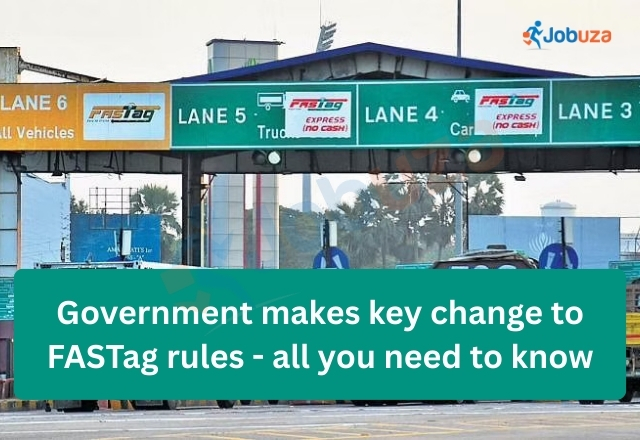
The government has announced a major relief for private vehicle owners by simplifying the FASTag issuance process. From February 1, 2026, buyers of new vehicles will no longer be required to complete a separate Know Your Customer (KYC) process while applying for FASTag.
The National Highways Authority of India (NHAI) stated that the decision aims to reduce delays, avoid repeated verification issues, and ensure smoother toll payments across national highways. Under the new system, vehicle details will be verified directly at the time of FASTag issuance, making the process faster and more efficient.
No Separate KYC for New FASTag Applicants
Earlier, vehicle owners applying for a new FASTag often faced problems such as incorrect KYC details, document mismatches, and repeated verification requests. These issues frequently delayed FASTag activation and caused inconvenience to motorists.
Under the revised rules, a separate KYC process has been removed for new FASTags. Instead, the vehicle’s Registration Certificate (RC) will be used for verification. This allows all necessary checks to be completed in a single step, reducing paperwork and simplifying the overall process for new vehicle owners.
What This Means for Existing FASTag Users
There is no change for vehicles that already have an active FASTag. Existing FASTag holders will not be required to undergo KYC again, provided there are no discrepancies or complaints linked to their FASTag account.
Verification will be initiated only in cases where a FASTag has been issued incorrectly or when vehicle details are found to be inaccurate. In such situations, authorities may review and correct the records to maintain system accuracy.
Banks to Follow Stricter Verification Norms
Under the new guidelines, banks issuing FASTags will have greater responsibility. Banks must verify vehicle details through the VAHAN portal before activating any FASTag. Without proper verification of registration data, FASTag activation will not be permitted.
According to the government, these measures are intended to prevent misuse, eliminate incorrect FASTag issuance, and improve transparency, while ensuring a smoother experience for genuine users.
Why This Change Is Important
The updated FASTag rules strike a balance between ease of use and system security. By removing unnecessary steps for new vehicle owners and strengthening verification at the bank level, the government aims to make toll collection more reliable, efficient, and user-friendly.
Vehicle owners are advised to ensure that their registration details are accurate and updated to avoid any issues during FASTag issuance or activation.
by Jobuza Team | Jan 7, 2026 | BLOG, Latest Jobs, UPSC Jobs
The Uttarakhand Public Service Commission (UKPSC) has officially announced Lecturer recruitment for government colleges in 2026. A total of 808 lecturer vacancies have been notified, offering a strong opportunity for candidates seeking a secure government teaching job in Uttarakhand.
Out of the total posts, 725 vacancies are for the General Branch, while 83 posts are reserved for the Women Branch. Candidates who hold a postgraduate degree along with a teaching qualification such as B.Ed or L.T. Diploma are eligible to apply.
The online application process will start on December 31, 2025, and the last date to apply is January 20, 2026. Interested candidates are advised to check eligibility carefully and submit their applications well before the deadline.
Vacancy Details
Subjects Covered:
Hindi, English, Sanskrit, Physics, Chemistry, Mathematics, Biology, Civics, Economics, History, Geography, Sociology, Commerce, Arts, Agriculture, Home Science, and other related subjects.
Eligibility Criteria
Educational Qualification:
Candidates must have a postgraduate degree in the relevant subject along with B.Ed or L.T. Diploma from a recognized institution.
Age Limit:
-
Minimum age: 21 years
-
Maximum age: 42 years
Age relaxation will be provided to SC, ST, OBC, and other reserved categories as per Uttarakhand government rules.
How to Apply for UKPSC Lecturer Recruitment 2026
Candidates can follow these steps to apply online:
-
Visit the official UKPSC website at psc.uk.gov.in
-
Click on the link for UKPSC Lecturer Recruitment 2026
-
Read the notification carefully before applying
-
Click on Apply Online and fill in all required personal and educational details
-
Upload scanned copies of photograph, signature, and necessary documents
-
Pay the application fee according to your category
-
Submit the application form and download a copy for future reference
The application process must be completed before January 20, 2026.
Selection Process
The selection of candidates will be carried out in the following stages:
Written Examination:
Eligible candidates will appear for a subject-wise written exam conducted by UKPSC.
Document Verification:
Candidates who qualify in the written examination will be called for verification of original documents.
Final Selection:
The final merit list will be prepared based on performance in the written exam and document verification.
Why This Recruitment Is Important
UKPSC Lecturer Recruitment 2026 provides a stable career opportunity in government education, attractive salary benefits, and long-term job security. Candidates planning to build a future in teaching should not miss this opportunity.

by Jobuza Team | Jan 6, 2026 | BLOG, Latest Jobs, UPSC Jobs
New Teacher Vacancies in UP 2026: Big updates are expected soon regarding teacher recruitment in Uttar Pradesh. The Uttar Pradesh Secondary Education Department is likely to send a proposal to the Education Service Selection Commission to fill more than 30,000 vacant TGT and PGT posts. Candidates preparing for government teaching jobs may receive positive news at the beginning of 2026.
Recruitment Process to Begin Soon
Recently, the issue of vacant TGT and PGT posts in non-government aided secondary schools was raised in both houses of the legislature. In response, the UP government confirmed that the Education Service Selection Commission has been formed, and the recruitment process for new teachers will begin shortly.
At present, the Secondary Education Department is collecting vacancy details from districts. Once the data collection is complete, the final requisition will be forwarded to the commission to initiate the recruitment process.
Expected Vacancies Under UP TGT PGT Recruitment 2026
This recruitment drive is expected to fill a large number of teaching posts across Uttar Pradesh. As per reports, around 30,731 vacancies may be announced in early 2026.
-
TGT (Trained Graduate Teacher): 24,515 posts
-
PGT (Post Graduate Teacher): 6,216 posts
These vacancies will be filled in aided secondary schools across the state.
Timeline for UP Teacher Recruitment Notification
According to directions issued by the Directorate of Education, all District Inspectors of Schools (DIOS) have been asked to verify and submit vacancy certificates. Posts reserved for transfers in the 2025–26 academic session will not be included in this process.
The Uttar Pradesh Education Selection Commission had already sought vacancy information for new recruitment on July 29. The deadline for submitting requisitions, including potential vacancies, has been fixed as March 31, 2026.
Once this process is completed, the UP Teacher Recruitment 2026 notification is expected to be released, officially starting the direct recruitment process.
Online Process and Transparency Measures
Before the notification is issued, all verified vacancies will be uploaded on the UPESSC portal by the Education Directorate. Each district has been instructed to ensure the accuracy of the data before final submission.
According to Deputy Director (Secondary-3) Dr. Brajesh Mishra, the entire exercise is being conducted to ensure transparency, accuracy, and efficiency. After approval, the recruitment process will be conducted fully online through the official portal.
What Candidates Should Do Now
Aspirants preparing for UP teacher jobs should focus on exam preparation and regularly check the official website for updates. With a large number of vacancies expected, UP Teacher Recruitment 2026 is likely to be one of the biggest opportunities for teaching aspirants in the coming year.

by Jobuza Team | Jan 6, 2026 | BLOG, Trending News
New Delhi: Indian Railways has announced a 3 percent discount on unreserved (general) ticket fares for passengers booking tickets through the RailOne mobile app. The Ministry of Railways confirmed that this offer will be available for six months, from January 14, 2026, to July 14, 2026.
Software Changes Ordered for Implementation
To introduce this discount, Indian Railways sent a letter to the Centre for Railway Information Systems (CRIS) on December 30, asking for necessary updates to the ticketing software. The ministry clarified that the discount will be applicable on all digital payment modes, including UPI, debit cards, credit cards, and net banking.
Up to 6% Benefit for R-Wallet Users
Currently, passengers paying through R-Wallet on the RailOne app receive 3 percent cashback, and this benefit will continue. With the new discount in place, R-Wallet users can now get a total benefit of up to 6 percent when booking general tickets through the RailOne app.
Discount Valid Only on RailOne App
Railway officials have made it clear that the 3 percent discount is available only on the RailOne app. Bookings made through other websites or apps will not qualify for this offer. The decision aims to encourage passengers to use the official app and reduce long queues at railway ticket counters.
What Is RailOne App?
RailOne is a single platform app developed by Indian Railways to offer all train-related services in one place. The app is free to download on Android and iOS devices. Once logged in using mPIN or biometric authentication, users can access all features easily without repeated logins.
How RailOne App Makes Travel Easier
Earlier, passengers needed multiple apps for different services such as ticket booking, train status, complaints, and food ordering. Managing several apps often caused confusion and used more mobile storage.
The RailOne app removes this problem by providing all essential railway services in one app, making train travel more convenient and hassle-free.
by Jobuza Team | Jan 6, 2026 | BLOG, Trending News
New Delhi: The Employees’ Provident Fund Organisation (EPFO) has introduced major changes to partial withdrawal rules under the newly implemented EPFO 3.0 system. The objective of these reforms is to simplify PF withdrawal rules, bring uniformity, and make the process more employee-friendly. The decisions were approved by the Central Board of Trustees under the chairmanship of Union Labour Minister Mansukh Mandaviya.
Changes in PF Withdrawal During Unemployment
Earlier, unemployed employees were allowed to withdraw 75 percent of their PF balance after one month of unemployment, while the remaining 25 percent could be withdrawn after two months.
Under EPFO 3.0, this rule has been modified. Employees can now immediately withdraw 75 percent of their PF amount after unemployment. However, full 100 percent withdrawal is permitted only after 12 months of continuous unemployment. This change aims to ensure long-term financial security while still providing immediate relief.
Pension Withdrawal Rules Tightened
Previously, pension withdrawal was allowed after two months of unemployment. Under the new EPFO 3.0 rules, the waiting period has been extended to 36 months (three years). This means employees can withdraw pension benefits only after being unemployed for a longer duration.
In cases of company lockouts or permanent closures, employees are allowed to withdraw 75 percent of their EPF corpus, while 25 percent must remain in the account to maintain the required minimum balance.
Withdrawals for Medical Emergencies and Special Situations
During pandemics or national emergencies, employees can still withdraw three months’ basic salary plus DA or 75 percent of their PF balance, whichever is lower. Under EPFO 3.0, the process has been standardised and made faster.
For medical emergencies involving self or family members, withdrawals are now allowed based on six months’ basic salary plus DA or the employee’s contribution, but a minimum service period of 12 months is mandatory.
Education and Marriage Withdrawal Rules Relaxed
EPFO 3.0 offers greater flexibility for education and marriage expenses. Employees can now withdraw PF for education up to 10 times and for marriage up to 5 times, which is more than what was allowed earlier. This change is expected to benefit young employees planning major life events.
Housing and Home Renovation Made Easier
Earlier, employees needed 24 to 36 months of service to withdraw PF for house construction, plot purchase, or housing-related expenses. Under EPFO 3.0, the minimum service requirement has been reduced to 12 months for all partial withdrawals, including housing needs.
Rules for home renovation remain unchanged but are now included in a uniform withdrawal framework. Housing loan-related withdrawals have also become fully digital and faster, reducing paperwork and delays.
Key Benefits of EPFO 3.0
The biggest benefit of EPFO 3.0 is the standardised 12-month minimum service requirement for most partial withdrawals. This reduces confusion, improves transparency, and ensures quicker access to PF funds when employees need them the most.
Overall, EPFO 3.0 marks a significant step towards making provident fund rules simpler, more consistent, and more accessible for India’s workforce.