by Jobuza Team | Jan 12, 2026 | BLOG, Trending News
Indian Railways has announced an important update for passengers booking train tickets through IRCTC. Starting Monday, January 5, 2026, the ticket booking time for Aadhaar-authenticated IRCTC users will be extended on the day the Advance Reservation Period (ARP) opens.
Earlier, on December 29, 2025, the Railways had revised the booking window for Aadhaar-linked IRCTC accounts. The latest change further expands this time period, giving verified users more flexibility while booking tickets.
According to Indian Railways, the move is aimed at ensuring that reservation benefits reach genuine passengers and to curb misuse of the system by touts and other unauthorised agents.
New IRCTC Ticket Booking Time for Aadhaar-Authenticated Users
In an official statement, IRCTC said that with effect from January 5, 2026, Aadhaar-authenticated users will be allowed to book reserved train tickets from 08:00 hrs to 16:00 hrs on the first day of the reservation window.
Until January 4, Aadhaar-verified users were permitted to book tickets only between 08:00 hrs and 12:00 hrs on the opening day of reservations.
This extension provides an additional four hours for Aadhaar-linked users to complete their bookings.
How Aadhaar Authentication Rules Evolved
Last year, Indian Railways made Aadhaar-based verification mandatory for booking reserved tickets through the IRCTC website or mobile app during the first 15 minutes of the opening of general reservations.
The requirement was later extended to the morning hours, allowing Aadhaar-authenticated bookings between 08:00 hrs and 10:00 hrs on the opening day. Subsequently, on December 29, the booking window was expanded further, permitting Aadhaar-verified users to book tickets until 12:00 hrs.
The latest update now extends this window up to 16:00 hrs, making it the widest booking window so far for Aadhaar-authenticated IRCTC users.
No Change in PRS Counter Booking Process
Indian Railways has clarified that there will be no change in the ticket booking procedure at computerised Passenger Reservation System (PRS) counters. The updated rule applies only to online ticket bookings made through the IRCTC website or app.
Updated Indian Railways Chart Preparation Timing
Indian Railways has also reiterated the latest guidelines regarding reservation chart preparation:
For trains departing between 05:01 hrs and 14:00 hrs, the first reservation chart will be prepared preferably by 20:00 hrs on the previous day.
For trains departing between 14:01 hrs and 23:59 hrs, as well as trains departing between 00:00 hrs and 05:00 hrs, the first reservation chart will be prepared preferably at least 10 hours before departure.
Passengers are advised to keep these timings in mind while checking seat availability and booking tickets.

by Jobuza Team | Jan 12, 2026 | BLOG, Latest Jobs, PSU Jobs, State Govt Job
The New Year has brought positive news for candidates preparing to join the Haryana Police. On Thursday, the Haryana Staff Selection Commission (HSSC) released an official notification for the recruitment of 5,500 Constable posts across the state.
As per the notification, the vacancies include 4,500 posts for Male Constables, 600 posts for Female Constables, and 400 posts for Haryana Railway Police.
Online Application Dates and Fee Details
HSSC Chairman Himmat Singh confirmed that the recruitment has been announced under Advertisement No. 01/2026. Online applications for the second phase of the Common Eligibility Test (CET) can be submitted from January 11 to January 25, 2026, up to 11:59 pm.
No application fee will be charged for candidates from any category. The complete and detailed recruitment advertisement is available on the official website of the Haryana Staff Selection Commission.
Validity Period for Reservation Certificates
Candidates applying under reserved categories must ensure that their certificates meet the prescribed validity requirements:
-
BC-A, BC-B and EWS certificates must be issued between April 1, 2025 and January 25, 2026
-
DSC and OSC certificates must be issued after November 13, 2024 and before the application closing date
-
Ex-Servicemen Family (ESM) eligibility certificates must be issued or renewed after January 12, 2025
Applicants are advised to verify certificate dates carefully, as invalid documents may lead to rejection.
Fresh Application Required for Previous Applicants
Candidates who had applied earlier under Advertisement No. 14/2024 will also be required to submit a fresh application for this recruitment process. However, such candidates will be eligible for age relaxation as per the applicable rules.
The Commission will release information related to the exam date and admit card download separately at a later stage.
No Correction Window Will Be Provided
The HSSC Chairman has strongly advised all applicants to read the recruitment notification carefully before submitting their forms. Candidates must ensure that all details are entered correctly before final submission.
Applicants have been warned not to depend on CSC centers or intermediaries while filling out the application form. If any error is found in the submitted application and it is rejected, no correction portal will be opened.
Once submitted, applications will be treated as final and incorrect forms will be automatically rejected. Candidates are therefore advised to fill out the application form personally and with complete caution.

by Jobuza Team | Jan 12, 2026 | BLOG, Trending News
Google has started quietly rolling out a long-awaited Gmail feature that finally allows users to change their @gmail.com email address without losing any data or account history. For years, Google maintained that a Gmail username, once chosen, was permanent. That stance has now changed.
With this update, users can select a new Gmail username within the same Google account, and all existing data will remain intact. This includes emails, contacts, Drive files, photos, calendar events, YouTube data, and app access.
Why This Update Is a Big Deal
Earlier, changing a Gmail address was a complicated and risky process. Users had to create a completely new Google account, manually forward emails, and attempt to migrate data like contacts, files, photos, and calendar events. Even then, there was no guarantee that everything would transfer correctly, making the process frustrating and error-prone.
Now, Google has simplified everything. Once the feature becomes available in your account, you can change your Gmail username directly from the settings, without re-entering personal information or moving data manually.
How the New Gmail Address Change Works
When the feature is visible in your account, you can find it by going to:
Google Account → Personal info → Email
From there, users can choose a new Gmail username, and the transition happens automatically within the same account. There’s no need to leave the Gmail settings screen, and no data migration is required.
Google’s support pages for this feature are already live and available in multiple languages, including Hindi, which suggests the rollout is already in early testing phases.
What Happens to Your Old Gmail Address
After changing your Gmail address, your old email ID will continue to work as an alias. This means:
-
Emails sent to your old Gmail address will still be delivered to your inbox
-
You can sign in to Google services using either the old or new email address
-
All existing emails, files, contacts, photos, calendar events, and app access remain unchanged
In short, your digital life stays exactly where it is.
Important Limitations You Should Know
While this feature is extremely useful, there are a few restrictions:
-
After changing your Gmail address, you cannot create another new Gmail address for one year
-
Google allows only a limited number of Gmail address changes per account, likely around three to four changes over the account’s lifetime
-
Google recommends backing up your data before making the change, as a general safety precaution
Google has not clarified whether these limits will vary by country or account type.
Why Changing a Gmail Address Matters Today
An email address is no longer just a way to send messages. It has become a core part of a person’s digital identity, used on resumes, business cards, job portals, banking services, and professional communication.
For users who chose a Gmail address years ago and have wanted to update it without starting over, this change is a major improvement. It reflects Google’s acknowledgment of how central Gmail accounts have become in everyday life.
As the rollout continues, more users will see this option appear in their accounts. We’ll update this information as Google shares more details about availability and rules surrounding Gmail address changes.
by Jobuza Team | Jan 7, 2026 | BLOG, Latest Jobs, State Govt Job
The Odisha Public Service Commission (OPSC) has officially released the Assistant Agriculture Officer (AAO) Recruitment 2026 notification. This recruitment drive is being conducted for the Agriculture and Farmers’ Empowerment Department, Odisha.
It is a strong opportunity for candidates holding a degree in Agriculture or Horticulture who are seeking a stable Odisha government job. The selection process will consist of a written examination followed by an interview. Eligible candidates should complete the online application process within the specified dates.
Important Dates for OPSC AAO Recruitment 2026
Candidates must carefully note the key dates related to the recruitment process:
-
Notification release date: December 31, 2025
-
Online application start date: January 10, 2026
-
Last date to apply online: January 27, 2026
-
Admit card release: February 2026 (tentative)
-
Written examination date: February 19, 2026
Vacancy Details
OPSC has announced a total of 118 vacancies for the Assistant Agriculture Officer post.
The vacancies are distributed among different categories according to government reservation rules. The AAO post falls under Group-B, Class-II services of the Odisha Agriculture and Food Production Service.
Eligibility Criteria
Educational Qualification
Candidates must possess one of the following qualifications from a recognized university:
-
Bachelor’s degree in Agriculture (B.Sc. Agriculture), or
-
Bachelor’s degree in Horticulture (B.Sc. Horticulture)
No other educational qualification will be considered eligible for this recruitment.
Age Limit
-
Minimum age: 21 years
-
Maximum age: 38 years
The age will be calculated as on January 1, 2025. Age relaxation will be applicable for candidates belonging to reserved categories such as SC, ST, SEBC, women, persons with disabilities, and ex-servicemen, as per government norms.
Selection Process and Exam Pattern
The selection process for Assistant Agriculture Officer includes the following stages:
Written Examination
Only candidates who qualify in the written examination will be called for the interview.
-
Examination mode: Online
-
Number of papers: 2
-
Marks per paper: 100
-
Total marks: 200
-
Total questions: 200 multiple-choice questions
-
Negative marking: 0.25 marks will be deducted for each incorrect answer
-
Exam date: February 19, 2026
Interview
Candidates shortlisted from the written exam will appear for the interview or personality test. Final selection will be based on combined performance.
Salary and Job Location
Selected candidates will be appointed under Pay Level 10, as per Odisha government pay rules. The posting may be in any district or department within the state of Odisha.
How to Apply Online
Candidates can apply online by following the steps below:
-
Visit the official website of OPSC
-
Open the link for AAO Recruitment 2026
-
Read the detailed notification carefully
-
Fill out the online application form with correct details
-
Upload required documents as per instructions
-
Submit the application before January 27, 2026
Applicants are advised to complete the application process well before the last date to avoid technical issues.
by Jobuza Team | Jan 7, 2026 | BLOG, Trending News
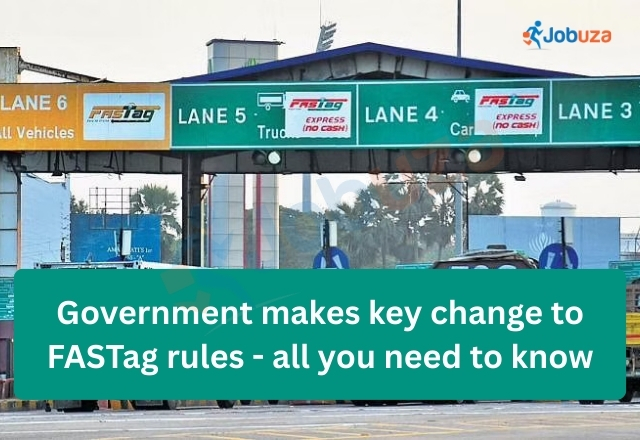
The government has announced a major relief for private vehicle owners by simplifying the FASTag issuance process. From February 1, 2026, buyers of new vehicles will no longer be required to complete a separate Know Your Customer (KYC) process while applying for FASTag.
The National Highways Authority of India (NHAI) stated that the decision aims to reduce delays, avoid repeated verification issues, and ensure smoother toll payments across national highways. Under the new system, vehicle details will be verified directly at the time of FASTag issuance, making the process faster and more efficient.
No Separate KYC for New FASTag Applicants
Earlier, vehicle owners applying for a new FASTag often faced problems such as incorrect KYC details, document mismatches, and repeated verification requests. These issues frequently delayed FASTag activation and caused inconvenience to motorists.
Under the revised rules, a separate KYC process has been removed for new FASTags. Instead, the vehicle’s Registration Certificate (RC) will be used for verification. This allows all necessary checks to be completed in a single step, reducing paperwork and simplifying the overall process for new vehicle owners.
What This Means for Existing FASTag Users
There is no change for vehicles that already have an active FASTag. Existing FASTag holders will not be required to undergo KYC again, provided there are no discrepancies or complaints linked to their FASTag account.
Verification will be initiated only in cases where a FASTag has been issued incorrectly or when vehicle details are found to be inaccurate. In such situations, authorities may review and correct the records to maintain system accuracy.
Banks to Follow Stricter Verification Norms
Under the new guidelines, banks issuing FASTags will have greater responsibility. Banks must verify vehicle details through the VAHAN portal before activating any FASTag. Without proper verification of registration data, FASTag activation will not be permitted.
According to the government, these measures are intended to prevent misuse, eliminate incorrect FASTag issuance, and improve transparency, while ensuring a smoother experience for genuine users.
Why This Change Is Important
The updated FASTag rules strike a balance between ease of use and system security. By removing unnecessary steps for new vehicle owners and strengthening verification at the bank level, the government aims to make toll collection more reliable, efficient, and user-friendly.
Vehicle owners are advised to ensure that their registration details are accurate and updated to avoid any issues during FASTag issuance or activation.
by Jobuza Team | Jan 7, 2026 | BLOG, Latest Jobs, UPSC Jobs
The Uttarakhand Public Service Commission (UKPSC) has officially announced Lecturer recruitment for government colleges in 2026. A total of 808 lecturer vacancies have been notified, offering a strong opportunity for candidates seeking a secure government teaching job in Uttarakhand.
Out of the total posts, 725 vacancies are for the General Branch, while 83 posts are reserved for the Women Branch. Candidates who hold a postgraduate degree along with a teaching qualification such as B.Ed or L.T. Diploma are eligible to apply.
The online application process will start on December 31, 2025, and the last date to apply is January 20, 2026. Interested candidates are advised to check eligibility carefully and submit their applications well before the deadline.
Vacancy Details
Subjects Covered:
Hindi, English, Sanskrit, Physics, Chemistry, Mathematics, Biology, Civics, Economics, History, Geography, Sociology, Commerce, Arts, Agriculture, Home Science, and other related subjects.
Eligibility Criteria
Educational Qualification:
Candidates must have a postgraduate degree in the relevant subject along with B.Ed or L.T. Diploma from a recognized institution.
Age Limit:
-
Minimum age: 21 years
-
Maximum age: 42 years
Age relaxation will be provided to SC, ST, OBC, and other reserved categories as per Uttarakhand government rules.
How to Apply for UKPSC Lecturer Recruitment 2026
Candidates can follow these steps to apply online:
-
Visit the official UKPSC website at psc.uk.gov.in
-
Click on the link for UKPSC Lecturer Recruitment 2026
-
Read the notification carefully before applying
-
Click on Apply Online and fill in all required personal and educational details
-
Upload scanned copies of photograph, signature, and necessary documents
-
Pay the application fee according to your category
-
Submit the application form and download a copy for future reference
The application process must be completed before January 20, 2026.
Selection Process
The selection of candidates will be carried out in the following stages:
Written Examination:
Eligible candidates will appear for a subject-wise written exam conducted by UKPSC.
Document Verification:
Candidates who qualify in the written examination will be called for verification of original documents.
Final Selection:
The final merit list will be prepared based on performance in the written exam and document verification.
Why This Recruitment Is Important
UKPSC Lecturer Recruitment 2026 provides a stable career opportunity in government education, attractive salary benefits, and long-term job security. Candidates planning to build a future in teaching should not miss this opportunity.