by Jobuza Team | May 28, 2026 | BLOG, Trending News
Bharat Gas customers have been advised to complete their eKYC process before June 30, 2026, to continue receiving LPG cylinder services and subsidy benefits without interruption. Bharat Petroleum has issued an important update for all LPG consumers, asking them to complete biometric-based verification as part of the government’s digital authentication initiative.
Customers who fail to complete the eKYC process within the given deadline may face difficulties in receiving LPG subsidies and booking gas cylinders in the future.
Why Bharat Gas eKYC Is Important
The government and oil marketing companies are focusing on digital verification to make LPG distribution more transparent and secure. The eKYC process helps eliminate fake or duplicate gas connections and ensures that subsidies reach genuine consumers only.
Biometric authentication-based verification has now become an important requirement for LPG users across the country.
Bharat Gas Users Can Complete eKYC From Home
Bharat Gas customers no longer need to visit the gas agency for basic verification. The company has introduced a simple online process through the HelloBPCL App, allowing users to complete their eKYC directly from their smartphones.
Customers only need their Aadhaar-linked mobile number and the official HelloBPCL application to complete the process.
How to Complete Bharat Gas eKYC Through HelloBPCL App
Download the HelloBPCL App
First, open the Google Play Store or Apple App Store on your mobile phone. Search for the HelloBPCL App and install it on your device.
Login Using Registered Mobile Number
After opening the app, enter your registered mobile number linked to your Bharat Gas connection. You will receive an OTP for verification. Enter the OTP to log in successfully.
Once logged in, go to the LPG Services or Bharat Gas section available on the homepage.
Select the eKYC Option
Inside the Bharat Gas section, tap on the eKYC or Biometric Authentication option.
Enter your Aadhaar number carefully. An OTP may be sent to the mobile number linked with your Aadhaar card. Complete the verification process by entering the OTP.
In some cases, customers may also be asked for fingerprint verification or face authentication. For biometric verification, users may need to visit the nearest Bharat Gas agency or authorised verification centre.
Submit and Complete Verification
After filling in all the required details, click on the Submit button to complete the eKYC process.
Once verification is successful, customers will receive confirmation through SMS or app notification.
What Happens if eKYC Is Not Completed
Customers who do not complete their Bharat Gas eKYC before June 30, 2026, may face issues with LPG subsidy transfers and gas cylinder services. Oil companies may temporarily suspend subsidy benefits until verification is completed.
Consumers are advised to complete the process as early as possible to avoid last-minute technical issues or delays.
Bharat Gas eKYC 2026 Key Details
Organisation: Bharat Petroleum Corporation Limited (BPCL)
Service: Bharat Gas LPG Connection
Process Required: eKYC Verification
Last Date: June 30, 2026
Mode: Online Through HelloBPCL App
Requirement: Aadhaar-linked mobile number
Purpose: Continue LPG subsidy and gas services without interruption
Read More Trending News Updates
by Jobuza Team | May 25, 2026 | BLOG, Trending News
The Income Tax Return filing season has started, and taxpayers are preparing to submit their returns for the financial year. Filing an ITR becomes much easier and error-free when all important documents are kept ready in advance.
Many taxpayers begin the filing process without proper preparation and later struggle to collect documents while filling the form. This often leads to mistakes, incorrect income reporting, delayed refunds, or even notices from the Income Tax Department.
Keeping all required documents ready before filing your Income Tax Return helps ensure accurate tax calculation, smooth verification, and faster processing of refunds.
Why Keeping Documents Ready Before Filing ITR Is Important
Before filing your ITR, it is important to organize all financial and tax-related documents properly. These records help taxpayers report their income correctly, claim deductions, verify taxes already paid, and avoid mismatches in tax details.
Proper documentation also reduces the chances of receiving an income tax notice due to incorrect information or missing disclosures.
Salary and Tax Documents Required for ITR Filing
Salaried individuals should keep salary and tax-related documents ready before starting the filing process.
Important documents include:
- Form 16 issued by the employer
- Form 16A or Form 16B for TDS on non-salary income
- Annual Information Statement (AIS)
- Form 26AS for tax credit verification
- Salary slips
- Bank statements
- Fixed Deposit interest certificates
These documents help taxpayers verify salary income, tax deductions, and interest earnings accurately.
Income Proof Documents You Should Keep Ready
Taxpayers must also keep records of all additional sources of income.
Important income-related documents include:
- Capital gains statements from shares, mutual funds, gold, or property sales
- Broker statements and transaction reports
- Dividend income details
- Rental income documents
- Interest income certificates
These documents help ensure that all taxable income is properly declared while filing the return.
Documents Required Under the New Tax Regime
Taxpayers choosing the new income tax regime should keep specific documents related to eligible benefits and contributions.
These include:
- Employer contribution details to NPS account
- Home loan interest certificate
Although the new tax regime offers fewer deductions, these documents may still be required for eligible claims and record verification.
Documents Required Under the Old Tax Regime
Taxpayers opting for the old tax regime should collect all deduction and exemption-related documents before filing ITR.
Important documents include:
Section 80C Investment Proof
- Provident Fund contribution details
- LIC premium receipts
- ELSS investment documents
- Tuition fee receipts
Section 80D Health Insurance Proof
- Health insurance premium payment receipts
Other Important Deduction Documents
- NPS contribution details
- Home loan interest certificate
- Education loan documents under Section 80E
- Donation receipts under Section 80G
These records help taxpayers claim deductions and reduce taxable income legally.
Other Important Documents Needed for ITR Filing
Apart from income and deduction proofs, taxpayers should also keep some essential personal and banking documents ready.
These include:
- PAN card linked with Aadhaar
- Aadhaar number
- Pre-verified bank account details for refund processing
- Rent receipts and rental agreement for HRA claims
Keeping these details ready helps avoid delays during verification and refund processing.
Experts Suggest Waiting for Form 16 Before Filing ITR
Tax experts generally recommend waiting until employers issue Form 16 before filing the Income Tax Return.
According to tax professionals, most employers are expected to issue Form 16 for FY 2025-26 by June 15, 2026. Filing the return after receiving Form 16 helps taxpayers match salary income, TDS details, and deductions correctly.
This reduces the possibility of errors and ensures smoother processing of the return.
Final Words
Filing your Income Tax Return becomes much simpler when all important documents are organized beforehand. Proper preparation not only saves time but also helps avoid mistakes, tax notices, and refund delays.
Read More Trending News Updates
by Jobuza Team | May 15, 2026 | BLOG, PAN/Aadhar Card Updates, Trending News
Unique Identification Authority of India issues Aadhaar cards to residents of India without any age restriction. This means even a newborn baby can be enrolled for Aadhaar through the Baal Aadhaar scheme.
Baal Aadhaar is specially designed for children below five years of age and serves as an important identity document for school admissions, government schemes, healthcare services, and other official purposes.
Parents can apply for their child’s Aadhaar free of cost at authorised Aadhaar enrolment centres.
Documents Required for Baal Aadhaar Registration
To enrol a child below the age of five years for Aadhaar, parents generally need:
- Child’s Birth Certificate
- Hospital discharge slip in case of newborns
- Aadhaar card of one parent or guardian
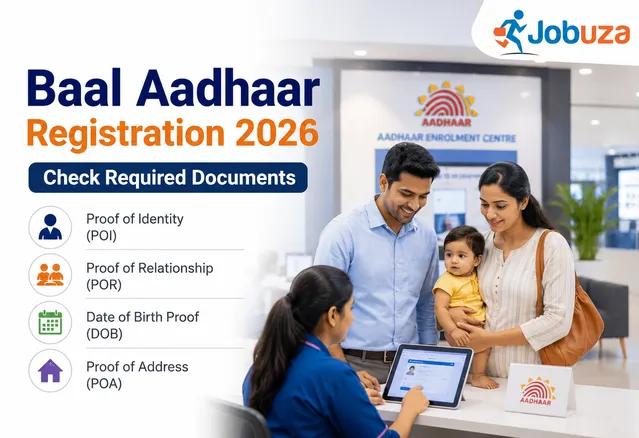
Apart from these, UIDAI also accepts several other documents under different categories such as identity proof, relationship proof, date of birth proof, and address proof.
Proof of Identity Documents Accepted for Baal Aadhaar
The following documents can be used as Proof of Identity (POI) for Aadhaar enrolment:
- Passport
- PAN Card
- Voter ID
- Driving Licence
- Ration Card with photograph
- Government photo ID cards
- NREGS Job Card
- Educational institution photo ID
- Bank passbook with photograph
- Pensioner photo card
- Kissan photo passbook
- CGHS or ECHS card
- Disability ID card
- Jan Aadhaar or Bhamashah card
- School Leaving Certificate with photograph
- School Transfer Certificate
- Gazette notification for name change
- Marriage certificate with photograph
UIDAI also accepts certificates issued by gazetted officers, village panchayat heads, MPs, MLAs, and recognised institutions in prescribed formats.
Proof of Relationship Documents for Child Aadhaar
For children below five years, parents may need to submit Proof of Relationship (POR) documents showing the connection between the child and the Head of Family.
Accepted documents include:
- Birth Certificate
- Passport
- PDS Card
- Pension Card
- Army Canteen Card
- Government-issued family entitlement documents
- Marriage Certificate
- Hospital discharge slip for newborn child
- Jan Aadhaar or Bhamashah Card
Certificates issued by local authorities or government officials may also be accepted.
Date of Birth Documents Required for Aadhaar
The following documents are accepted as valid proof of date of birth:
- Birth Certificate
- Passport
- PAN Card
- School records
- School Leaving Certificate
- Marksheet issued by government board or university
- Government-issued ID containing date of birth
- Educational institution ID card
- EPFO certificate
The Birth Certificate remains the most commonly used document for children below five years.
Proof of Address Documents Accepted
Parents or guardians may also need to provide address proof while applying for Baal Aadhaar.
Accepted Proof of Address (POA) documents include:
- Passport
- Bank passbook or statement
- Post office account statement
- Ration Card
- Voter ID
- Driving Licence
- Electricity bill
- Water bill
- Telephone bill
- Gas connection bill
- Insurance policy
- Registered rent agreement
- Vehicle registration certificate
- Parent’s passport in case of minors
- School identity card
- Jan Aadhaar card
Certificates issued by government authorities, village panchayats, municipal councillors, or educational institutions are also accepted in some cases.
Important Things Parents Should Know
Children below five years are not required to provide biometric details such as fingerprints or iris scans during initial enrolment. Only a facial photograph is captured at the time of registration.
Once the child turns five years old, biometric details must be updated mandatorily. Another biometric update is required again after the age of 15 years.
How To Apply for Baal Aadhaar
Parents can visit the nearest Aadhaar enrolment centre with the required documents and complete the application process.
The enrolment process usually includes:
- Filling the Aadhaar enrolment form
- Providing parent or guardian Aadhaar details
- Submitting supporting documents
- Capturing the child’s photograph
After verification, the Baal Aadhaar is generated and delivered to the registered address.
Parents are advised to carry original documents for verification during the enrolment process.
Read More Trending News Updates

by Jobuza Team | May 15, 2026 | BLOG, Trending News
Dead Lizard Found: A video circulating rapidly on social media has shocked many users after claiming that a lizard-like creature was found inside a sealed bottle of Thums Up. The clip has triggered concern among consumers and reignited discussions around food and beverage safety in India.
The viral video has attracted widespread attention online, with viewers expressing both fear and disbelief. However, no official authority or company has yet confirmed the authenticity of the claim.
What the Viral Video Shows
In the video, a man is seen opening a bottle of Thums Up and pouring the soft drink into another container. As the liquid flows out, a strange object resembling a dead lizard appears to emerge from inside the bottle.
The post accompanying the video claims that the bottle was sealed before purchase. However, important details such as the exact location, date, and source of the incident remain unclear.
Due to the absence of verified information, many users are questioning whether the video is genuine or digitally manipulated.
No Official Statement From Coca-Cola India
So far, Coca-Cola India has not released any official response regarding the viral video.
There is also no confirmation about whether a formal complaint has been submitted to the company or to any food safety authority. This lack of official clarification has further increased public curiosity and speculation surrounding the incident.
Social Media Users Divided Over the Viral Clip
The video has created mixed reactions across social media platforms.
Some users are calling it a serious food safety issue and demanding a proper investigation into the matter. Others believe the video may have been edited or staged to gain attention online.
Several viewers have also questioned the appearance of the bottle and the way the drink was being poured in the video, suggesting that the footage should not be accepted as genuine without proper verification.
Food Safety Concerns Raised Again
Whether authentic or fake, the incident has once again highlighted growing concerns around food and beverage safety among consumers.
Experts believe that viral videos involving popular brands can spread panic quickly if accurate information is not provided in time. They also stress the importance of proper investigation before drawing conclusions from social media content.
Incidents like these often raise awareness about the need for strict quality checks, transparent communication, and responsible sharing of online content.
Experts Advise Caution Before Believing Viral Claims
Dead Lizard Found: Digital experts and food safety observers have advised people not to trust viral videos immediately without confirmation from official authorities.
With edited and misleading videos becoming increasingly common online, users are encouraged to verify facts before sharing such content further.
Authorities may investigate the matter if any formal complaint or evidence is submitted regarding the alleged incident.
Read More Trending News Updates

by Jobuza Team | May 14, 2026 | BLOG, Trending News
The central government has increased the import duty on gold and silver from 6 percent to 15 percent in a major move aimed at protecting India’s foreign exchange reserves and strengthening the economy amid global uncertainty.
Under the revised structure, gold and silver imports will now attract a 10 percent basic customs duty along with a 5 percent Agriculture Infrastructure and Development Cess (AIDC). This brings the total effective import duty to 15 percent.
The decision comes at a time when rising global crude oil prices, pressure on the rupee, and increasing demand for US dollars are creating challenges for the Indian economy.
Why the Government Increased Gold Import Duty
The government’s decision is being linked to several economic concerns, including the growing import bill and pressure on foreign exchange reserves.
Experts believe that higher import duty may help reduce excessive dependence on imported gold and improve the country’s overall trade balance.
Reduction in Gold and Silver Imports
India is one of the world’s largest consumers of gold, but a major portion of domestic demand is fulfilled through imports.
According to industry data, investment demand for gold has also increased sharply in recent months. Reports suggest that investment in gold ETFs rose significantly during the March quarter.
By increasing import duty, the government aims to make imported gold more expensive, which may reduce unnecessary demand and lower overall imports.
Experts also believe that promoting gold recycling and encouraging participation in the Gold Monetization Scheme could help reduce dependence on imported precious metals.
Pressure on Foreign Exchange Reserves
Gold imports are paid for in US dollars, which directly affects India’s foreign exchange reserves.
At the same time, rising crude oil prices and geopolitical tensions in the global market have increased demand for the dollar worldwide. This has added further pressure on India’s forex reserves.
Prime Minister Narendra Modi has also urged citizens to avoid unnecessary purchases and conserve resources to support the economy during uncertain global conditions.
Reports indicate that gold imports had already fallen sharply in recent months, and the higher duty could lead to a further decline.
Government Wants To Stabilise the Rupee
The Indian rupee has been facing continuous pressure against the US dollar.
When imports of commodities like gold and crude oil rise, the country needs more dollars for payments, which increases demand for the US currency and weakens the rupee further.
By discouraging imports of non-essential products such as gold, the government hopes to reduce pressure on the rupee and maintain currency stability.
Economists believe that controlling unnecessary imports can help improve investor confidence and reduce volatility in the foreign exchange market.
Efforts To Reduce Trade Deficit
The trade deficit increases when a country imports more goods than it exports.
Experts often classify gold as a non-productive import because it does not directly contribute to manufacturing output or exports on a large scale.
Along with crude oil and electronic goods, gold imports contribute significantly to India’s overall import bill.
The government believes that reducing gold imports can help improve the country’s trade balance and support long-term economic stability.
Jewelry Industry Raises Concerns
While the government sees the move as necessary for economic management, the jewelry industry has expressed concerns about its impact on demand and employment.
Industry representatives say that a sharp rise in gold prices due to higher import duty could reduce consumer purchases, affecting jewelers, artisans, and workers associated with the sector.
Millions of people in India are directly or indirectly connected to the jewelry industry for their livelihood.
Experts believe the long-term success of the policy will depend on how effectively the government supports domestic gold recycling and alternative investment options.
Impact on Gold Prices and Consumers
Following the increase in import duty, gold and silver prices in the domestic market may rise further.
Consumers planning to buy jewelry or invest in gold could face higher costs in the coming months.
At the same time, financial experts believe that the move may encourage some investors to explore alternative investment options instead of physical gold purchases.
Read More Trending News Updates
by Jobuza Team | May 14, 2026 | BLOG, Trending News
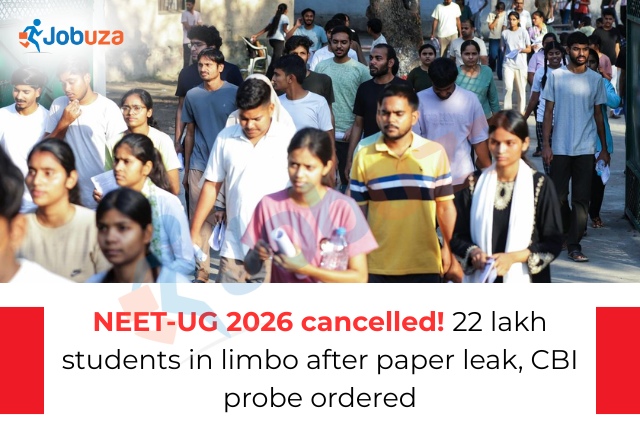
The National Testing Agency (NTA) has officially cancelled the NEET UG 2026 examination following allegations of a major paper leak. The entrance exam, which was conducted on May 3 and attended by more than 22 lakh students across the country, will now be held again from the beginning.
The decision came after reports of irregularities surfaced just days after the examination. The matter has now been handed over to the Central Bureau of Investigation for a detailed investigation into the alleged leak and possible involvement of organised networks.
Why NEET UG 2026 Was Cancelled
According to the NTA, the examination was cancelled after evidence shared by law enforcement agencies suggested that the integrity of the exam had been compromised.
The agency stated that allowing the existing examination results to stand could have damaged the credibility and fairness of one of India’s largest medical entrance examinations. As a result, the authorities decided that conducting a fresh examination was the only fair solution for all candidates.
The controversy reportedly began after officials received information regarding suspicious activities linked to the question paper shortly after the exam concluded.
What the CBI Investigation Will Focus On
The central government has assigned the case to the CBI to investigate how the alleged leaked paper reached candidates before the examination.
Reports suggest that the leaked material may have included all 90 Biology questions and all 45 Chemistry questions from the actual examination paper.
Investigators are expected to examine whether the incident involved an organised cheating network operating across multiple states.
The investigation will reportedly trace the suspected leak route beginning from a printing facility in Jaipur and extending to several locations, including:
- Sikar
- Jhunjhunu
- Nagaur
- Dehradun
- Jaipur
- Kerala
Authorities have already questioned around 15 individuals in connection with the case.
The NTA has assured full cooperation with the investigation and said that all technical records, documents, and related data will be provided to the agency.
Relief Measures Announced for Students
To reduce inconvenience for students, the NTA has announced several relief measures for candidates affected by the cancellation.
The agency clarified that students will not need to complete a fresh registration process. Existing application data will automatically remain valid for the re-examination.
The previously allotted examination centres will also continue for most candidates.
In addition:
- No additional application fee will be charged
- Any fee already collected will be refunded
- Fresh admit cards will be issued before the new examination date
The revised examination schedule is expected to be announced through official channels in the coming weeks.
NTA Appeals Students To Avoid Rumours
The NTA has advised students and parents not to rely on unverified information circulating on social media platforms.
Candidates have been asked to follow only official announcements for updates regarding the new exam date, admit cards, and examination guidelines.
The agency also encouraged students to continue their preparation while waiting for the revised schedule.
Uncertainty Among Lakhs of Medical Aspirants
The cancellation has created anxiety and uncertainty among lakhs of NEET aspirants and their families. For many students, the examination represents years of preparation and determines admission into medical colleges across India.
Despite the disruption, officials have maintained that protecting the fairness and transparency of the examination system is essential for safeguarding the future of deserving candidates.
Students are now waiting for the official announcement regarding the fresh NEET UG 2026 examination date and further instructions from the NTA.
Read More Trending News Updates