by Jobuza Team | May 13, 2026 | BLOG, Trending News
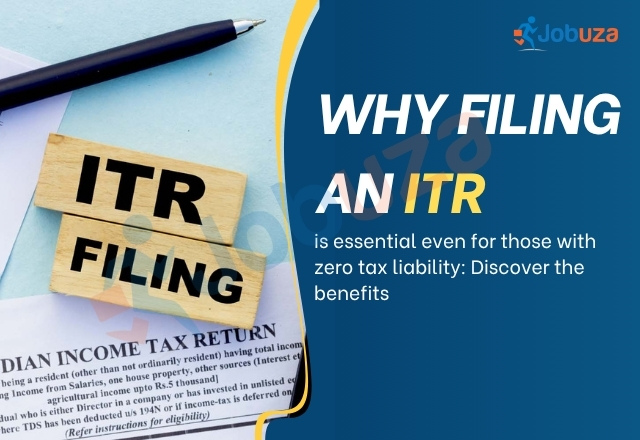
Many people believe that filing an Income Tax Return (ITR) is necessary only when they have to pay income tax. However, this is not entirely true. Even individuals with zero tax liability can benefit significantly from filing their ITR on time.
In today’s digital financial system, filing an ITR is not just about paying taxes. It also acts as an official record of your income, financial activities, and tax compliance. Whether you are a salaried employee, freelancer, student, or small business owner, filing an ITR can provide several long-term financial advantages.
Filing ITR Helps You Claim TDS Refunds
There are many situations where Tax Deducted at Source (TDS) is deducted even when your total income falls below the taxable limit.
For example, TDS may be deducted from:
- Bank fixed deposit interest
- Freelance income
- Dividend earnings
- Contract payments
In such cases, the only way to claim a refund of the deducted amount is by filing an Income Tax Return.
Without filing an ITR, the deducted money may remain unclaimed.
ITR Serves as an Official Income Record
An ITR works as a legal and official document of your annual income and financial transactions. It also helps maintain transparency between taxpayers and the Income Tax Department.
Your filed return gets matched with important records such as:
- AIS (Annual Information Statement)
- TIS (Taxpayer Information Summary)
This helps ensure that your financial details remain properly documented and reduces the chances of receiving notices or scrutiny in the future.
Important for Loan Applications
Income Tax Returns play an important role when applying for different types of loans.
Banks and financial institutions often ask applicants to submit ITR records for the previous two to three years while processing:
- Home loans
- Car loans
- Personal loans
- Business loans
Even if you had no tax liability during those years, your ITR still acts as proof of income and financial stability. A regular ITR filing history can improve your credibility and increase the chances of loan approval.
Useful for Visa Applications
ITR documents are also considered important during visa processing.
Many countries ask applicants to provide Income Tax Return records for the last three to five years for:
- Student visas
- Work visas
- Tourist visas
- Business visas
These documents help embassies verify your financial background and income sources. In some cases, the absence of ITR records may affect the approval process.
Filing ITR Improves Financial Credibility
Regularly filing Income Tax Returns reflects financial discipline and responsible tax compliance. It creates a strong financial profile that can be beneficial in the future for banking, investments, insurance, and credit-related matters.
Even if your income is currently below the taxable limit, maintaining a proper ITR history can be valuable later when your income increases or financial requirements change.
Income Tax Department Tracks Financial Transactions
With increasing digitisation, the Income Tax Department can monitor many types of financial activities, including:
- Bank transactions
- Investment records
- High-value purchases
- Online financial activities
Filing an ITR helps maintain proper documentation of your income and financial dealings. This can help avoid confusion or unnecessary inquiries in the future.
Why Filing ITR Is a Smart Financial Habit
Filing an Income Tax Return is no longer limited to taxpayers with high incomes. It has become an important financial practice for maintaining transparency, building financial credibility, and accessing banking and visa-related benefits.
Even when there is no tax liability, filing an ITR can help you secure refunds, strengthen your financial profile, and keep your income records officially documented.

by Jobuza Team | May 13, 2026 | BLOG, Trending News
State-owned oil marketing companies have issued an important warning for LPG consumers across India regarding a growing number of online delivery scams. Major companies including Hindustan Petroleum Corporation Limited, Indian Oil Corporation, and Bharat Petroleum have alerted customers about fraudsters sending fake LPG delivery messages and making fraudulent calls in the name of gas agencies.
The companies shared the warning through their official social media platforms after reports of increasing cyber fraud cases targeting domestic LPG users.
Fake LPG Delivery Messages Targeting Customers
According to the advisory, scammers are sending fake SMS and WhatsApp messages that appear similar to official LPG delivery notifications. These messages are designed to trick customers into sharing sensitive details such as One-Time Passwords (OTPs) and Delivery Authentication Codes (DACs).
In several cases, fraudsters are also calling consumers while pretending to be gas agency representatives. They ask customers to complete KYC verification or Aadhaar linking to avoid disconnection of gas services. During the process, they request OTPs and other confidential information.
Oil companies have clearly stated that official representatives never ask customers to share OTPs through phone calls, WhatsApp chats, or suspicious links.
HPCL Shares Official Delivery Message Details
HPCL explained that genuine LPG delivery messages follow a specific format. According to the company, official delivery SMS messages are sent only from the sender name “VM-HPGASc-S” and contain a 4-digit OTP used only during cylinder delivery.
The company advised customers not to trust any urgent or suspicious-looking message that differs from the official format.
HPCL also clarified that its employees or delivery agents never ask customers to share OTPs over calls or messaging apps.
How LPG Consumers Can Stay Safe
Customers are advised to use only official platforms while booking LPG cylinders or updating account details. Consumers should avoid clicking unknown links or responding to messages received from personal mobile numbers.
Official apps recommended by the companies include:
Consumers should also regularly verify messages received from gas agencies and avoid sharing personal details without confirmation.
What To Do If You Become a Victim of LPG Scam
If any customer has accidentally shared banking details, OTPs, or lost money in such scams, they should immediately contact the National Cyber Crime Helpline by dialing 1930.
Cybercrime experts say that reporting fraud within the “golden hour” significantly increases the chances of freezing stolen funds and preventing further misuse.
Consumers can also report incidents through the official cybercrime portal managed by the Government of India.
Oil Companies Urge Customers To Remain Alert
With digital fraud cases increasing rapidly, oil marketing companies are encouraging LPG users to stay cautious while dealing with online messages and calls related to gas delivery services.
Customers are advised to trust only official communication channels and avoid sharing sensitive information with unknown callers or unverified platforms.
by Jobuza Team | May 11, 2026 | BLOG, Trending News
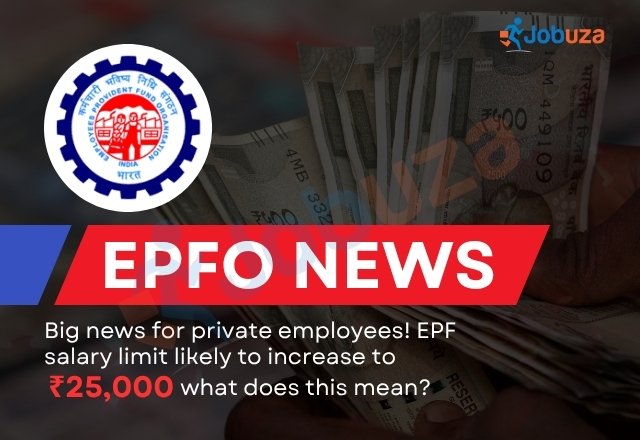
There may soon be a major change in the Employees’ Provident Fund (EPF) system for private sector employees in India. According to media reports, the central government is considering increasing the salary threshold for mandatory EPF coverage from the current ₹15,000 to ₹25,000 per month.
Although no official notification has been issued yet, discussions regarding this proposal are reportedly underway. If implemented, the move could bring a large number of additional employees under the EPF scheme and strengthen social security benefits for workers.
What Is the Current EPF Salary Limit
At present, employees earning up to ₹15,000 per month in basic salary plus dearness allowance are required to become members of the EPF scheme.
Employees earning above this limit can choose whether they want to join EPF, provided they were not previously registered as EPF members.
This wage ceiling has remained unchanged for several years, and the proposed revision is being seen as an important reform for salaried employees.
What Will Change if the Salary Limit Is Raised to ₹25,000
If the government increases the EPF salary threshold to ₹25,000, employees earning up to this amount will be required to enroll in the EPF scheme.
This means employees with salaries between ₹15,000 and ₹25,000 will no longer have the option to opt out of EPF membership.
For example, if a newly hired employee earns a basic salary of ₹18,000 per month, EPF enrollment would become mandatory under the proposed rule.
The change is expected to expand EPF coverage and improve retirement savings for millions of private employees.
How the New EPF Limit Could Impact Employees
One of the biggest impacts of this change would be an increase in monthly PF contributions.
Currently, EPF contributions are calculated as 12 percent of basic salary and dearness allowance from both the employee and employer side.
If the salary limit increases, employees earning higher salaries within the new range may see a larger deduction toward their PF account.
For instance, an employee earning ₹20,000 per month may contribute around ₹2,400 monthly toward EPF instead of the earlier ₹1,800 contribution.
Although this could slightly reduce take-home salary in the short term, it would help employees build a larger retirement corpus over time.
Why the Government May Increase the EPF Wage Ceiling
The proposed increase is aimed at improving financial security and retirement benefits for workers in the private sector. Rising salaries and inflation have also made the existing ₹15,000 limit less relevant compared to current income levels.
By increasing the wage ceiling, the government may ensure that more employees receive long-term savings benefits through the EPF system.
No Official Announcement Yet
While reports suggest that the proposal is under consideration, the government has not made any official announcement regarding the change.
Employees and employers are advised to wait for a formal notification from EPFO or the Ministry of Labour and Employment before drawing conclusions.
If approved, the move could become one of the most significant changes to the EPF system in recent years.
by Jobuza Team | May 8, 2026 | BLOG, Trending News
Filing Income Tax Returns (ITR) can sometimes feel confusing, especially for first-time taxpayers. Even small mistakes in the return form may lead to an income tax notice from the Income Tax Department. However, receiving a notice does not always mean that you have done something wrong.
In many cases, notices are issued simply to verify information, correct errors, or request clarification about certain details mentioned in the return.
What Is an Income Tax Notice
An income tax notice is an official communication sent by the Income Tax Department. It can be issued either before or after filing your ITR. The notice may relate to missing information, mismatched records, incorrect details, or even routine verification.
Before taking any action, taxpayers should first verify whether the notice is genuine. This can be done through the official Income Tax e-filing portal using details such as PAN number, Document Identification Number (DIN), and other required information.
Why You May Receive an Income Tax Notice
There are several common reasons why taxpayers receive notices from the Income Tax Department. Most notices are triggered due to mismatches between the information provided in the return and the data already available with the department.
Some common reasons include:
- Failure to file Income Tax Return
- Filing ITR using the wrong form
- Mismatch in TDS details between Form 26AS, AIS, and ITR
- Not reporting rental income, freelance income, pension, or interest income
- Missing capital gains from shares, mutual funds, or property sales
- High-value transactions not matching declared income
- Non-disclosure of assets or investments
- Random assessment or scrutiny by the department
Ignoring a notice can lead to penalties or further action, so it is important to respond within the given timeline.
What to Do After Receiving an Income Tax Notice
The first step is to carefully read the notice and identify the section under which it has been issued. This helps you understand the purpose of the notice and the type of response required.
After understanding the notice, collect all relevant documents such as:
- Form 16
- Bank statements
- Investment proofs
- PAN card details
- Transaction records
- Capital gains statements
Next, log in to the Income Tax e-filing portal and check the “Pending Actions” or “e-Proceedings” section. Upload the required explanation along with supporting documents and submit your response online.
Once the response is submitted, download the acknowledgement copy for future reference. Taxpayers should continue monitoring their email and the e-filing portal for further communication from the department.
If required, you can also seek help from a Chartered Accountant or tax advisor.
Importance of Choosing the Correct ITR Form
Using the wrong ITR form is one of the major reasons taxpayers receive notices. Selecting the correct form based on your income type is extremely important.
ITR-1
ITR-1 is meant for salaried individuals with income up to Rs. 50 lakh, one house property, and income from other sources such as interest. It is the most commonly used form for individual taxpayers.
ITR-2
ITR-2 is for individuals and Hindu Undivided Families (HUFs) who earn capital gains, foreign income, or income from multiple house properties, but do not have business income.
ITR-3
ITR-3 applies to individuals and HUFs who run a business or profession and maintain detailed books of accounts.
ITR-4
ITR-4 is designed for small business owners, freelancers, and professionals who opt for the presumptive taxation scheme under Sections 44AD, 44ADA, or 44AE.
Do Not Panic if You Receive a Tax Notice
Receiving an income tax notice is not always a sign of trouble. In many cases, it is simply an intimation or a request for clarification. The most important thing is to remain calm, verify the notice, and respond within the prescribed deadline.
Timely action and accurate documentation can help resolve most notices quickly and smoothly.

by Jobuza Team | May 8, 2026 | BLOG, PAN/Aadhar Card Updates, Trending News
Google has introduced support for Aadhaar-based digital IDs in India through Google Wallet, allowing users to securely store their Aadhaar details digitally. With this new feature, users may no longer need to carry a physical Aadhaar card everywhere for identity verification.
The feature has been launched in partnership with the Unique Identification Authority of India (UIDAI). After adding Aadhaar to Google Wallet, users can verify their identity digitally in a secure and controlled manner.
Google Wallet Aadhaar Feature Explained
One of the biggest advantages of this feature is enhanced privacy and security. Instead of sharing the complete Aadhaar card every time, users can now choose to share only the required information.
The system works on a “Verifiable Credentials” model. This means if a service only requires age verification or identity confirmation, users can share just that specific detail without exposing their full Aadhaar number or other personal information.
This selective sharing system reduces the risk of data misuse and provides better control over personal information.
Share Only the Information You Want
According to Google, the feature follows international security standards and includes a “selective disclosure” capability. This gives users full control over what information they want to share during verification.
For example, if a platform only needs to confirm whether a user is above a certain age, only the age-related data can be shared instead of the complete Aadhaar details.
This approach makes digital verification safer and more convenient for users.
Where the New Aadhaar Feature Can Be Used
Google has partnered with multiple platforms to support this digital identity feature. Users will be able to use Aadhaar verification for several online and offline services.
Some of the supported use cases include:
- Age verification while booking movies on PVR INOX
- Identity verification on BharatMatrimony
- Faster visa application processing on Atlys
- Visitor verification through MyGate
Google has also stated that more platforms and services are expected to adopt this system in the coming months.
Google Expanding Digital ID Services Globally
Along with India, Google is expanding its digital ID capabilities to other countries including Singapore, Taiwan, and Brazil. In these countries, users will be able to store passport-based digital IDs inside Google Wallet.
This move reflects Google’s broader push toward secure digital identity management worldwide.
Why This Feature Matters
The Aadhaar digital ID feature in Google Wallet is expected to improve both convenience and security for millions of users in India. It reduces the need to repeatedly carry and present physical identity documents while also giving users greater control over their personal data.
As digital verification becomes more common across services and applications, features like selective disclosure and secure digital identity storage could become an important part of everyday digital life.
Read More Trending News Updates
by Jobuza Team | May 6, 2026 | BLOG, Trending News
ITR Filing 2025–26 Begins: Don’t Rush Without Checking Key Details
The process for filing Income Tax Returns for the assessment year 2025–26 has officially started. With the portal now active, many taxpayers have already begun submitting their returns. Salaried individuals are showing strong participation, largely because online filing has made the process faster and more convenient. Over time, digital systems have simplified tax filing, allowing people to complete it easily from home.
ITR-1 (Sahaj) Remains the Most Popular Form
ITR-1, also known as Sahaj, continues to be the most widely used form among taxpayers. It is suitable for individuals who earn income from salary, have one house property, and receive interest income. Its simple format makes it an ideal choice for small taxpayers who prefer a straightforward and hassle-free filing process.
Why You Should Wait for TDS Updates Before Filing
While the filing process has started, experts advise taxpayers not to rush. The deadline for employers and institutions to file TDS returns is May 31. Only after this date is the complete tax data updated in Form 26AS and the Annual Information Statement (AIS).
Filing returns before this update can lead to mismatches in income or tax details. These discrepancies may later require corrections, which can complicate the entire process.
Incorrect or Incomplete Data Can Create Problems
If TDS details are not fully updated, taxpayers may end up filing incorrect returns. In such cases, they are required to submit a revised return. This not only takes extra time but can also be confusing for many individuals.
Avoiding this situation is simple. Waiting for complete and accurate data ensures that your return is filed correctly the first time.
Document Verification Is Essential Before Filing
Before submitting your return, it is important to verify all documents carefully. Taxpayers should check Form 16, bank statements, and investment proofs. These details must match with the information available in Form 26AS and AIS.
Even small errors can lead to notices or delays. Taking a few extra minutes to review everything properly can help avoid unnecessary issues later.
E-Filing Portal Has Made the Process Easier
The Income Tax Department has improved the e-filing portal to make it more user-friendly. Features like pre-filled data have reduced manual effort and made the process more accurate.
Taxpayers can now file their returns quickly and conveniently from home without relying heavily on external help.
Benefits of Filing ITR on Time
Filing your return on time helps you avoid penalties and ensures smooth financial planning. It also plays an important role in processes like loan approvals and visa applications.
Maintaining a consistent record of timely filings strengthens your financial credibility and keeps your records organized.
File Carefully to Avoid Future Hassles
The best approach to ITR filing is to be patient and accurate. Instead of rushing, wait until all tax-related data is fully updated. A carefully filed return reduces the chances of errors and eliminates the need for revisions.
By following the right process and verifying all details, taxpayers can complete their filing smoothly and without stress.