by Jobuza Team | Jan 12, 2026 | BLOG, Trending News
Indian Railways has announced an important update for passengers booking train tickets through IRCTC. Starting Monday, January 5, 2026, the ticket booking time for Aadhaar-authenticated IRCTC users will be extended on the day the Advance Reservation Period (ARP) opens.
Earlier, on December 29, 2025, the Railways had revised the booking window for Aadhaar-linked IRCTC accounts. The latest change further expands this time period, giving verified users more flexibility while booking tickets.
According to Indian Railways, the move is aimed at ensuring that reservation benefits reach genuine passengers and to curb misuse of the system by touts and other unauthorised agents.
New IRCTC Ticket Booking Time for Aadhaar-Authenticated Users
In an official statement, IRCTC said that with effect from January 5, 2026, Aadhaar-authenticated users will be allowed to book reserved train tickets from 08:00 hrs to 16:00 hrs on the first day of the reservation window.
Until January 4, Aadhaar-verified users were permitted to book tickets only between 08:00 hrs and 12:00 hrs on the opening day of reservations.
This extension provides an additional four hours for Aadhaar-linked users to complete their bookings.
How Aadhaar Authentication Rules Evolved
Last year, Indian Railways made Aadhaar-based verification mandatory for booking reserved tickets through the IRCTC website or mobile app during the first 15 minutes of the opening of general reservations.
The requirement was later extended to the morning hours, allowing Aadhaar-authenticated bookings between 08:00 hrs and 10:00 hrs on the opening day. Subsequently, on December 29, the booking window was expanded further, permitting Aadhaar-verified users to book tickets until 12:00 hrs.
The latest update now extends this window up to 16:00 hrs, making it the widest booking window so far for Aadhaar-authenticated IRCTC users.
No Change in PRS Counter Booking Process
Indian Railways has clarified that there will be no change in the ticket booking procedure at computerised Passenger Reservation System (PRS) counters. The updated rule applies only to online ticket bookings made through the IRCTC website or app.
Updated Indian Railways Chart Preparation Timing
Indian Railways has also reiterated the latest guidelines regarding reservation chart preparation:
For trains departing between 05:01 hrs and 14:00 hrs, the first reservation chart will be prepared preferably by 20:00 hrs on the previous day.
For trains departing between 14:01 hrs and 23:59 hrs, as well as trains departing between 00:00 hrs and 05:00 hrs, the first reservation chart will be prepared preferably at least 10 hours before departure.
Passengers are advised to keep these timings in mind while checking seat availability and booking tickets.

by Jobuza Team | Jan 12, 2026 | BLOG, Trending News
Google has started quietly rolling out a long-awaited Gmail feature that finally allows users to change their @gmail.com email address without losing any data or account history. For years, Google maintained that a Gmail username, once chosen, was permanent. That stance has now changed.
With this update, users can select a new Gmail username within the same Google account, and all existing data will remain intact. This includes emails, contacts, Drive files, photos, calendar events, YouTube data, and app access.
Why This Update Is a Big Deal
Earlier, changing a Gmail address was a complicated and risky process. Users had to create a completely new Google account, manually forward emails, and attempt to migrate data like contacts, files, photos, and calendar events. Even then, there was no guarantee that everything would transfer correctly, making the process frustrating and error-prone.
Now, Google has simplified everything. Once the feature becomes available in your account, you can change your Gmail username directly from the settings, without re-entering personal information or moving data manually.
How the New Gmail Address Change Works
When the feature is visible in your account, you can find it by going to:
Google Account → Personal info → Email
From there, users can choose a new Gmail username, and the transition happens automatically within the same account. There’s no need to leave the Gmail settings screen, and no data migration is required.
Google’s support pages for this feature are already live and available in multiple languages, including Hindi, which suggests the rollout is already in early testing phases.
What Happens to Your Old Gmail Address
After changing your Gmail address, your old email ID will continue to work as an alias. This means:
-
Emails sent to your old Gmail address will still be delivered to your inbox
-
You can sign in to Google services using either the old or new email address
-
All existing emails, files, contacts, photos, calendar events, and app access remain unchanged
In short, your digital life stays exactly where it is.
Important Limitations You Should Know
While this feature is extremely useful, there are a few restrictions:
-
After changing your Gmail address, you cannot create another new Gmail address for one year
-
Google allows only a limited number of Gmail address changes per account, likely around three to four changes over the account’s lifetime
-
Google recommends backing up your data before making the change, as a general safety precaution
Google has not clarified whether these limits will vary by country or account type.
Why Changing a Gmail Address Matters Today
An email address is no longer just a way to send messages. It has become a core part of a person’s digital identity, used on resumes, business cards, job portals, banking services, and professional communication.
For users who chose a Gmail address years ago and have wanted to update it without starting over, this change is a major improvement. It reflects Google’s acknowledgment of how central Gmail accounts have become in everyday life.
As the rollout continues, more users will see this option appear in their accounts. We’ll update this information as Google shares more details about availability and rules surrounding Gmail address changes.
by Jobuza Team | Jan 7, 2026 | BLOG, Trending News
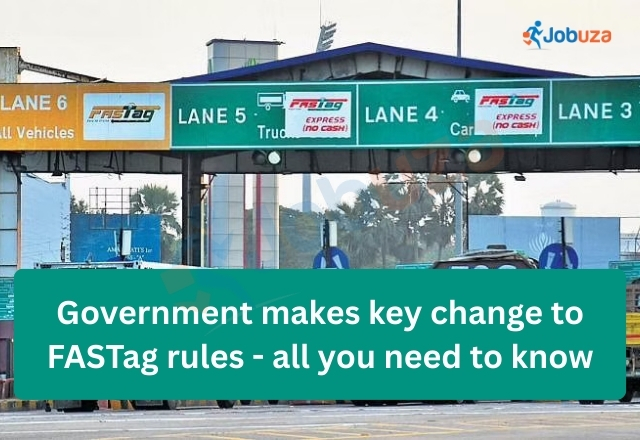
The government has announced a major relief for private vehicle owners by simplifying the FASTag issuance process. From February 1, 2026, buyers of new vehicles will no longer be required to complete a separate Know Your Customer (KYC) process while applying for FASTag.
The National Highways Authority of India (NHAI) stated that the decision aims to reduce delays, avoid repeated verification issues, and ensure smoother toll payments across national highways. Under the new system, vehicle details will be verified directly at the time of FASTag issuance, making the process faster and more efficient.
No Separate KYC for New FASTag Applicants
Earlier, vehicle owners applying for a new FASTag often faced problems such as incorrect KYC details, document mismatches, and repeated verification requests. These issues frequently delayed FASTag activation and caused inconvenience to motorists.
Under the revised rules, a separate KYC process has been removed for new FASTags. Instead, the vehicle’s Registration Certificate (RC) will be used for verification. This allows all necessary checks to be completed in a single step, reducing paperwork and simplifying the overall process for new vehicle owners.
What This Means for Existing FASTag Users
There is no change for vehicles that already have an active FASTag. Existing FASTag holders will not be required to undergo KYC again, provided there are no discrepancies or complaints linked to their FASTag account.
Verification will be initiated only in cases where a FASTag has been issued incorrectly or when vehicle details are found to be inaccurate. In such situations, authorities may review and correct the records to maintain system accuracy.
Banks to Follow Stricter Verification Norms
Under the new guidelines, banks issuing FASTags will have greater responsibility. Banks must verify vehicle details through the VAHAN portal before activating any FASTag. Without proper verification of registration data, FASTag activation will not be permitted.
According to the government, these measures are intended to prevent misuse, eliminate incorrect FASTag issuance, and improve transparency, while ensuring a smoother experience for genuine users.
Why This Change Is Important
The updated FASTag rules strike a balance between ease of use and system security. By removing unnecessary steps for new vehicle owners and strengthening verification at the bank level, the government aims to make toll collection more reliable, efficient, and user-friendly.
Vehicle owners are advised to ensure that their registration details are accurate and updated to avoid any issues during FASTag issuance or activation.

by Jobuza Team | Jan 6, 2026 | BLOG, Trending News
New Delhi: Indian Railways has announced a 3 percent discount on unreserved (general) ticket fares for passengers booking tickets through the RailOne mobile app. The Ministry of Railways confirmed that this offer will be available for six months, from January 14, 2026, to July 14, 2026.
Software Changes Ordered for Implementation
To introduce this discount, Indian Railways sent a letter to the Centre for Railway Information Systems (CRIS) on December 30, asking for necessary updates to the ticketing software. The ministry clarified that the discount will be applicable on all digital payment modes, including UPI, debit cards, credit cards, and net banking.
Up to 6% Benefit for R-Wallet Users
Currently, passengers paying through R-Wallet on the RailOne app receive 3 percent cashback, and this benefit will continue. With the new discount in place, R-Wallet users can now get a total benefit of up to 6 percent when booking general tickets through the RailOne app.
Discount Valid Only on RailOne App
Railway officials have made it clear that the 3 percent discount is available only on the RailOne app. Bookings made through other websites or apps will not qualify for this offer. The decision aims to encourage passengers to use the official app and reduce long queues at railway ticket counters.
What Is RailOne App?
RailOne is a single platform app developed by Indian Railways to offer all train-related services in one place. The app is free to download on Android and iOS devices. Once logged in using mPIN or biometric authentication, users can access all features easily without repeated logins.
How RailOne App Makes Travel Easier
Earlier, passengers needed multiple apps for different services such as ticket booking, train status, complaints, and food ordering. Managing several apps often caused confusion and used more mobile storage.
The RailOne app removes this problem by providing all essential railway services in one app, making train travel more convenient and hassle-free.
by Jobuza Team | Jan 6, 2026 | BLOG, Trending News
New Delhi: The Employees’ Provident Fund Organisation (EPFO) has introduced major changes to partial withdrawal rules under the newly implemented EPFO 3.0 system. The objective of these reforms is to simplify PF withdrawal rules, bring uniformity, and make the process more employee-friendly. The decisions were approved by the Central Board of Trustees under the chairmanship of Union Labour Minister Mansukh Mandaviya.
Changes in PF Withdrawal During Unemployment
Earlier, unemployed employees were allowed to withdraw 75 percent of their PF balance after one month of unemployment, while the remaining 25 percent could be withdrawn after two months.
Under EPFO 3.0, this rule has been modified. Employees can now immediately withdraw 75 percent of their PF amount after unemployment. However, full 100 percent withdrawal is permitted only after 12 months of continuous unemployment. This change aims to ensure long-term financial security while still providing immediate relief.
Pension Withdrawal Rules Tightened
Previously, pension withdrawal was allowed after two months of unemployment. Under the new EPFO 3.0 rules, the waiting period has been extended to 36 months (three years). This means employees can withdraw pension benefits only after being unemployed for a longer duration.
In cases of company lockouts or permanent closures, employees are allowed to withdraw 75 percent of their EPF corpus, while 25 percent must remain in the account to maintain the required minimum balance.
Withdrawals for Medical Emergencies and Special Situations
During pandemics or national emergencies, employees can still withdraw three months’ basic salary plus DA or 75 percent of their PF balance, whichever is lower. Under EPFO 3.0, the process has been standardised and made faster.
For medical emergencies involving self or family members, withdrawals are now allowed based on six months’ basic salary plus DA or the employee’s contribution, but a minimum service period of 12 months is mandatory.
Education and Marriage Withdrawal Rules Relaxed
EPFO 3.0 offers greater flexibility for education and marriage expenses. Employees can now withdraw PF for education up to 10 times and for marriage up to 5 times, which is more than what was allowed earlier. This change is expected to benefit young employees planning major life events.
Housing and Home Renovation Made Easier
Earlier, employees needed 24 to 36 months of service to withdraw PF for house construction, plot purchase, or housing-related expenses. Under EPFO 3.0, the minimum service requirement has been reduced to 12 months for all partial withdrawals, including housing needs.
Rules for home renovation remain unchanged but are now included in a uniform withdrawal framework. Housing loan-related withdrawals have also become fully digital and faster, reducing paperwork and delays.
Key Benefits of EPFO 3.0
The biggest benefit of EPFO 3.0 is the standardised 12-month minimum service requirement for most partial withdrawals. This reduces confusion, improves transparency, and ensures quicker access to PF funds when employees need them the most.
Overall, EPFO 3.0 marks a significant step towards making provident fund rules simpler, more consistent, and more accessible for India’s workforce.

by Jobuza Team | Jan 5, 2026 | BLOG, Trending News
As 2025 comes to an end, several important regulatory and financial changes are scheduled to take effect across India from January 1, 2026. These updates will impact banking services, taxation, fuel prices, salaries, and everyday expenses. From PAN-Aadhaar linking to vehicle price hikes, the new rules are expected to directly affect the income, savings, and lifestyle of common citizens.
Here is a detailed look at the nine major changes coming into force with the start of the new year.
1. PAN-Aadhaar Linking Becomes Mandatory
The deadline to link PAN with Aadhaar will end in December 2025. If the two documents are not linked by then, the PAN card will be deactivated from January 1, 2026.
Once deactivated, individuals will not be able to file income tax returns, receive tax refunds, or access several banking and financial services. Participation in government schemes and high-value financial transactions may also be restricted. Taxpayers are advised to complete the linking process before the year ends to avoid disruption.
2. Stricter Rules for UPI, SIM Verification and Messaging Apps
To address the growing cases of digital fraud, authorities are tightening security norms across multiple platforms. This includes stricter verification for UPI transactions, enhanced SIM card verification processes, and identity checks on popular messaging apps such as WhatsApp, Telegram and Signal.
The new measures aim to improve monitoring of suspicious transactions and reduce misuse of digital communication channels.
3. Revised Loan and Fixed Deposit Interest Rates
Several major banks, including SBI, PNB and HDFC Bank, have announced changes to loan interest rates and fixed deposit returns. Borrowers may benefit from revised lending rates, while investors can expect updated returns on fixed deposits.
These new rates will be applicable from January 1, 2026, helping individuals plan their finances more effectively.
4. LPG Cylinder Price Revision
LPG cylinder prices will be reviewed again on January 1. Depending on global and domestic factors, prices may either increase or decrease, directly affecting household budgets.
Recently, commercial LPG cylinder prices were reduced by ₹10, bringing the rate in Delhi to ₹1,580.50. Any new revision will add to or reduce monthly kitchen expenses.
5. CNG, PNG and ATF Price Updates
Along with LPG, prices of CNG, PNG and Aviation Turbine Fuel will also be revised. These rates depend on international crude oil prices and market demand.
Changes in CNG and PNG prices can affect daily commuting and household fuel costs, while ATF price revisions may influence air travel fares.
6. Preparations for the New Income Tax Act
Although the new Income Tax Act, 2025 will replace the existing law from April 1, 2026, the government is expected to notify updated income tax return forms and revised assessment rules as early as January.
The objective is to simplify tax filing, reduce litigation, and increase transparency for taxpayers ahead of the full rollout.
7. Implementation of the 8th Pay Commission
The 8th Central Pay Commission is expected to be considered effective from January 1, 2026. This marks the end of the 7th Pay Commission, whose tenure concludes on December 31, 2025.
If implemented, government employees may see revised salaries, while pensioners could receive enhanced pension benefits under the new pay structure.
8. New Rules for Farmers
Several changes aimed at improving transparency and welfare delivery will come into effect for farmers. A Unique Farmer ID will become mandatory to avail benefits under the PM-Kisan scheme in states such as Uttar Pradesh.
In addition, claims under the PM Fasal Bima Yojana will now cover crop damage caused by wild animals, provided the damage is reported within 72 hours.
9. Vehicle Price Hike From January 1
Many automobile manufacturers have announced price hikes effective from January 1, 2026. Brands such as Nissan, BMW, JSW MG Motor, Renault and Ather Energy will increase prices by ₹3,000 to up to 3 percent.
Tata Motors and Honda may also follow suit. Rising input costs and higher production expenses are cited as the primary reasons for the increase.
What These Changes Mean for You
With the new rules coming into force, daily expenses may rise due to fuel and vehicle price revisions. Banking and tax compliance requirements will become stricter, making timely documentation essential. Government employees may benefit from pay commission revisions, while farmers could receive better insurance coverage and welfare access.