by Jobuza Team | Nov 25, 2025 | BLOG, Trending News
EPF vs NPS: Planning for retirement is one of the most important steps in building long-term financial security. In India, the Employees’ Provident Fund (EPF) and the National Pension System (NPS) are two of the most widely used government-backed schemes. Both help individuals save for their future but differ in how they work, who can invest, the type of returns they offer, and their tax benefits.
EPF vs NPS: EPF mainly targets salaried employees in the organised sector, offering fixed and guaranteed returns. NPS is open to all citizens and provides market-linked returns that can grow significantly over the long term. Understanding these differences helps you choose the plan that matches your financial goals.
Meaning and Objective
EPF (Employees’ Provident Fund)
EPF is a retirement savings scheme managed by the Employees’ Provident Fund Organisation. It provides financial security after retirement. Both employees and employers contribute 12 percent of the employee’s basic salary and dearness allowance each month.
NPS (National Pension System)
NPS is a pension scheme regulated by the Pension Fund Regulatory and Development Authority. It encourages long-term savings for retirement and is open to individuals aged 18 to 70.
Eligibility
EPF
Applicable only to salaried employees working in organisations registered under the EPF Act.
NPS
Open to all Indian citizens, including salaried individuals, self-employed professionals, and those working in the unorganised sector.
Type of Returns
EPF
Offers fixed and guaranteed returns declared annually by the government. The interest rate generally stays between 8 to 8.5 percent.
NPS
Provides market-linked returns based on investments in equity, corporate bonds, and government securities. Long-term returns usually range between 9 to 12 percent.
Tax Benefits
EPF
Employee contributions qualify for tax deductions under Section 80C. The interest earned and the final maturity amount are tax-free if the employee has completed five years of service.
NPS
Offers tax benefits under Section 80CCD(1) and an additional deduction of up to fifty thousand rupees under Section 80CCD(1B). At retirement, sixty percent of the corpus is tax-free, while the remaining forty percent must be used to purchase an annuity, and the pension received is taxable.
Risk Factor
EPF
Low risk, as the returns are government-backed and stable.
NPS
Moderate risk due to market-linked returns. Over time, equity exposure can provide higher growth.
Withdrawal Rules
EPF
Allows full withdrawal at retirement or after two months of unemployment. Partial withdrawals are permitted for specific purposes such as education, home purchase, and medical emergencies.
NPS
Allows partial withdrawals of up to twenty-five percent after three years for specific reasons. At retirement, sixty percent of the corpus can be withdrawn, while forty percent must be invested in an annuity plan.
Flexibility
EPF
Less flexible since it is directly linked to an employee’s organisation and cannot be customised.
NPS
Highly flexible with options to choose fund managers, switch investment preferences, and adjust portfolios as needed.
Returns and Growth Potential
EPF
Provides stable returns due to a fixed interest rate.
NPS
Offers higher long-term growth because of equity exposure, making it suitable for investors comfortable with moderate risk.
Conclusion
Both EPF and NPS help build financial stability after retirement, but they meet different needs. EPF is ideal for individuals seeking safety and guaranteed returns. NPS is better for those who prefer higher growth over the long term and can handle market movement. Many people choose to invest in both to balance stability and growth.
by Jobuza Team | Oct 31, 2025 | BLOG, Trending News
Imagine becoming a crorepati just by saving money in a safe, government-backed scheme. Sounds impossible? It isn’t. With the Public Provident Fund (PPF) and a smart savings approach called the 15+5+5 formula, your yearly savings of ₹1.5 lakh can grow into ₹1 crore — without taking any risk.
Let’s see how this plan works and why it’s a simple, steady way to build long-term wealth.
What Is PPF and Why Do People Trust It?
The Public Provident Fund (PPF) is a savings scheme launched by the Government of India to help people build wealth safely over time. It’s one of the most reliable investment options for those who prefer security over market risk.
Here’s what makes PPF special:
-
It’s completely risk-free because it’s backed by the government.
-
Offers an attractive interest rate, currently around 7.1% per year.
-
You can claim tax benefits under Section 80C of the Income Tax Act.
-
The interest and maturity amount are fully tax-free.
A PPF account runs for 15 years, but you can extend it in blocks of 5 years — and that’s the real secret behind the 15+5+5 formula.
How You Can Extend Your PPF Account
After 15 years, you get two choices:
-
Without adding new money: Just let your balance grow with interest.
-
With continued deposits: Keep investing every year to earn interest on both old and new savings.
If your goal is to create big wealth, the second option — continuing deposits — is the smarter path.
The Power of the 15+5+5 Formula
This formula is simple:
Here’s how your money can grow if you invest ₹1.5 lakh every year at an average interest rate of 7.1%:
-
After 15 years: You invest ₹22.5 lakh and get around ₹40.68 lakh.
-
After 20 years (first extension): You invest ₹30 lakh and get around ₹70 lakh.
-
After 25 years (second extension): You invest ₹37.5 lakh and end up with ₹1.02 crore.
That’s how consistent savings, patience, and compounding work together to create real wealth.
Earn Monthly Income After Reaching ₹1 Crore
Once your PPF balance touches ₹1 crore, you can stop investing and still let the money grow. At 7.1% interest, ₹1 crore will earn about ₹7.1 lakh per year — or roughly ₹60,000 per month.
And the best part? It’s completely tax-free. This makes PPF a great option for retirement income or long-term financial security.
Tips to Get the Best Out of Your PPF
-
Invest regularly: Deposit ₹1.5 lakh every year without fail.
-
Avoid early withdrawals: Let your money stay invested for the full period.
-
Add a nominee: So your family can access the funds easily.
-
Check updates: The government revises interest rates every quarter, so stay informed.
Final Thoughts
PPF isn’t just a savings scheme — it’s a powerful tool for building long-term, tax-free wealth. The 15+5+5 strategy shows how small, steady contributions can turn into ₹1 crore with time and discipline.
If you’re looking for a safe, tax-efficient, and guaranteed way to grow your money for the future, the Public Provident Fund is one of the best options you can choose.
by Jobuza Team | Oct 30, 2025 | BLOG, Trending News
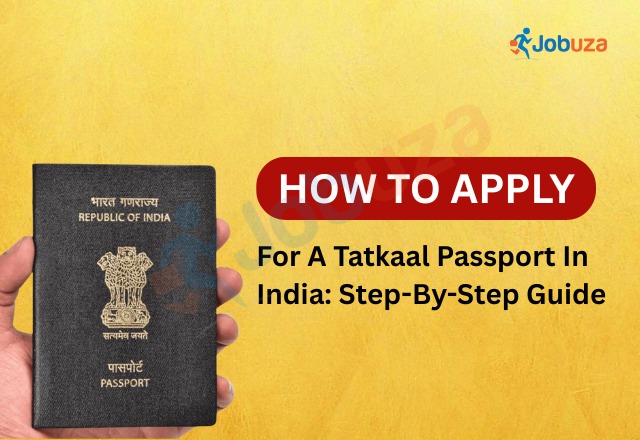
If you’ve been following travel trends, you might have noticed the Tatkaal passport service making headlines. Why the buzz? Indians are travelling more than ever—be it for business trips, family vacations, or urgent medical needs. When time is tight, the Tatkaal passport acts like a fast-track solution, cutting down waiting periods drastically.
But what exactly is a Tatkaal passport, and how can you apply without getting lost in government jargon? Here’s a clear, step-by-step guide.
What Is a Tatkaal Passport?
Tatkaal literally means “immediate.” Unlike a regular passport, which can take weeks or even months to process, a Tatkaal passport is usually issued within three working days, provided your documents and police verification are in order.
The speed comes at a cost—Tatkaal passport fees are higher than a regular passport. However, for urgent travel, it offers peace of mind and fast approval.
Who Can Apply for a Tatkaal Passport?
Tatkaal passports are meant for individuals with genuine urgent travel needs. This includes students travelling abroad, professionals with tight deadlines, or families handling emergencies. Authorities carefully scrutinize each application, so it’s important to provide accurate documents and valid proof of urgency.
Tatkaal vs Normal Passport
| Feature |
Tatkaal Passport |
Normal Passport |
| Processing Time |
1–3 working days |
Several weeks or months |
| Cost |
Higher |
Standard fee |
| Purpose |
Urgent travel |
Regular travel |
Step-by-Step Guide to Applying for a Tatkaal Passport
Step 1: Register Online
Visit the official Passport Seva website and create an account. Once registered, you’ll receive login credentials to start your application.
Step 2: Fill Out the Application Form
Select the Tatkaal option and complete the form carefully. Even minor errors can lead to delays, so double-check every detail.
Step 3: Upload Required Documents
Upload scanned copies of identity proof, address proof, and date of birth. For Tatkaal, you also need to submit proof of urgency, such as a booked ticket or a formal letter explaining your situation.
Step 4: Pay the Fees
Tatkaal fees are higher than standard passports. Payments can be made via UPI, net banking, debit or credit card, or SBI challan. Keep the receipt safe—it is required at the Passport Seva Kendra.
Step 5: Book an Appointment
Choose a convenient slot at your nearest Passport Seva Kendra. You’ll receive confirmation via SMS or email.
Step 6: Attend Your Appointment
Visit the PSK with your original documents, printed application, and payment receipt. After verification and biometrics, your application is processed. If all documents are in order, your Tatkaal passport will be issued in record time.
Final Thoughts
The Tatkaal passport is designed for urgent travel and can be a lifesaver when time is critical. While it costs more than a regular passport, the speed, convenience, and stress-free experience make it worthwhile. By following the steps carefully, you can ensure a smooth Tatkaal passport application process.

by Jobuza Team | Oct 30, 2025 | BLOG, Trending News
Indian Railways to Allow Passengers to Change Travel Dates for Booked Tickets
Indian Railways is set to make travelling more convenient for millions of passengers. For the first time, travellers will soon be able to change the travel date of their confirmed tickets online without paying any extra charges. This new facility will be available from January 2025, according to Union Minister Ashwini Vaishnaw.
The announcement comes as a major relief for passengers whose plans often change unexpectedly. Until now, travellers had to cancel their booked tickets and rebook new ones if they wanted to travel on a different date. This process not only involved time and effort but also led to fare deductions based on the cancellation timing.
Calling the existing system “unfair and not in the interest of passengers,” Vaishnaw said the new policy will make rail travel more flexible and passenger-friendly. The minister added that the necessary instructions have already been issued to implement the new changes.
However, the facility will still depend on seat availability for the rescheduled date. If seats are available, passengers can shift their journey easily. In cases where the new fare is higher than the original, travellers will need to pay the difference.
This move is expected to benefit millions of railway users across India who often face unexpected changes in travel plans. It will also help reduce the financial burden of cancellation charges that passengers currently bear.
Under the current cancellation rules, if a confirmed ticket is cancelled between 48 and 12 hours before departure, 25 per cent of the fare is deducted. The deduction increases for cancellations made closer to departure, and once the reservation chart is prepared, refunds are generally not permitted.
With this upcoming change, Indian Railways aims to provide a more convenient, transparent, and flexible travel experience for passengers across the country.
by Jobuza Team | Oct 28, 2025 | BLOG, Trending News
GST 2.0 Tips: It has been over two weeks since GST 2.0 came into effect, but many consumers are yet to see a noticeable drop in prices. Despite the government’s effort to reduce tax rates on dozens of goods and services, a recent survey indicates that the benefits have not fully reached large sections of shoppers.
According to a LocalCircles survey with more than 78,000 responses from over 27,000 participants across 332 districts, the pass-through of GST 2.0 benefits remains uneven.
Key Findings:
-
Automobiles: The only category showing widespread compliance, with 76% of buyers reporting full benefits.
-
Food Items: Only 10% of respondents saw full GST benefits on packaged foods, while 47% noticed no price reduction.
-
Medicines: Around 10% of consumers reported full benefits, 24% experienced partial relief, and over 60% said prices remained unchanged.
-
Appliances & Consumer Electronics: About one-third of buyers noticed full benefits, with another third seeing partial reductions.
The revised GST was designed to make nearly 80 essential and aspirational goods more affordable. Daily items like paneer, UHT milk, and essential medicines now carry tax rates of 0–5%, while cars, refrigerators, and air conditioners saw reductions from 28% to 18%.
However, in practice, retailers charging older prices have slowed the impact. Many are still selling pre-GST stock at old rates. Online platforms such as BigBasket, Tata 1mg, Amazon, Myntra, and Ajio have also been flagged for showing outdated prices.
GST 2.0 Tips: Experts highlight the complexity of last-mile compliance. With millions of retail touchpoints in FMCG and pharmaceuticals, ensuring every retailer passes on GST 2.0 benefits is a challenge. The government has responded by directing the National Consumer Helpline (NCH) and the Central Board of Indirect Taxes and Customs (CBIC) to monitor complaints closely.
What You Can Do If You Are Overcharged
Consumers who notice that GST reductions haven’t been applied can take action. Filing a complaint is straightforward:
-
Call: Dial 1915 to reach the National Consumer Helpline.
-
Online: Submit a complaint via the NCH website or mobile app.
-
Other Options: Email or WhatsApp your grievance.
Complaints are accepted in 17 languages, making the process accessible nationwide. GST-related complaints now have a dedicated category for faster resolution.
Experts stress that filing a complaint not only protects your rights but also ensures accountability in the marketplace. Each registered grievance signals to retailers that GST reductions are mandatory and not optional.
If you’ve been charged extra despite GST 2.0 rate cuts, take action. It’s your right as a consumer, and your complaint helps ensure that GST benefits reach every household as intended.
by Jobuza Team | Oct 28, 2025 | BLOG, Trending News
IRCTC Tatkal Booking: Booking a train ticket during the festive season in India can be one of the toughest tasks. Even with special trains running, millions of passengers rush to book tickets at the same time. For those who need to travel urgently, the Tatkal ticket booking service of Indian Railways is the most reliable option. Here’s a complete guide on how the Tatkal system works, when to book, and how to secure a confirmed ticket in seconds.
What is Tatkal Ticket Booking?
The Tatkal service was introduced by Indian Railways to help passengers book tickets at short notice. These tickets can be booked one day before the journey, making them ideal for emergency or last-minute travel. However, because of limited availability, Tatkal tickets sell out within minutes of opening, especially during peak travel seasons like Diwali, Holi, or summer vacations.
When Can You Book Tatkal Tickets?
Unlike regular train tickets, which can be booked 120 days in advance, Tatkal tickets open just one day before the train’s scheduled departure from the starting station.
The Tatkal quota is limited — only 10% to 30% of the total seats are reserved under this scheme. This is why booking competition is so high, particularly on busy routes such as Delhi–Mumbai, Chennai–Bengaluru, and Kolkata–Patna.
Timings for Tatkal Ticket Booking
IRCTC follows fixed timings for Tatkal bookings, and logging in even a minute late can cost you your seat.
-
For AC classes (1A, 2A, 3A, CC, EC): Booking starts at 10:00 AM
-
For Non-AC classes (Sleeper, 2S): Booking starts at 11:00 AM
Passengers should be ready and logged into the IRCTC website or app a few minutes before booking starts to improve their chances of getting a confirmed ticket.
Tips to Book Confirmed Tatkal Tickets Quickly
Speed and preparation are the keys to successful Tatkal booking. Here’s how you can increase your chances:
-
Log in before time: Sign in at least 5–10 minutes before Tatkal booking starts.
-
Save passenger details: Use the “Master List” feature on IRCTC to save passenger names, ages, and ID details in advance.
-
Enable browser autofill: Autofill can automatically enter information within seconds.
-
Use Quick Payment Methods: Choose fast options like UPI, Net Banking, or e-Wallets to complete transactions instantly.
-
Avoid page reloads: Reloading the page or switching tabs can cause delays or booking failure.
Using IRCTC’s QuickBook feature can further speed up the process and reduce manual steps during booking.
Cost of Tatkal Tickets
Tatkal tickets are more expensive than regular tickets since they are treated as a priority service. The Tatkal charges are added as an extra fee over the base fare.
Additionally, Indian Railways offers Premium Tatkal tickets, which follow dynamic pricing, similar to airline fares. This means prices may increase depending on seat availability and demand at the time of booking.
Final Takeaway
The IRCTC Tatkal ticket booking system is designed for passengers who need urgent travel. While tickets get sold out within minutes, a little preparation, fast payment, and smart use of IRCTC tools can help you get confirmed seats easily. Staying alert during the booking window and keeping all details ready is the best strategy for success.