by Jobuza Team | May 19, 2025 | BLOG, PAN/Aadhar Card Updates, Trending News
How to Check If an Aadhaar Card Is Genuine: Simple Methods to Verify Using Your Smartphone
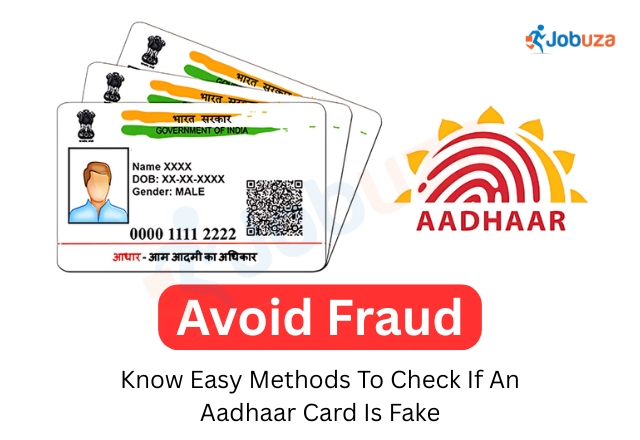
Avoid Aadhaar Scams: Aadhaar has become a vital part of everyday life in India. From banking and mobile verification to accessing government services, Aadhaar is now linked to almost every major activity. Its wide usage has made it a trusted identity document for individuals, businesses, and government agencies.
However, with increasing reliance on Aadhaar, cases of fake or forged Aadhaar cards have also surfaced. Fraudsters have been found using counterfeit Aadhaar cards for illegal activities, including renting properties or securing employment. If you unknowingly hire or rent to someone with a fake Aadhaar, it can lead to serious legal consequences.
To protect yourself and your organization, it is essential to verify the authenticity of an Aadhaar card before placing your trust in it. Fortunately, UIDAI (Unique Identification Authority of India) provides easy ways to verify Aadhaar using your smartphone.
Method 1: Verify Aadhaar Using the mAadhaar App
Avoid Aadhaar Scams: UIDAI has launched the mAadhaar mobile app to help users manage and verify their Aadhaar information easily.
Follow these steps to verify Aadhaar through the mAadhaar app:
-
Go to the Google Play Store or Apple App Store and download the mAadhaar app.
-
Open the app and log in using your registered mobile number.
-
Navigate to the “My Aadhaar” section.
-
Enter the Aadhaar number and your basic location details.
-
The app will immediately check and confirm whether the Aadhaar number is valid and genuine.
If the Aadhaar number is invalid or does not exist in UIDAI’s database, it will be flagged accordingly.
Method 2: Use the Aadhaar QR Code Scanner to Verify Details
All Aadhaar cards issued by UIDAI contain a secure QR code that holds important details such as name, date of birth, address, and a photograph.
Here’s how to verify Aadhaar using a QR code:
-
Download the official Aadhaar QR Scanner app from the Google Play Store.
-
Open the app and scan the QR code printed on the Aadhaar card.
-
If the card is genuine, the app will instantly display all the stored information.
-
If the card is fake, no information will be shown after scanning.
This is one of the fastest and most reliable ways to confirm the authenticity of an Aadhaar card without needing any additional documents.
Why Verifying Aadhaar Is Important
-
Protect against fraud: Ensures you are dealing with a legitimate identity
-
Stay compliant: Avoid legal trouble when hiring, renting, or entering into any agreement
-
Build trust: Helps businesses and landlords verify identity before making commitments
-
Save time and resources: Instant verification avoids lengthy background checks in many cases
Final Thoughts
In a digital world where identity fraud is becoming more sophisticated, verifying an Aadhaar card before placing trust in it is a smart and necessary step. Whether you’re a landlord, employer, or service provider, taking a few moments to confirm Aadhaar authenticity can save you from future complications.
With tools like the mAadhaar app and Aadhaar QR Scanner, you can now verify any Aadhaar card in minutes—right from your phone. Stay informed, stay secure.

by Jobuza Team | May 19, 2025 | BLOG, Trending News
Indian Railways Enforces New Rules from May 15: General Ticket Holders Barred from Sleeper and AC Coaches
New Indian Railway rules: Starting May 15, 2025, Indian Railways has implemented a major rule change that affects train travel across the country. As per the new guidelines, passengers holding general (unreserved) tickets will no longer be allowed to board sleeper or AC coaches, even if they hold valid tickets.
What the New Rule Means
New Indian Railway rules: This change aims to enhance the travel experience for passengers with reserved tickets. Until now, many sleeper and AC coach travelers have faced overcrowding and inconvenience due to the unauthorized entry of general ticket holders. With the new rule in place, Indian Railways hopes to reduce such discomfort and improve onboard hygiene and safety.
Reserved Passengers to Benefit
Passengers with confirmed reservations in sleeper or AC classes will now have more space and comfort during their journey. The move is expected to significantly reduce crowding in reserved coaches, especially during peak travel times.
Challenges for General Ticket Holders
While the change is a relief for reserved passengers, it poses challenges for general ticket holders. These travelers must now strictly remain in their designated unreserved coaches, even if the reserved coaches appear to have space. Indian Railways has emphasized that the new rule will be strictly enforced, and violators may face penalties.
Indian Railways’ Objective
The primary goal behind this decision is to:
Indian Railways officials have also highlighted that unauthorized occupancy of reserved seats has often led to disputes, inconvenience, and delays in train operations.
Advisory for Passengers
Passengers planning to travel after May 15 are advised to:
-
Book tickets in advance to secure a reserved seat
-
Avoid boarding sleeper or AC coaches with only a general ticket
-
Consider alternative travel dates or classes if tickets are waitlisted
The new rule underlines the importance of planning ahead and booking confirmed tickets, especially for long-distance or overnight travel.
Final Note
The revised railway rule is a step towards creating a more organized and passenger-friendly travel environment. While it may initially affect general ticket holders, it is designed to ensure a better experience for everyone onboard. Passengers are urged to follow the new guidelines to avoid inconvenience and enjoy a smoother journey.
by Jobuza Team | May 15, 2025 | BLOG, Trending News
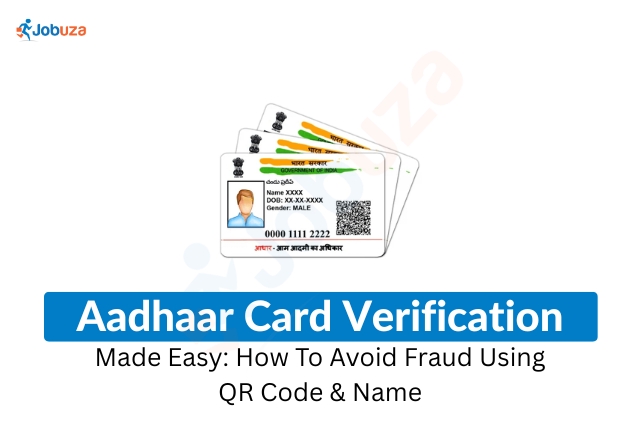
Verifying the authenticity of an Aadhaar card has become more important than ever. With the rise in digital transactions and identity-based fraud, it’s crucial to ensure that an Aadhaar card is genuine before relying on it for any service, verification, or identification. Fortunately, the Unique Identification Authority of India (UIDAI) offers simple methods to verify Aadhaar details—either through the QR code printed on the card or via its official online portal.
Method 1: Verify Aadhaar Using the QR Code
Each Aadhaar card contains a QR code that securely holds the cardholder’s demographic details and photograph. This can be scanned using a smartphone for instant offline verification.
Step-by-Step Guide:
-
Download a UIDAI-approved app such as mAadhaar or the Aadhaar QR Scanner from the Play Store or App Store.
-
Open the app and choose the option to scan a QR code.
-
Use your phone’s camera to scan the QR code printed on the Aadhaar card.
-
View the displayed details, which typically include the person’s name, gender, date of birth, and photo.
-
Cross-check the details with the physical Aadhaar card to confirm authenticity.
This method is especially useful when verifying someone’s identity in person, without having to manually enter Aadhaar numbers.
Method 2: Verify Aadhaar Using the UIDAI Website
If you need to verify an Aadhaar number online, the UIDAI website offers a secure and easy-to-use tool that confirms whether an Aadhaar number is valid.
Here’s how to do it:
-
Visit the official UIDAI website.
-
Go to the ‘My Aadhaar’ section.
-
Click on ‘Verify Aadhaar Number’.
-
Enter the 12-digit Aadhaar number or the Virtual ID (VID).
-
Complete the CAPTCHA and click ‘Verify’.
If the Aadhaar is valid, the portal will display a message confirming it, along with masked personal details (like partial name or age band) for additional assurance.
Important: While many people believe you can verify Aadhaar using just a name, the UIDAI website does not offer this feature. A valid Aadhaar number or VID is required for any verification.
Why Aadhaar Verification is Important
Identity fraud is a growing concern, especially with the wide use of Aadhaar across government and private services. Verifying Aadhaar ensures:
-
Protection against identity theft
-
Accurate KYC compliance
-
Safety in financial and official transactions
-
Reduced risk of accepting fake or forged documents
By using official UIDAI channels and apps, individuals and businesses can securely validate Aadhaar cards and stay protected from fraudulent activities.
If you’re concerned about your Aadhaar being misused, it’s also recommended to regularly monitor its usage via the UIDAI portal. Verifying before trusting any Aadhaar card is a smart and necessary step in today’s digital age.

by Jobuza Team | May 15, 2025 | BLOG, Trending News
When planning for retirement, choosing the right investment scheme can significantly impact the size of your final corpus. In India, three of the most trusted and widely used retirement savings options are the National Pension System (NPS), Employees’ Provident Fund (EPF), and Public Provident Fund (PPF).
Each scheme comes with its own set of features, tax benefits, and returns. But if you’re investing ₹1.5 lakh annually, which of these three can help you build the largest retirement corpus over time?
Let’s compare NPS, EPF, and PPF in terms of structure, tax savings, returns, liquidity, and long-term gains.
Understanding the Basics
National Pension System (NPS)
NPS is a government-regulated pension scheme managed by the Pension Fund Regulatory and Development Authority (PFRDA). It allows you to invest in a mix of equities, government bonds, and corporate debt, offering flexible asset allocation and higher return potential. NPS is ideal for those comfortable with some market-linked risk.
Employees’ Provident Fund (EPF)
EPF is a compulsory retirement savings scheme for salaried employees. Both the employee and employer contribute a fixed percentage of the salary every month. The fund earns interest at a rate declared annually by the government, making it a low-risk option with predictable growth.
Public Provident Fund (PPF)
PPF is a long-term savings option backed by the Government of India. It comes with a lock-in period of 15 years and offers a fixed interest rate, updated quarterly. PPF is popular among conservative investors seeking stability and tax-free returns.
Tax Benefits Compared
NPS:
-
Deduction up to ₹1.5 lakh under Section 80C
-
Additional ₹50,000 deduction under Section 80CCD(1B)
-
At retirement, 60% of the corpus is tax-free, and 40% must be used to purchase an annuity, which is taxable
EPF:
-
Eligible for deduction under Section 80C
-
Interest earned and maturity amount are tax-free after five years of continuous service
-
Offers Exempt-Exempt-Exempt (EEE) tax status under certain conditions
PPF:
-
Entire investment qualifies for deduction under Section 80C
-
Interest and maturity amount are completely tax-free
-
Also follows the EEE tax regime
Returns and Risk Profile
NPS:
-
Average returns range from 9% to 12%, depending on asset allocation and market conditions
-
Higher return potential due to equity exposure, but carries some market risk
EPF:
-
Offers stable returns around 8.25% annually
-
Low risk, backed by government guarantees
-
Suitable for long-term financial safety
PPF:
-
Offers a fixed interest rate, currently at 7.1% (compounded annually)
-
Completely risk-free
-
Best suited for conservative investors
Liquidity and Withdrawal Rules
NPS:
-
Partial withdrawals (up to 25% of contributions) allowed after three years for specific purposes
-
Full withdrawal available at age 60
-
60% of the corpus can be withdrawn tax-free; the rest goes into an annuity
EPF:
-
Partial withdrawals permitted for marriage, medical emergencies, education, and home purchase
-
Full withdrawal allowed at retirement or after two months of unemployment
PPF:
-
Partial withdrawals allowed after the seventh financial year
-
Loans available against the balance from the third financial year
-
Full withdrawal only after 15 years
Corpus Comparison with ₹1.5 Lakh Annual Investment Over 35 Years
Assuming no change in interest rates and consistent contributions:
-
NPS (10% average return): ₹4.47 crore
-
EPF (8.25% fixed return): ₹3.06 crore
-
PPF (7.1% fixed return): ₹2.79 crore
These estimates are based on compounded annual returns and may vary with changes in policy rates or market performance.
Expert Insight
Financial experts often recommend a diversified approach rather than relying on a single investment avenue. NPS is suitable for investors seeking higher returns and comfortable with some market volatility. EPF and PPF, on the other hand, are better for risk-averse individuals who prefer guaranteed returns and capital protection.
Combining these schemes can help balance growth, stability, and tax efficiency — all key to building a secure retirement corpus.
Disclaimer: This article is for informational purposes only. Always consult a certified financial advisor before making investment decisions.

by Jobuza Team | May 14, 2025 | BLOG, Trending News
Credit Card Scam Alert: 5 Warning Signs You’re Getting a Fake Call
The growing adoption of credit cards across India, financial frauds especially those involving scam calls have become alarmingly common. These scams are not only well-planned but are constantly evolving, making it essential for consumers to stay alert and informed.
Understanding the warning signs of fake credit card calls is critical to protecting your financial security and long-term well-being. In this guide, we highlight five major red flags that indicate a potential scam, and share actionable steps for you can take to stay safe.
-
Unsolicited Calls Claiming to Be from Banks or the RBI
One of the most common credit card scams involves fraudsters impersonating representatives of reputed institutions such as the Reserve Bank of India (RBI), the Securities and Exchange Board of India (SEBI), or popular commercial banks. They often claim there are issues with your credit card and may even threaten account suspension.
For instance, the Press Information Bureau (PIB) recently debunked a scam in which callers posed as RBI officials to mislead consumers. It is important to understand that legitimate financial authorities will never call you out of the blue with such threats. Always verify such claims by contacting the institution through its official website or helpline before taking any action.
-
Requests for Sensitive Personal Information
Legitimate banks will never ask for confidential details such as your credit card number, CVV, OTP, or ATM PIN over a phone call. Fraudsters, however, frequently use fake credit card enhancement offers or urgent notifications to lure victims into sharing this information.
A recent case involved a group operating near the Noida-Delhi border who tricked hundreds of people with fake offers, collecting their personal financial information and stealing money. To protect yourself, never disclose sensitive information to unsolicited callers, regardless of how convincing they sound.
-
Pressure Tactics and a False Sense of Urgency
Scammers rely heavily on creating panic. They may say your credit card is blocked, or that you have won a prize and must act immediately to claim it. These tactics are designed to force you into making snap decisions without verifying the authenticity of the call.
Genuine institutions will never pressure you into sharing details or making payments instantly. If a caller tries to rush or scare you, hang up immediately. Then, contact your bank directly using official channels to confirm whether there is any issue with your account.
-
Spoofed Caller IDs and Unusual Payment Requests
Some scam calls appear to come from an official number due to caller ID spoofing. In these cases, the number might look legitimate, but the person on the other end is a fraudster. They might also request payments through suspicious methods such as prepaid gift cards, e-wallets, or even cryptocurrency.
These are clear indicators of a scam. Authentic banks will always use traditional and secure payment methods, and will never ask for payment in unconventional forms.
-
Offers That Sound Too Good to Be True
Beware of unsolicited offers that seem overly generous—such as massive credit limit increases, lifetime free cards, or guaranteed cashback and rewards. While these offers may sound tempting, they are often a cover for phishing attempts.
Always verify any credit card offer by visiting the official website of your bank or calling their customer care number. Never trust offers received via unknown calls or messages without verification.
How to Protect Yourself from Credit Card Scam Calls
To stay safe from credit card fraud, follow these simple but effective practices:
-
Verify Caller Identity: If you receive an unexpected call regarding your credit card, hang up and contact your bank’s official helpline to verify the claim.
-
Never Share Personal Information: Refrain from sharing sensitive information like OTPs, CVVs, and PINs with anyone over the phone, especially if the call was unsolicited.
-
Report Suspicious Calls Immediately: Notify your bank and local authorities about scam attempts. You can also file a complaint with the cybercrime cell or lodge an FIR at your nearest police station.
-
Stay Informed: Educate yourself about common scam techniques, read up on financial safety measures, and always stay calm when dealing with suspicious calls.
Final Thoughts
Credit Card Scam Alert: Fake credit card calls are a serious threat to your financial well-being. However, by recognizing the red flags and staying vigilant, you can protect yourself and your loved ones from falling victim to fraud. When in doubt, always verify the information through official sources and never act in haste.
Would you like this formatted as a downloadable PDF for easy sharing or publishing on your site?
by Jobuza Team | May 14, 2025 | BLOG, Trending News
New Delhi: Checking your PF balance no longer requires logging into portals or filling out lengthy forms. The Employees’ Provident Fund Organisation (EPFO) now allows members to check their PF balance and recent contribution details using a simple missed call or SMS—quick, free, and hassle-free.
Who Can Use This Service?
To use this feature, your Universal Account Number (UAN) must be activated and linked to at least one KYC detail such as Aadhaar, PAN, or a bank account. Also, your mobile number should be registered with your UAN.
How to Check PF Balance via Missed Call
Follow these easy steps to get your PF balance using just a missed call:
-
Ensure your mobile number is linked with your UAN on the EPFO portal.
-
Make sure your UAN is KYC-compliant (linked to Aadhaar, PAN, or bank account).
-
Dial 9966044425 from your registered mobile number.
-
The call will disconnect automatically after two rings—there are no charges.
-
You’ll receive an SMS with your PF balance and last contribution details.
How to Check PF Balance via SMS
You can also check your PF details using a simple SMS:
-
Type EPFOHO UAN [Language Code] in your SMS app.
-
Send the message to 7738299899 from your registered mobile number.
For example, to receive details in English, type:
This service is available in multiple Indian languages including Hindi (HIN), Telugu (TEL), Bengali (BEN), and more.