by Jobuza Team | May 21, 2026 | BLOG, IT/Tech Jobs, Latest Jobs, Technical/IT Jobs
AAICLAS Recruitment 2026: AAI Cargo Logistics and Allied Services Company Limited (AAICLAS) has released the official notification for the recruitment of Security Screener posts. The recruitment drive aims to fill a total of 158 vacancies at various airports and cargo locations across India.
Interested and eligible candidates can apply online through the official website, aaiclas.aero. The online application process started on May 18, 2026, and the last date to submit the application form is June 08, 2026.
Candidates looking for aviation and airport sector jobs can take advantage of this opportunity by applying for the Security Screener (Fresher) positions.
AAICLAS Recruitment 2026 Notification
AAICLAS has published the recruitment notification under Advertisement No. 01/2026 on its official website. The notification contains important details related to vacancies, eligibility criteria, age limit, application process, and job responsibilities.
Applicants are advised to carefully read the official notification before applying online.
AAICLAS Recruitment 2026 Important Dates
The online application process for AAICLAS Security Screener Recruitment 2026 commenced on May 18, 2026.
The last date to complete the online registration process is June 08, 2026.
Candidates should submit their applications before the deadline to avoid last-minute technical issues.
AAICLAS Security Screener Vacancy 2026
A total of 158 Security Screener vacancies have been announced under the recruitment drive.
The selected candidates may be posted at various airports and cargo complexes including locations such as Dehradun, Kolkata, Patna, Trichy, and other cities across the country.
The detailed location-wise vacancy distribution is available in the official notification.
AAICLAS Recruitment 2026 Eligibility Criteria
Candidates applying for AAICLAS Security Screener Recruitment 2026 must fulfill the educational qualification, language proficiency, and age limit conditions mentioned in the notification.
Educational Qualification
Applicants should possess a graduation degree from a recognized university or institution.
General, OBC, and EWS category candidates must have secured at least 60 percent marks in graduation.
SC and ST category candidates must have obtained a minimum of 55 percent marks.
Candidates are required to enter their graduation percentage in numerical format while filling out the application form.
Language Requirement
Applicants should have the ability to read and speak English and Hindi. Knowledge of the local language will also be considered beneficial.
Age Limit
The maximum age limit for applicants is 27 years as on May 01, 2026.
Age relaxation for reserved category candidates will be applicable as per government rules.
AAICLAS Security Screener Job Profile
Selected candidates will be responsible for screening cargo and in-line hold baggage using technical and security equipment.
The role also includes carrying out various security-related duties at airports and cargo complexes to ensure safe and secure operations.
AAICLAS Recruitment 2026 Selection Process
The detailed selection process will be mentioned in the official notification. Candidates are advised to regularly visit the official website for updates related to examination, interview, or document verification procedures.
How to Apply for AAICLAS Recruitment 2026
Interested candidates can apply online through the official website of AAICLAS.
Applicants need to visit the recruitment section on the website, complete the registration process, fill in personal and educational details, upload required documents, and submit the application form online.
Candidates should keep a copy of the submitted application form for future reference.
Important Instructions for Candidates
Candidates should ensure that all details entered in the application form are accurate and supported by valid documents. Incorrect or incomplete applications may be rejected during the verification process.
Applicants are also advised to regularly check the official AAICLAS website for further announcements regarding recruitment stages, admit cards, and selection updates.

by Jobuza Team | May 21, 2026 | BLOG, Latest Jobs, Teaching Jobs
IISER Recruitment 2026: The Indian Institute of Science Education and Research (IISER) Mohali has released the official notification for recruitment to various Non-Teaching posts. IISER Mohali is an Institute of National Importance functioning under the Ministry of Education, Government of India.
The recruitment notification was published in the Employment News dated May 16 to 22, 2026. Interested and eligible candidates can apply online for these regular Non-Faculty positions through the official website on or before June 15, 2026.
This recruitment drive offers opportunities across multiple administrative, technical, engineering, healthcare, and support positions.
IISER Recruitment 2026 Notification
IISER Mohali has issued a detailed notification containing information related to vacancies, eligibility criteria, educational qualifications, age limit, salary structure, and application process.
Candidates are advised to carefully read the official notification before applying for the recruitment process.
IISER Recruitment 2026 Important Date
The online application process is currently active on the official website of IISER Mohali.
The last date to submit the online application form is June 15, 2026.
Applicants should complete the registration process before the deadline to avoid last-minute issues.
IISER Non-Teaching Vacancy 2026 Details
A total of 40 vacancies have been announced for various Group A, Group B, and Group C Non-Teaching posts.
Some of the major vacancies include:
Group A Posts
- Superintending Engineer
- Deputy Registrar
- Deputy Librarian
- Principal Technical Officer
- Senior Technical Officer
- Assistant Executive Engineer
Group B Posts
- Senior Superintendent
- Library Superintendent
- Senior Technical Assistant
- Physical Education Instructor
- Counsellor
- Nurse
- Junior Engineer
- Junior Translator
Group C Posts
- Pharmacist
- Junior Technical Assistant
- Junior Office Assistant
Candidates can check the official notification for detailed post-wise vacancy distribution.
IISER Recruitment 2026 Eligibility Criteria
Candidates applying for IISER Non-Teaching Recruitment 2026 must fulfill the educational qualification and other eligibility conditions prescribed for each post.
The eligibility criteria vary according to the position applied for. Different posts require qualifications such as graduation, engineering degree, diploma, technical certification, nursing qualification, pharmacy qualification, or relevant work experience.
Applicants are advised to refer to the official notification for detailed post-wise eligibility and age limit information.
IISER Recruitment 2026 Salary
Selected candidates will receive salary and allowances as per Central Government norms and pay levels applicable to the respective posts.
The salary structure differs according to the grade and category of the post.
IISER Recruitment 2026 Selection Process
The selection process may include written examination, skill test, interview, document verification, or any other assessment method depending on the nature of the post.
The final selection will be based on the candidate’s performance and fulfillment of eligibility conditions.
How to Apply for IISER Recruitment 2026
Interested candidates can apply online through the official recruitment portal of IISER Mohali.
Applicants need to register themselves using valid personal and contact details. After registration, candidates must complete the online application form, upload the required documents, and submit the form before the last date.
Candidates are advised to keep a copy of the submitted application form for future reference.
Important Instructions
Candidates should ensure that all details entered in the application form are correct and match their official documents. Incomplete or incorrect applications may be rejected.
Applicants are also advised to regularly visit the official website for updates regarding examination dates, admit cards, interview schedules, and recruitment announcements.

by Jobuza Team | May 20, 2026 | BLOG, Latest Jobs
NALCO Recruitment 2026: National Aluminium Company Limited (NALCO), a Navratna Central Public Sector Enterprise, has released the official notification for the recruitment of 268 Non-Executive posts. The vacancies are available at the Mines and Refinery Complex located in Damanjodi, Odisha.
Candidates who have passed Class 10 and possess an ITI certification in the relevant trade can apply online through the official website, nalcoindia.com. The online application process will begin on May 21, 2026, and the last date to apply is June 10, 2026.
This recruitment drive offers opportunities in multiple technical and operational positions with attractive salary packages and government sector benefits.
NALCO Recruitment 2026 Notification
NALCO has published the detailed recruitment notification for various Non-Executive positions. The official notification contains important details related to eligibility criteria, vacancy distribution, salary structure, application process, and selection procedure.
Candidates are advised to carefully read the notification before submitting their online applications.
NALCO Recruitment 2026 Important Dates
The online application process for NALCO Recruitment 2026 will start on May 21, 2026.
The last date to complete the online registration process is June 10, 2026.
Candidates should complete the application process before the deadline to avoid last-minute issues.
NALCO Vacancy 2026 Details
A total of 268 vacancies have been announced for various Non-Executive posts at the Mines and Refinery Complex in Odisha.
Some of the major positions include:
- Operator (HEMM)
- Technician (Electrical)
- Lab Assistant
- Instrumentation/Instrument Mechanic
- Mining Mate
- Other technical posts
The detailed post-wise vacancy distribution is available in the official notification.
NALCO Recruitment 2026 Eligibility Criteria
Candidates applying for NALCO Non-Executive Recruitment 2026 must fulfill the required educational qualification, work experience, nationality, and age criteria.
Educational Qualification
Candidates must have passed Class 10 from a recognized board.
Applicants should also possess an ITI certificate approved under NCVT or NCVET in the relevant trade.
For the Lab Assistant post, candidates should hold a B.Sc. (Hons.) degree in Chemistry from a recognized university.
Work Experience
Candidates applying for Technician Grade posts such as Electrical and Instrumentation/Instrument Mechanic must have at least two years of relevant work experience.
For the Operator (HEMM) position, one year of experience in the Diesel Mechanic trade is required.
NALCO Recruitment 2026 Age Limit
The minimum age required is 27 years, while the maximum age limit is 35 years.
Age relaxation will be provided to reserved category candidates as per government rules.
OBC candidates will receive 3 years of relaxation.
SC/ST candidates will receive 5 years of relaxation.
PwBD candidates will receive 10 years of relaxation.
NALCO Recruitment 2026 Salary
Selected candidates will receive salary in the pay scale ranging from Rs. 29,500 to Rs. 70,000 per month depending on the post and grade.
Along with salary, employees will also be entitled to additional allowances and benefits as per company rules.
NALCO Recruitment 2026 Application Process
Eligible candidates can apply online through the official NALCO website.
Applicants need to complete the registration process using their name, email ID, and other required details. After registration, candidates must fill out the application form carefully and upload scanned copies of photographs, signatures, and supporting documents.
Candidates should verify all information before final submission and keep a copy of the application form for future reference.
Important Instructions
Candidates should ensure that they meet all eligibility conditions before applying for the recruitment process. Incomplete or incorrect applications may be rejected at any stage.
Applicants are advised to regularly visit the official website for updates related to examination dates, admit cards, and further recruitment announcements.
by Jobuza Team | May 20, 2026 | BLOG, IT/Tech Jobs, Latest Jobs, Technical/IT Jobs
The Railway Recruitment Boards (RRBs) have released the short notification for RRB Technician Recruitment 2026 under CEN 02/2026. According to the official announcement, a total of 6565 Technician vacancies will be filled across various railway zones in India.
The online application process will begin on June 30, 2026, and eligible candidates will be able to submit their application forms until July 29, 2026 through the official website, rrbapply.gov.in.
This recruitment drive includes vacancies for Technician Grade I Signal and Technician Grade III posts. Candidates preparing for railway jobs can expect detailed information regarding zone-wise vacancies, syllabus, reservation rules, and exam pattern in the complete notification, which will be released soon.
RRB Technician Recruitment 2026 Overview
The recruitment will be conducted by the Railway Recruitment Boards for technician posts under the 7th CPC pay scale. Selected candidates will receive an initial salary of Rs. 29,200 per month along with railway allowances and other benefits.
Out of the total 6565 vacancies, 323 posts are available for Technician Grade I Signal, while 6242 vacancies are for Technician Grade III.
Candidates can apply only through online mode on the official RRB application portal.
RRB Technician Recruitment 2026 Important Dates
The online registration process for RRB Technician Recruitment 2026 will start from June 30, 2026.
The last date to submit the online application form is July 29, 2026.
Candidates are advised to complete the application process well before the deadline to avoid last-minute technical issues.
RRB Technician Vacancy 2026 Details
The recruitment drive aims to fill a total of 6565 technician posts across different railway zones.
Post-wise vacancies are as follows:
Technician Grade I Signal – 323 Posts
Technician Grade III – 6242 Posts
The detailed zone-wise vacancy distribution will be released in the official notification.
RRB Technician Eligibility Criteria 2026
Candidates applying for RRB Technician Recruitment 2026 must fulfill the educational qualification and age limit criteria prescribed by the Railway Recruitment Boards.
Educational Qualification
For Technician Grade I Signal posts, candidates should possess a B.E., B.Tech, Engineering Diploma, or B.Sc. degree in the relevant discipline from a recognized institute or university.
For Technician Grade III posts, candidates must have passed Class 10 along with an ITI certificate in the relevant trade. Candidates with Class 12 qualification along with Physics, Chemistry, and Mathematics may also be eligible for certain posts.
Age Limit
For Technician Grade I Signal posts, the age limit is 18 to 33 years.
For Technician Grade III posts, the age limit is 18 to 30 years.
The age calculation will be based on July 1, 2026. Age relaxation for reserved category candidates will be provided as per government rules.
RRB Technician Recruitment 2026 Application Fee
Candidates belonging to General, OBC, and EWS categories will have to pay an application fee of Rs. 500.
Candidates from SC, ST, and other reserved categories will need to pay Rs. 250.
The fee payment process will be conducted online.
RRB Technician Selection Process 2026
The selection process for RRB Technician Recruitment 2026 will consist of multiple stages.
Candidates will first appear for the Computer-Based Test (CBT). Those who qualify will be called for Document Verification and Medical Examination.
Final selection will be based on performance in all required stages and fulfillment of eligibility conditions.
RRB Technician Salary 2026
Selected candidates for Technician posts will receive salary under Level-5 of the 7th CPC pay matrix. The starting basic pay is Rs. 29,200 per month along with additional railway allowances and benefits.
Important Instructions for Candidates
Candidates are advised to regularly visit the official RRB website for updates regarding the detailed notification, syllabus, exam dates, and application process.
Before applying, applicants should carefully check all eligibility conditions and keep their educational documents, identity proof, and photographs ready for the online registration process.
by Jobuza Team | May 15, 2026 | BLOG, PAN/Aadhar Card Updates, Trending News
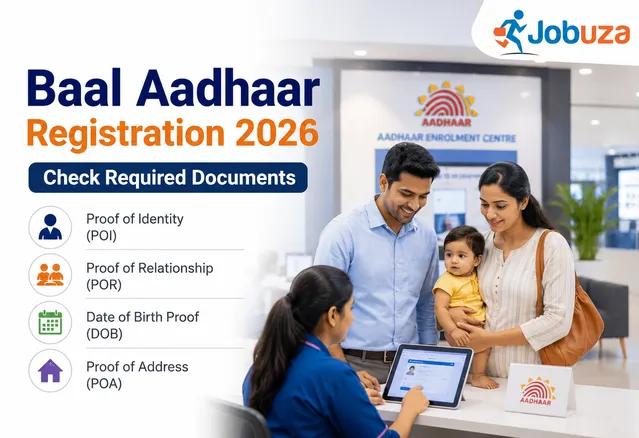
Unique Identification Authority of India issues Aadhaar cards to residents of India without any age restriction. This means even a newborn baby can be enrolled for Aadhaar through the Baal Aadhaar scheme.
Baal Aadhaar is specially designed for children below five years of age and serves as an important identity document for school admissions, government schemes, healthcare services, and other official purposes.
Parents can apply for their child’s Aadhaar free of cost at authorised Aadhaar enrolment centres.
Documents Required for Baal Aadhaar Registration
To enrol a child below the age of five years for Aadhaar, parents generally need:
- Child’s Birth Certificate
- Hospital discharge slip in case of newborns
- Aadhaar card of one parent or guardian
Apart from these, UIDAI also accepts several other documents under different categories such as identity proof, relationship proof, date of birth proof, and address proof.
Proof of Identity Documents Accepted for Baal Aadhaar
The following documents can be used as Proof of Identity (POI) for Aadhaar enrolment:
- Passport
- PAN Card
- Voter ID
- Driving Licence
- Ration Card with photograph
- Government photo ID cards
- NREGS Job Card
- Educational institution photo ID
- Bank passbook with photograph
- Pensioner photo card
- Kissan photo passbook
- CGHS or ECHS card
- Disability ID card
- Jan Aadhaar or Bhamashah card
- School Leaving Certificate with photograph
- School Transfer Certificate
- Gazette notification for name change
- Marriage certificate with photograph
UIDAI also accepts certificates issued by gazetted officers, village panchayat heads, MPs, MLAs, and recognised institutions in prescribed formats.
Proof of Relationship Documents for Child Aadhaar
For children below five years, parents may need to submit Proof of Relationship (POR) documents showing the connection between the child and the Head of Family.
Accepted documents include:
- Birth Certificate
- Passport
- PDS Card
- Pension Card
- Army Canteen Card
- Government-issued family entitlement documents
- Marriage Certificate
- Hospital discharge slip for newborn child
- Jan Aadhaar or Bhamashah Card
Certificates issued by local authorities or government officials may also be accepted.
Date of Birth Documents Required for Aadhaar
The following documents are accepted as valid proof of date of birth:
- Birth Certificate
- Passport
- PAN Card
- School records
- School Leaving Certificate
- Marksheet issued by government board or university
- Government-issued ID containing date of birth
- Educational institution ID card
- EPFO certificate
The Birth Certificate remains the most commonly used document for children below five years.
Proof of Address Documents Accepted
Parents or guardians may also need to provide address proof while applying for Baal Aadhaar.
Accepted Proof of Address (POA) documents include:
- Passport
- Bank passbook or statement
- Post office account statement
- Ration Card
- Voter ID
- Driving Licence
- Electricity bill
- Water bill
- Telephone bill
- Gas connection bill
- Insurance policy
- Registered rent agreement
- Vehicle registration certificate
- Parent’s passport in case of minors
- School identity card
- Jan Aadhaar card
Certificates issued by government authorities, village panchayats, municipal councillors, or educational institutions are also accepted in some cases.
Important Things Parents Should Know
Children below five years are not required to provide biometric details such as fingerprints or iris scans during initial enrolment. Only a facial photograph is captured at the time of registration.
Once the child turns five years old, biometric details must be updated mandatorily. Another biometric update is required again after the age of 15 years.
How To Apply for Baal Aadhaar
Parents can visit the nearest Aadhaar enrolment centre with the required documents and complete the application process.
The enrolment process usually includes:
- Filling the Aadhaar enrolment form
- Providing parent or guardian Aadhaar details
- Submitting supporting documents
- Capturing the child’s photograph
After verification, the Baal Aadhaar is generated and delivered to the registered address.
Parents are advised to carry original documents for verification during the enrolment process.
Read More Trending News Updates

by Jobuza Team | May 15, 2026 | BLOG, Trending News
Dead Lizard Found: A video circulating rapidly on social media has shocked many users after claiming that a lizard-like creature was found inside a sealed bottle of Thums Up. The clip has triggered concern among consumers and reignited discussions around food and beverage safety in India.
The viral video has attracted widespread attention online, with viewers expressing both fear and disbelief. However, no official authority or company has yet confirmed the authenticity of the claim.
What the Viral Video Shows
In the video, a man is seen opening a bottle of Thums Up and pouring the soft drink into another container. As the liquid flows out, a strange object resembling a dead lizard appears to emerge from inside the bottle.
The post accompanying the video claims that the bottle was sealed before purchase. However, important details such as the exact location, date, and source of the incident remain unclear.
Due to the absence of verified information, many users are questioning whether the video is genuine or digitally manipulated.
No Official Statement From Coca-Cola India
So far, Coca-Cola India has not released any official response regarding the viral video.
There is also no confirmation about whether a formal complaint has been submitted to the company or to any food safety authority. This lack of official clarification has further increased public curiosity and speculation surrounding the incident.
Social Media Users Divided Over the Viral Clip
The video has created mixed reactions across social media platforms.
Some users are calling it a serious food safety issue and demanding a proper investigation into the matter. Others believe the video may have been edited or staged to gain attention online.
Several viewers have also questioned the appearance of the bottle and the way the drink was being poured in the video, suggesting that the footage should not be accepted as genuine without proper verification.
Food Safety Concerns Raised Again
Whether authentic or fake, the incident has once again highlighted growing concerns around food and beverage safety among consumers.
Experts believe that viral videos involving popular brands can spread panic quickly if accurate information is not provided in time. They also stress the importance of proper investigation before drawing conclusions from social media content.
Incidents like these often raise awareness about the need for strict quality checks, transparent communication, and responsible sharing of online content.
Experts Advise Caution Before Believing Viral Claims
Dead Lizard Found: Digital experts and food safety observers have advised people not to trust viral videos immediately without confirmation from official authorities.
With edited and misleading videos becoming increasingly common online, users are encouraged to verify facts before sharing such content further.
Authorities may investigate the matter if any formal complaint or evidence is submitted regarding the alleged incident.
Read More Trending News Updates