by Jobuza Team | Jan 19, 2026 | BLOG, Trending News
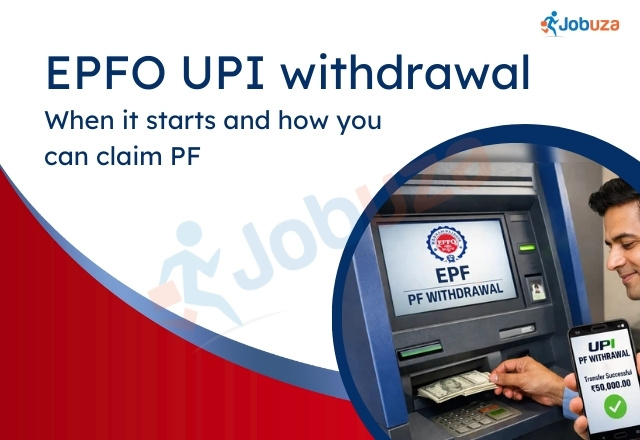
EPFO to Introduce UPI-Based PF Withdrawal Soon
Employees can withdraw the money deposited in their Provident Fund account either after retirement or, in some cases, even earlier. However, the current PF withdrawal process often takes several days. This is expected to change soon, as the Employees’ Provident Fund Organisation (EPFO) is preparing to introduce UPI-based PF withdrawals.
PF Withdrawal to Become Faster and Simpler
EPFO’s upcoming UPI facility is set to bring major relief to PF account holders. Once implemented, members will no longer need to wait days to receive their PF money. Instead, PF withdrawals will work much like regular UPI payments, allowing funds to be credited quickly in case of emergencies.
According to the latest updates, EPFO plans to roll out the UPI-based PF withdrawal feature within the next two to three months. Technical integration is currently underway in coordination with the National Payments Corporation of India (NPCI).
BHIM App to Be Used Initially
In the initial phase, PF withdrawals through UPI will be available via the BHIM app. When a member submits a PF withdrawal request on the app, the system will carry out instant backend verification.
For approved reasons such as medical emergencies or education-related needs, the claim will be processed quickly. Once verified, the PF amount will be transferred directly through the banking system, with SBI acting as the settlement bank.
Faster Than the Current PF Claim Process
At present, even an online PF advance claim of up to ₹5 lakh usually takes at least three working days to process. With the introduction of the UPI system, this waiting period is expected to reduce significantly, allowing members to access funds almost instantly when needed.
This change marks a major improvement for PF members who require quick access to their savings during urgent situations.
Limits and Safety Measures
To prevent misuse, EPFO may introduce withdrawal limits in the initial phase, in line with RBI’s existing UPI guidelines. This means members may not be able to withdraw the full PF balance through UPI at the start.
For now, the service will remain limited to the BHIM app. However, it is expected to expand to other UPI platforms in the future once the system stabilises.

by Jobuza Team | Jan 19, 2026 | BLOG, PAN/Aadhar Card Updates, Trending News
Imagine Losing Money Without an OTP or PIN
Imagine waking up to find money missing from your bank account—even though you never shared an OTP, PIN, or password. This is exactly how the AEPS Aadhaar scam works. The fraud mainly affects people in rural and semi-urban areas, where Aadhaar-linked banking services are widely used.
How Does the Aadhaar (AEPS) Fraud Work?
Fraudsters begin by illegally obtaining Aadhaar details and biometric data, such as fingerprints. This information often comes from leaked databases or unsafe data handling at unauthorised centres.
Using this stolen data, scammers create fake fingerprints and use them on AEPS-enabled micro-ATMs. Since AEPS transactions rely on Aadhaar number and biometric verification, money can be withdrawn without any OTP or PIN—making it appear as if the account holder authorised the transaction.
Aadhaar Scam and the Role of Mule Accounts
Once the money is withdrawn, it doesn’t go directly to the fraudsters. Instead, it is routed through mule accounts. These are bank accounts that are either rented, sold, or compromised and then used to move stolen funds.
By transferring money through multiple mule accounts, scammers make it extremely difficult for authorities to trace the final destination or identify the real criminals behind the fraud.
How GPS-Enabled Devices Can Help Prevent AEPS Fraud
Security experts believe that GPS-enabled micro-ATMs can significantly reduce AEPS fraud. With this system, transactions are allowed only from the registered location of the device. If a transaction is attempted from a different location, it automatically fails.
This approach not only protects customers but also helps banks detect high-risk areas and prevent large-scale fraud more effectively.
The Future of Aadhaar Security
In the coming years, AEPS devices are expected to become even more secure. Technologies like AI-based fraud detection and biometric liveness checks can help ensure that only real, live fingerprints are accepted.
Importantly, these systems track the location of the machine, not the individual, ensuring better security without compromising personal privacy.
Aadhaar Scam: How Can You Protect Yourself?
Awareness is your strongest defence against Aadhaar-related fraud.
Lock your Aadhaar number and biometrics through the official UIDAI website whenever they are not in use. Avoid updating your Aadhaar at unknown or unofficial centres. When sharing a photocopy of your Aadhaar card, always make it from the physical card and clearly mention the purpose. If you share a digital copy, delete it immediately after use.
By staying alert and following basic safety practices, you can greatly reduce the risk of falling victim to AEPS and Aadhaar scams.
Read More PAN/Aadhar Card Updates

by Jobuza Team | Jan 15, 2026 | BLOG, Trending News
The Government of India has introduced the Income Tax Act 2025, which will come into effect from April 1, 2026. This new law will replace the existing Income Tax Act of 1961, which has been in force for more than six decades. While the new Act does not change tax rates, it brings major structural and procedural reforms aimed at simplifying the tax system and making it easier for taxpayers to understand and comply with.
Single Tax Year Introduced: Assessment Year and Previous Year Removed
One of the most important changes in the Income Tax Act 2025 is the removal of the distinction between the assessment year and the previous year.
Under the old law, income earned in one financial year was assessed and taxed in the following year, which often confused taxpayers. The new Act introduces a single tax year, meaning income will be earned, assessed, and taxed within the same period. This change will make tax calculations clearer and reduce confusion for individual taxpayers and businesses.
Refund Allowed Even If ITR Is Filed Late
The new law also provides relief to taxpayers who fail to file their Income Tax Return (ITR) on time. Under the Income Tax Act 2025, taxpayers will still be able to claim a refund of excess TDS (Tax Deducted at Source) even if the return is filed late.
Earlier, delayed filing often resulted in penalties or loss of refund eligibility. This change ensures fairness and reduces financial stress for taxpayers who miss deadlines due to genuine reasons.
No Change in Tax Rates Under the New Law
The government has clearly stated that there will be no change in tax rates under the Income Tax Act 2025. Any changes to tax slabs or rates will continue to be announced through the Union Budget and Finance Act, as done earlier.
The purpose of the new Act is not to increase tax burden, but to simplify tax laws, reduce ambiguity, and improve compliance.
Why the Old Income Tax Act Needed Replacement
The Income Tax Act of 1961 was introduced when India was a newly independent country. At that time, economic conditions, business practices, and technology were vastly different.
Over the years, the Act was amended multiple times, leading to:
-
Complex sections and sub-sections
-
Outdated and irrelevant provisions
-
Difficult language for common taxpayers
-
Increased tax disputes and litigation
In today’s digital and fast-changing economy, the old law had become difficult to understand and implement. This made a complete rewrite necessary.
Purpose and Objectives of the Income Tax Act 2025
The main objectives of the new Act are:
-
To make tax laws simple and easy to understand
-
To reduce tax disputes and litigation
-
To remove outdated and unnecessary provisions
-
To improve transparency and compliance
-
To save time for taxpayers and businesses
The government claims that the new Act will be nearly half the length of the old law, making it far more user-friendly.
Fewer Sections and Cleaner Structure
The 1961 Act contained around 298 sections and 23 chapters, covering various taxes such as personal income tax, corporate tax, securities transactions, gift tax, and wealth tax.
Over time, several taxes like:
were abolished, but their provisions remained in the law, creating confusion.
The Income Tax retains only relevant and active provisions, removing obsolete sections and making the law concise and structured.
Budget 2026–27 Changes to Be Automatically Included
The government has confirmed that any changes announced in the Union Budget 2026–27, whether related to personal or corporate taxation, will automatically apply under the new Act.
This ensures continuity and avoids the need for frequent amendments.
New Rules and Tax Forms to Be Released Gradually
Rules under the Income Tax Act 2025 are currently being framed. The government will gradually release:
This phased rollout will allow taxpayers and professionals to adapt smoothly to the new system.
Legislative Journey of the New Income Tax Act
Earlier attempts to reform direct tax laws include the Direct Tax Code Bill, 2010, which could not be implemented due to political changes. Later, a six-member committee was formed in 2017, which submitted its report in 2019.
After years of review and drafting, the Income Tax Act 2025 was passed by Parliament on August 12, 2025, and received Presidential assent on August 21, 2025, officially becoming law.
What This Means for Taxpayers
From April 1, 2026, taxpayers can expect:
-
Easier understanding of tax liability
-
Simplified refund process
-
Fewer disputes and notices
-
Clearer compliance procedures
The new law aims to make taxation transparent, accessible, and stress-free for individuals and businesses alike.
Final Words
The Income Tax Act 2025 marks a major shift in India’s tax system. While tax rates remain unchanged, the law focuses on simplicity, clarity, and ease of compliance. By removing outdated provisions and introducing a single tax year, the government aims to reduce confusion and litigation while improving the overall tax experience.

by Jobuza Team | Jan 14, 2026 | BLOG, Defence Jobs, Latest Jobs
The Indian Navy has released the official notification for SSC Officer Recruitment 2026, inviting online applications for 260 Short Service Commission (SSC) Officer posts. Candidates holding qualifications such as B.Com, B.Sc, B.Tech/B.E, M.A, M.Sc, MBA/PGDM, and MCA are eligible to apply.
The online application process starts on 24 January 2026 and will remain open till 24 February 2026. Eligible candidates must apply through the official Indian Navy website joinindiannavy.gov.in.
This article provides complete details about the Indian Navy SSC Officer Recruitment 2026, including eligibility criteria, age limit, vacancy details, salary, selection process, important dates, and the step-by-step application process.
Indian Navy SSC Officer Recruitment 2026 Overview
| Details |
Information |
| Organization |
Indian Navy |
| Post Name |
SSC Officer (Short Service Commission) |
| Total Vacancies |
260 |
| Salary |
Approx. Rs 1,25,000 per month |
| Qualification |
B.Com, B.Sc, B.Tech/B.E, M.A, M.Sc, MBA/PGDM, MCA |
| Apply Online Start Date |
24 January 2026 |
| Last Date to Apply |
24 February 2026 |
| Official Website |
joinindiannavy.gov.in |
Indian Navy SSC Officer Vacancy Details 2026
| Branch / Cadre |
Vacancies |
Gender |
| Executive Branch (GS(X)/Hydro) |
76 |
Men & Women |
| Pilot |
25 |
Men & Women |
| Naval Air Operations Officer (Observer) |
20 |
Men & Women |
| Air Traffic Controller (ATC) |
18 |
Men & Women |
| Logistics |
10 |
Men & Women |
| Education |
07 |
Men & Women |
| Engineering Branch (GS) |
42 |
Men & Women |
| Submarine Technical (Engineering) |
08 |
Men |
| Electrical Branch (GS) |
38 |
Men & Women |
| Submarine Technical (Electrical) |
08 |
Men |
Indian Navy SSC Officer Eligibility Criteria 2026
Executive Branch (GS(X)/Hydro)
BE or B.Tech in any discipline with at least 60% marks.
Pilot
BE or B.Tech with 60% marks, along with 60% marks in Class X and XII, and 60% in English.
Naval Air Operations Officer (Observer)
BE or B.Tech with minimum 60% marks, including 60% in Class X/XII and English.
Air Traffic Controller (ATC)
BE or B.Tech with 60% marks, including 60% in Class X/XII and English.
Logistics
BE/B.Tech with First Class, or MBA (First Class), or B.Com/B.Sc with First Class along with PG Diploma in Finance, Logistics, Supply Chain Management, Material Management, or MCA/M.Sc with First Class.
Education Branch
M.Sc or M.A with minimum 60% marks in relevant subjects, or BE/B.Tech/M.Tech/MCA with 60% marks. Candidates must also have 60% marks in Class X or XII.
Engineering Branch (GS)
BE/B.Tech with 60% marks in Marine, Aerospace, Metallurgy, Instrumentation, Automobile, or Mechatronics Engineering.
Submarine Technical (Engineering)
BE/B.Tech with 60% marks in Mechanical, Production, Control, Aeronautical, Industrial Engineering, or Instrumentation.
Electrical Branch (GS)
BE/B.Tech with 60% marks in Electrical, Electronics, Power Electronics, Instrumentation, or Telecommunication.
Submarine Technical (Electrical)
BE/B.Tech with 60% marks in Electrical & Electronics, Electronics & Communication, or Applied Electronics.
Indian Navy SSC Officer Salary 2026
The initial gross salary of a Sub Lieutenant is approximately Rs 1,25,000 per month, including allowances.
Additional allowances:
-
Pilot and Observer Allowance: Rs 31,250 per month
-
Submarine Allowance: Rs 31,250 per month (after training)
Indian Navy SSC Officer Age Limit (As on 01 January 2027)
| Branch |
Date of Birth Range |
| Executive Branch (GS(X)/Hydro) |
02 Jan 2002 to 01 Jul 2007 |
| Pilot |
02 Jan 2003 to 01 Jan 2008 |
| Observer |
02 Jan 2003 to 01 Jan 2008 |
| ATC |
02 Jan 2002 to 01 Jan 2006 |
| Logistics |
02 Jan 2002 to 01 Jun 2007 |
| Education |
02 Jan 2002 to 01 Jan 2006 |
| Engineering Branch |
02 Jan 2002 to 01 Jul 2007 |
| Electrical Branch |
02 Jan 2002 to 01 Jul 2007 |
Indian Navy SSC Officer Important Dates 2026
| Event |
Date |
| Online Application Start |
24 January 2026 |
| Last Date to Apply Online |
24 February 2026 |
| Course Commencement |
January 2027 |
| Final Result Submission |
Before 20 December 2026 |
Indian Navy SSC Officer Selection Process 2026
The selection process includes:
-
Shortlisting based on normalized marks obtained in the qualifying degree.
-
SSB Interview for shortlisted candidates.
-
Medical Examination.
-
Final Merit List based on SSB marks, medical fitness, and vacancy availability.
Candidates will be informed about SSB interviews via email or SMS.
How to Apply for Indian Navy SSC Officer Recruitment 2026
Candidates must apply online through joinindiannavy.gov.in by following these steps:
-
Visit the official Indian Navy website.
-
Register using a valid email ID and mobile number.
-
Fill in personal, educational, and communication details carefully.
-
Upload scanned copies of required documents in prescribed format.
-
Review the application form thoroughly before final submission.
-
Submit the form and take a printout for future reference.
Once submitted, no changes will be allowed in the application form.
Final Words
The Indian Navy SSC Officer Recruitment 2026 is a great opportunity for graduates and postgraduates looking to serve the nation with pride while building a respected career. Interested candidates are advised to apply well before the last date and ensure they meet all eligibility conditions.

by Jobuza Team | Jan 13, 2026 | BLOG, Defence Jobs, Latest Jobs
The Indian Air Force (IAF) has officially released the Agniveervayu Recruitment 2026 notification under the Agnipath Scheme for Intake 01/2027. Candidates who have passed 10th, 12th, Diploma or Vocational courses are eligible to apply online through the official recruitment portal.
The online application process will begin on 12 January 2026 and will close on 01 February 2026. Interested candidates must submit their applications through the official website iafrecruitment.edcil.co.in before the last date.
This article provides complete details about IAF Agniveervayu Recruitment 2026, including eligibility criteria, age limit, salary, selection process, important dates, application steps and direct links.
Indian Air Force Agniveer Intake 2026 Overview
Organization Name: Indian Air Force (IAF)
Post Name: Agniveervayu
Intake: 01/2027
Total Vacancies: As per state-wise requirement
Salary: ₹30,000 to ₹40,000 per month
Qualification: 10+2 / Intermediate / Diploma / Vocational Course
Age Limit: Born between 01 January 2006 and 01 July 2009
Application Start Date: 12 January 2026
Last Date to Apply: 01 February 2026
Official Website: iafrecruitment.edcil.co.in
Indian Air Force Agniveer Intake Vacancy Details 2026
The number of vacancies for Agniveervayu posts will be allocated state-wise based on service requirements. The selection of female candidates will also depend on operational needs. Final selection will be prepared on state-wise merit.
IAF Agniveervayu Eligibility Criteria 2026
Educational Qualification
For Science Subjects
Candidates must meet any one of the following criteria:
-
Passed 10+2 / Intermediate with Mathematics, Physics and English with minimum 50% aggregate marks and 50% in English
-
Passed three-year Diploma in Engineering (Mechanical, Electrical, Electronics, Automobile, Computer Science, IT, Instrumentation) with 50% aggregate marks and 50% in English
-
Passed two-year Vocational Course with Physics and Mathematics as non-vocational subjects with 50% aggregate marks and 50% in English
For Other Than Science Subjects
Important Notes on Qualification
-
Only boards recognized by Central, State or UT governments will be accepted
-
Exact percentage mentioned in the marksheet will be considered (no rounding off)
-
Candidates eligible for Science subjects can also apply for Other Than Science subjects
IAF Agniveervayu Salary Structure 2026
-
1st Year: ₹30,000 per month
-
2nd Year: ₹33,000 per month
-
3rd Year: ₹36,500 per month
-
4th Year: ₹40,000 per month
Additional Benefits
-
Risk and Hardship Allowance (as applicable)
-
Dress, Travel, Ration, Clothing and Accommodation
-
Leave Travel Concession (LTC)
Seva Nidhi Package
After completion of four years, candidates will receive approximately ₹10.04 lakh, including equal contributions from the candidate and the Government of India (excluding interest).
Insurance Cover
A non-contributory life insurance cover of ₹48 lakh will be provided during the engagement period.
IAF Agniveervayu Age Limit 2026
-
Minimum Date of Birth: 01 January 2006
-
Maximum Date of Birth: 01 July 2009
-
Maximum Age at Enrolment: 21 years
Candidates must meet the age criteria at the time of enrolment.
IAF Agniveervayu Application Fee
-
Examination Fee: ₹550 + 18% GST
-
Total Fee: ₹649
-
Payment Mode: Online (Net Banking, Debit Card, Credit Card, UPI)
-
Appeal Medical Board Fee: ₹40 (if applicable)
The application fee is non-refundable under all circumstances.
IAF Agniveervayu Important Dates 2026
-
Online Application Start Date: 12 January 2026 (11:00 AM)
-
Last Date to Apply Online: 01 February 2026 (11:00 PM)
-
Phase I Online Exam: 30–31 March 2026
-
Provisional Select List: 14 November 2026
-
Enrolment List Publication: 01 December 2026
IAF Agniveervayu Selection Process 2026
Phase I – Online Written Test
-
Science Subjects: Physics, Mathematics and English
-
Other Than Science: English and Reasoning & General Awareness
-
Marking Scheme: +1 for correct answer, -0.25 for wrong answer
Phase II – Physical and Adaptability Tests
Phase III – Medical Examination
Candidates will undergo a detailed medical examination as per Indian Air Force medical standards.
Final selection will be based on state-wise merit, medical fitness and vacancy availability.
How to Apply for IAF Agniveervayu Recruitment 2026
-
Visit the official website iafrecruitment.edcil.co.in
-
Complete online registration using a valid email ID and mobile number
-
Fill in personal, educational and communication details
-
Upload required documents and images
-
Pay the application fee online
-
Submit the application and take a printout for future reference
Only one application per candidate is allowed.
by Jobuza Team | Jan 12, 2026 | Bank Jobs, BLOG, Central Govt Job, Latest Jobs
State Bank of India (SBI) has increased the number of vacancies under the Specialist Cadre Officer (SCO) Recruitment 2025-26. According to the latest notification issued by the bank, a total of 1,146 posts will now be filled under the Wealth Management Cadre.
Along with the increase in vacancies, SBI has also extended the last date for online applications to January 10, 2026. Eligible and interested candidates can apply through the official website of the State Bank of India.
Posts Included Under SBI SCO Recruitment 2025-26
The recruitment drive covers multiple roles in the Wealth Management Cadre. The eligibility requirements vary depending on the position.
Eligibility Criteria for SBI Specialist Cadre Officer Posts
VP Wealth (Senior Relationship Manager)
Candidates applying for the VP Wealth post must hold a graduate degree from a recognised institution. Preference will be given to applicants with an MBA in Banking, Finance, or Marketing, along with professional certifications such as NISM, CFP, or CFA.
Applicants must also have a minimum of six years of experience in sales and marketing with a reputed bank, wealth management firm, or Asset Management Company (AMC).
AVP Wealth (Relationship Manager)
For the AVP Wealth post, a graduate degree is mandatory. Candidates with a postgraduate qualification in Finance, Banking, or Marketing and certifications like NISM, CFP, or CFA will be given preference.
Additionally, candidates should have three to four years of experience in the banking or wealth management sector.
Customer Relationship Executive
Applicants for the Customer Relationship Executive post must possess a graduate degree. A valid two-wheeler driving licence is mandatory, as the role involves field-related responsibilities.
SBI SCO Recruitment 2025 Application Fee
Candidates are required to pay the application fee online based on their category:
-
SC, ST, and PwBD candidates are exempted from paying any fee
-
General, OBC, and EWS candidates must pay an application fee of Rs. 750
Once paid, the application fee will not be refunded under any circumstances.
Marking Scheme (HP SET 2026)
As per the marking scheme for HP SET 2026, each question carries 2 marks. Candidates will receive full marks for every correct answer, and no negative marking will be applied for incorrect responses.
No marks will be awarded for unanswered questions. In case a question is found to be incorrect and is cancelled due to a technical issue or human error, all candidates will be awarded 2 marks for that question.
Disclaimer
This content has been sourced and edited from Amar Ujala. While modifications have been made to improve clarity and readability, the original content belongs to its respective authors and website. We do not claim ownership of the original material.